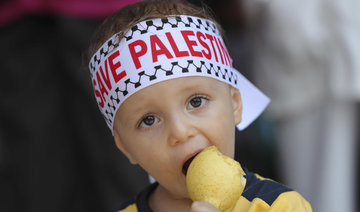
AMMAN: Palestinians have reacted angrily to US threats to cut off financial support to the UN refugee agency, which provides humanitarian aid to Palestinian refugees.
Saeb Erekat, secretary-general of the Palestine Liberation Organization (PLO), said the US administration is not acting as an honest broker. President Donald Trump is threatening to “starve Palestinian children in refugee camps and deny them their natural rights to health and education, if we do not endorse his terms and dictations,” Erekat said.
Another PLO leader, Hanan Ashrawi, said Trump “singlehandedly destroyed the very foundations of peace” by recognizing Jerusalem as Israel’s capital last month. She says the Palestinians “will not be blackmailed.”
She said: “Trump has sabotaged our search for peace, freedom and justice.”
The US has given the Palestinians more than $5 billion in economic and security aid since the mid-1990s, according to Congressional research figures, with an average of $100 million annually since 2008 for President Mahmoud Abbas’ security services.
Trump threatened to cut off US aid money to the PA, asking why the US should make “any of these massive future payments” when the Palestinians are “no longer willing to talk peace.”
Trump, in a pair of tweets, said “we pay the Palestinians HUNDRED OF MILLIONS OF DOLLARS a year and get no appreciation or respect.”
“They don’t even want to negotiate a long overdue ... peace treaty with Israel,” he wrote.
Salim Zanoun, speaker of the Palestine National Council, told Arab News that the council is due to meet in Ramallah on Jan. 14 and that “the Palestinian answer will be issued at that meeting.”
Khaled Abu Arafeh, minister of Jerusalem during the 2006 Ismail Haniyeh government, told Arab News that by his own admission Trump is using Palestinians. “The very same Palestinian leadership that trusted the Americans is now the subject of a policy of blackmail, bribery and bullying, using refugees who are the weakest party to announce his strategic policy totally in support of the occupiers.”
Abu Arafeh, who called the US decision “ever renewable in its stupidity,” said it would have an effect opposite to what Trump intended. “Palestinians will now be reinvigorated to join the stubborn resistance.”
Annes Sweidan, director of the PLO’s external relations, said various PLO factions have met to prepare a reply to Trump’s statement and that some ideas will be formulated in the meeting of the PLO’s executive committee.
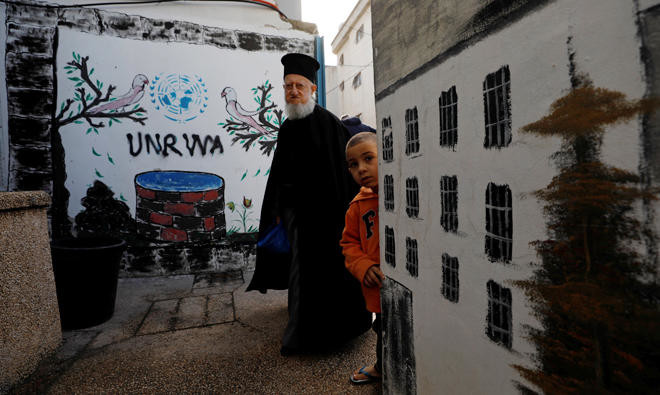
Demonstrations and protests have taken place at various locations of UN Relief Works Agency (UNRWA) offices throughout the occupied territories, Sweidan said.
Hamas leaders in Gaza slammed Trump’s threats to cut US aid to UNRWA and the Palestinian Authority. Hamas’ spokesman Fawzi Barhoum said in a statement that Trump’s threats are “cheap political blackmail” that unmasks the barbaric US policy.
A protest was held in Ramallah Wednesday outside the UN offices in which a representative of national and Islamic forces in the Ramallah area thanked the world community for its support at the UN General Assembly meeting.
The statement read out by Issam Abu Baker called on the UN to reject US threats against international agencies. “We reject all forms of US hegemony against international agencies and countries that support Palestinian rights.” The statement termed the US action “bullying” and called on the Americans to stop meddling in the affairs of international agencies.
Sami Mushasha, spokesman of UNRWA, said the agency has not been informed of any change in US funding. He said that UNRWA’s efforts are crucial for human development and its efforts in education, and health and for the dignity of Palestinian refugees and the stability of the region can’t be replaced.
The fact that Israel has not allowed a single refugee to return (while allowing non-refugee Jews to immediately become Israelis) has been a major source of anger and frustration to Palestinians. The PLO was created in refugee camps and has heralded their right of return as one of its most sacred goals.
Over the years, Israel itself has made a very modest contribution to the UN agency and has supported its work with the knowledge that poverty and lack of education will spur more violent resistance. The Israeli Foreign Ministry says on its official website that “Israel recognizes UNRWA’s important contribution to the welfare of the Palestinian refugees and their descendants.”