US nuclear button ‘much bigger’ than North Korea’s: Trump

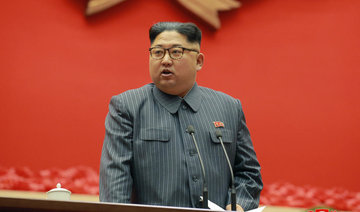
North Korean leader Kim Jong Un, left, has been on collision course with US President Donald Trump regarding Pyongyang’s nuclear ambitions. (Reuters)
Updated 03 January 2018
Follow

US nuclear button ‘much bigger’ than North Korea’s: Trump

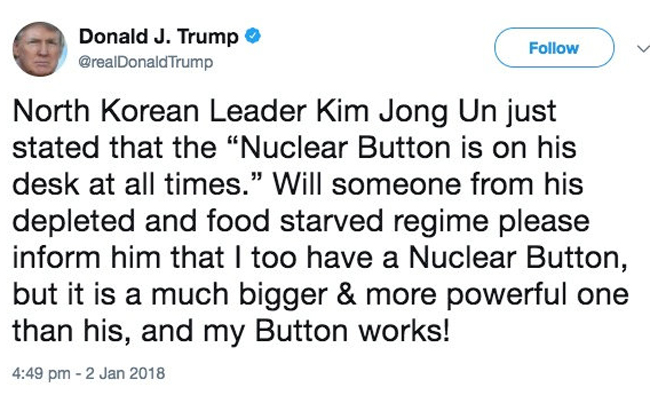
WASHINGTON: President Donald Trump boasted Tuesday that he has a bigger and more powerful “nuclear button” than North Korean leader Kim Jong Un.
The president’s Tuesday evening tweet came in response to Kim’s New Year’s address, in which he repeated fiery nuclear threats against the United States. He said he has a “nuclear button” on his office desk and warned that “the whole territory of the US is within the range of our nuclear strike.”
Trump mocked that assertion, writing, “Will someone from his depleted and food starved regime please inform him that I too have a Nuclear Button, but it is a much bigger & more powerful one than his, and my Button works!“
Earlier Tuesday, Trump sounded open to the possibility of an inter-Korean dialogue after made a rare overture toward South Korea in a New Year’s address. But Trump’s ambassador to the United Nations insisted talks would not be meaningful unless the North was getting rid of its nuclear weapons.
In a morning tweet, Trump said the US-led campaign of sanctions and other pressure were beginning to have a “big impact” on North Korea. He referred to the recent, dramatic escape of at least two North Korean soldiers across the heavily militarized border into South Korea. He also alluded to Kim’s comments Monday that he was willing to send a delegation to the Winter Olympics, which will be hosted by South Korea next month.
“Soldiers are dangerously fleeing to South Korea. Rocket man now wants to talk to South Korea for first time. Perhaps that is good news, perhaps not — we will see!” Trump said, using his derisive moniker for the young North Korean leader.
In response to Kim’s overture, South Korea on Tuesday offered high-level talks on Jan. 9 at the shared border village of Panmunjom to discuss Olympic cooperation and how to improve overall ties.
North Korea did not immediately react to the South’s proposal. If there are talks, they would be the first formal dialogue between the Koreas since December 2015. Relations have plunged as the North has accelerated its nuclear and ballistic missile development that now poses a direct threat to America, South Korea’s crucial ally.
The US administration, however, voiced suspicions that Kim was seeking to drive a wedge between Seoul and Washington. Pyongyang could view a closer relationship with Seoul has a way for reducing its growing international isolation and relief from sanctions that are starting to bite the North’s meager economy.
“We won’t take any of the talks seriously if they don’t do something to ban all nuclear weapons in North Korea,” US Ambassador Nikki Haley told reporters at the United Nations. “We consider this to be a very reckless regime. We don’t think we need a Band-Aid, and we don’t think we need to smile and take a picture.”
While Trump ratcheted up the tension Tuesday night, he doesn’t actually have a physical nuclear button.
The process for launching a nuclear strike is secret and complex, and involves the use of a nuclear “football,” which is carried by a rotating group of military officers everywhere the president goes and is equipped with communication tools and a book with prepared war plans.
If the president were to order a strike, he would identify himself to military officials at the Pentagon with codes unique to him. Those codes are recorded on a card known as the “biscuit” that is carried by the president at all times. He would then transmit the launch order to the Pentagon and Strategic Command.
North Korea has been punished with unprecedented sanctions at the UN over its weapons programs, and Haley warned Tuesday of more measures if the North conducts another missile test.
In Washington, State Department spokeswoman Heather Nauert did not express opposition Tuesday to South Korea holding talks with North Korea, but voiced deep skepticism about Kim’s intentions, saying he may be “trying to drive a wedge of some sort” between the US and its ally, which hosts 28,000 American forces.
South Korea’s liberal President Moon Jae-in has supported Trump’s pressure campaign against North Korea, but he’s less confrontational than the US president and favors dialogue to ease the North’s nuclear threats. Moon has long said he sees the Pyeongchang Olympics as a chance to improve inter-Korean ties.
White House spokeswoman Sarah Huckabee Sanders said the US would continue to put “maximum pressure” on North Korea to give up its nukes. She added that South Korea shares that goal.



Judge bars federal prosecutors from seeking the death penalty against Luigi Mangione

Updated 3 sec ago
Follow

Judge bars federal prosecutors from seeking the death penalty against Luigi Mangione

  • Judge Margaret Garnett’s Friday ruling foiled the Trump administration’s bid to see Mangione executed
  • Garnett dismissed a federal murder charge against Mangione, finding it technically flawed. She left in place stalking charges that could carry a life sentence
NEW YORK: Federal prosecutors can’t seek the death penalty against Luigi Mangione in the killing of UnitedHealthcare CEO Brian Thompson, a federal judge ruled Friday, foiling the Trump administration’s bid to see him executed for what it called a “premeditated, cold-blooded assassination that shocked America.”
Judge Margaret Garnett dismissed a federal murder charge that had enabled prosecutors to seek capital punishment, finding it technically flawed. She wrote that she did so to “foreclose the death penalty as an available punishment to be considered by the jury” as it weighs whether to convict Mangione.
Garnett also dismissed a gun charge but left in place stalking charges that carry a maximum punishment of life in prison. To seek the death penalty, prosecutors needed to show that Mangione killed Thompson while committing another “crime of violence.” Stalking doesn’t fit that definition, Garnett wrote in her opinion, citing case law and legal precedents.
In a win for prosecutors, Garnett ruled they can use evidence collected from his backpack during his arrest, including a 9mm handgun and a notebook in which authorities say Mangione described his intent to “wack” an insurance executive. Mangione’s lawyers had sought to exclude those items, arguing the search was illegal because police hadn’t yet obtained a warrant.
During a hearing Friday, Garnett gave prosecutors 30 days to update her on whether they’ll appeal her death penalty decision. A spokesperson for the US attorney’s office in Manhattan, which is prosecuting the federal case, declined to comment.
Garnett acknowledged that the decision “may strike the average person — and indeed many lawyers and judges — as tortured and strange, and the result may seem contrary to our intuitions about the criminal law.” But, she said, it reflected her “committed effort to faithfully apply the dictates of the Supreme Court to the charges in this case. The law must be the Court’s only concern.”
Mangione, 27, appeared relaxed as he sat with his lawyers during the scheduled hearing, which took place about an hour after Garnett issued her written ruling. Prosecutors retained their right to appeal but said they were ready to proceed to trial.
Outside court afterward, Mangione attorney Karen Friedman Agnifilo said her client and his defense team were relieved by the “incredible decision.”
Jury selection in the federal case is set for Sept. 8, followed by opening statements and testimony on Oct. 13. The state trial’s date hasn’t been set. On Wednesday, the Manhattan district attorney’s office urged the judge in that case to schedule a July 1 trial date.
“That case is none of my concern,” Garnett said, adding that she would proceed as if the federal case is the only case unless she hears formally from parties involved in the state case. She also said the federal case will be paused if the government appeals her death penalty ruling.
Thompson, 50, was killed on Dec. 4, 2024, as he walked to a midtown Manhattan hotel for UnitedHealth Group’s annual investor conference. Surveillance video showed a masked gunman shooting him from behind. Police say “delay,” “deny” and “depose” were written on the ammunition, mimicking a phrase used by critics to describe how insurers avoid paying claims.
Mangione, an Ivy League graduate from a wealthy Maryland family, was arrested five days later at a McDonald’s in Altoona, Pennsylvania, about 230 miles (about 370 kilometers) west of Manhattan.
Following through on Trump’s campaign promise to vigorously pursue capital punishment, Attorney General Pam Bondi ordered Manhattan federal prosecutors last April to seek the death penalty against Mangione.
It was the first time the Justice Department sought the death penalty in President Donald Trump’s second term. He returned to office a year ago with a vow to resume federal executions after they were halted under his predecessor, President Joe Biden.
Garnett, a Biden appointee and former Manhattan federal prosecutor, ruled after hearing oral arguments earlier this month.
Besides seeking to have the death penalty rejected on the grounds Garnett cited, Mangione’s lawyers argued that Bondi’s announcement flouted long-established Justice Department protocols and was “based on politics, not merit.”
They said her remarks, followed by posts to her Instagram account and a TV appearance, “indelibly prejudiced” the grand jury process resulting in his indictment weeks later.
Prosecutors urged Garnett to keep the death penalty on the table, arguing that the charges were legally sound and Bondi’s remarks weren’t prejudicial, as “pretrial publicity, even when intense, is not itself a constitutional defect.”
Prosecutors argued that careful questioning of prospective jurors would alleviate the defense’s concerns about their knowledge of the case and ensure Mangione’s rights are respected at trial.
“What the defendant recasts as a constitutional crisis is merely a repackaging of arguments” rejected in previous cases, prosecutors said. “None warrants dismissal of the indictment or categorical preclusion of a congressionally authorized punishment.”