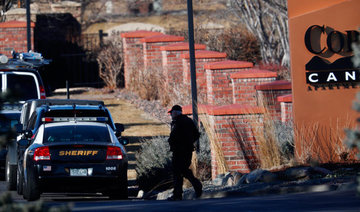
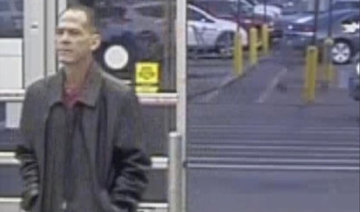
DENVER: Authorities had been contacted with concerns about the mental health of Matthew Riehl over a month before he shot and killed a Colorado deputy and wounded four others. But Riehl was never held for mental evaluation.
After Riehl published several social media posts critical of University of Wyoming professors, the campus police chief says officers called police in Lone Tree, Colorado, in November to warn them about Riehl, suggesting his rants were indicative of mental illness.
The Douglas County Sheriff’s Office says authorities received a call Sunday from someone who said Riehl might be having a mental breakdown, but deputies found no evidence of a crime and left.
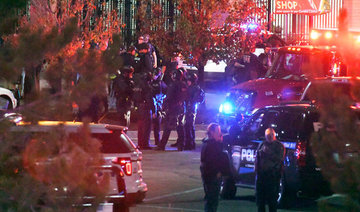
Later, deputies responded to another call about Riel. Authorities say Riehl fired more than 100 rounds before he was killed.


Colorado authorities were warned about gunman’s mental state

Colorado authorities were warned about gunman’s mental state

Pakistani visas fetch up to $1,800 as Kabul black market thrives
- Arab News investigates how Afghans resort to tour agents to obtain Pakistani travel documents
- Applicants say that following official channels only ends in silent rejection after months of waiting
KABUL: As they prepare to fly to Islamabad from Kabul, Asma and her father have paid far more than the official ticket price. Hidden in their travel costs are additional thousands of dollars — fees to tour agents, which they say were the most reliable way to secure a visa to be on board.
Asma’s destination is not Pakistan, but she has no choice and must go there first, as most diplomatic missions in Afghanistan suspended full consular services in 2021, when US-led forces left the country and the Taliban took power.
Waiting for years to reunite with her fiance, who lives in Switzerland, Asma needs to reach the Swiss Embassy for an interview. But first, she had to obtain a Pakistani visa.
After months of trying through official channels, her family finally chose another, more expensive way.
“We heard from neighbors that some agencies in Kabul could get it done faster,” Asma told Arab News. “I had no choice … The embassy requires a face-to-face meeting before they will issue my visa to join him. Pakistan is the closest option with a Swiss diplomatic mission.”
She paid $1,600 to a travel agency in Kabul that promised expedited processing. Her father, who must accompany her due to Afghanistan’s strict travel rules for unmarried women, was part of the same application.
Having spent $3,200, they received their visas on WhatsApp three days later — not through official channels but through a cousin’s contact.
“Pakistan was our only option. Iran is too difficult. Turkey is too expensive. Pakistan is close, and many Afghans go there,” Asma’s father said.
“We will fly after making an online appointment with the (Swiss) Embassy. There are daily flights from Kabul to Islamabad.”
Asma’s case is not unique, as a sprawling black market for Pakistani visas has taken root in Afghanistan’s capital. An investigation by Arab News has found that desperate applicants have been paying between $1,300 and $1,800 to tour agents to obtain the travel documents that officially cost over 50 times less.
Pakistan’s visa fee for Afghan nationals is approximately $25, paid through a fully digital online system. But applicants who attempt to follow through this channel say the process often ends in silent rejection after months of waiting.
Multiple travel agencies in Kabul and Nangarhar confirmed to Arab News that Pakistani visas are traded on the black market. While they said their services facilitated legitimate travel, most refused to speak on the record, citing the Taliban penal code, which criminalizes human trafficking.
One agency owner who agreed to speak anonymously described a system organized around waiting lists and contacts at the Pakistani Embassy and consulates in Kabul, Nangarhar, Kandahar and Mazar-e-Sharif.
“We have lists. Each list works like seats on a plane. When one list is full, we start filling the next. Every day, a list goes out — meaning visas are issued daily,” he said.
“Some contacts take less, some demand more. But these days, no visa costs less than $1,300, and none exceed $1,800. This rate has been stable for over a month.”
The figures align with those reported by multiple applicants and confirmed by other agencies. Medical visas cost between $1,300 and $1,500, while tourist visas range from $1,500 to $1,800.
The prices have increased lately, coinciding with deteriorating relations between Afghanistan and Pakistan. Earlier, a medical visa at the same travel agency would cost $350, while a tourist one would cost about $600.
“As tensions between our countries increased, official oversight collapsed,” the agency’s owner said. “The visas found their way to the black market because there is no official interest in monitoring or controlling what happens.”
The Pakistani Embassy in Kabul did not respond to requests for comment, despite repeated requests through official channels and WhatsApp.
“The embassy knows. The travel agencies registered with them — we are the only channel,” said a manager of another travel agency, which deals in visas.
“Some agencies have stronger links inside the embassy than others. That affects the price. But nothing gets done without us.”


