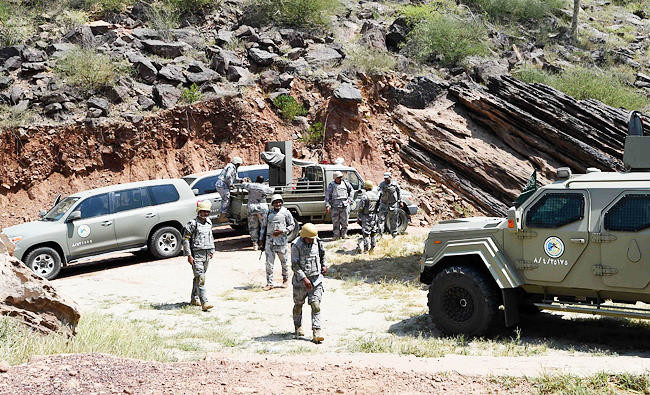
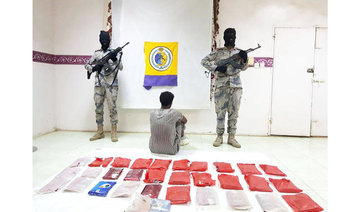
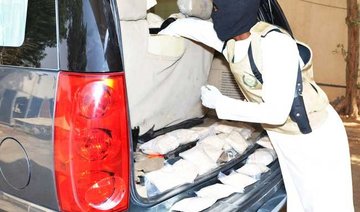
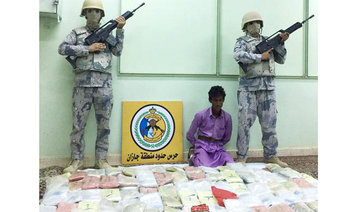
RIYADH: Saudi Border Guards in the southern border areas have foiled several attempts to smuggle more than half a ton of hashish, and arrested 30 smugglers of different nationalities in the Jazan and Najran areas over the past two weeks.
The Border Guard’s spokesman, Col. Saher Al-Harbi, said that these operations are part of the security forces efforts to combat drug trafficking across the Kingdom’s land and sea borders.
He said that during these operations nine Saudis, 13 Ethiopians, seven Yemenis and one Somali have been arrested and their attempts to smuggle hashish into the Kingdom have been effectively thwarted.
Al-Harbi announced that the seizures of drugs in their possession reached 536,422 grams of hashish.
He said that “the seizures and suspects were duly referred to the appropriate authorities to complete legal proceedings.”
Al-Harbi reiterated that the Border Guards will not hesitate to deal with such threats and are determined to protect the Kingdom’s borders from anything that threatens its security, stability and capabilities.

Saudi Border Guards thwart attempts to smuggle hashish
Saudi scientific organization celebrates 2025 Nobel Prize in Chemistry laureate Omar Yaghi
- King Abdulaziz City for Science and Technology honors him with a reception at its headquarters in Riyadh
- Yaghi, the first Saudi recipient of a Nobel Prize, shared the Nobel Prize with 2 other scientists for their pioneering work in molecular chemistry
LONDON: King Abdulaziz City for Science and Technology in Riyadh honored Omar Yaghi, the Saudi scientist and recipient of the 2025 Nobel Prize in Chemistry, with a reception at its headquarters in Riyadh on Thursday.
Yaghi is the first Saudi scientist awarded a Nobel Prize. He received it in December, alongside two other scientists, for their pioneering work in the field of molecular chemistry, and for contributions to energy, the environment and advanced materials.
He is also supervisor of the Center of Excellence for Nanomaterials for Clean Energy Applications, a collaboration between KACST and the University of California, Berkeley.
Munir Eldesouki, the president of KACST, said that the Kingdom is keen to recognize its scientific talents, in keeping with Saudi Vision 2030 and its goals relating to the fostering of scientific research.
Yaghi said he appreciated the support he had received from Saudi leaders during his career, and praised them for creating an enabling environment in which scientists are able to pursue world-class research, development and innovation.
Investment in national talent has created a research ecosystem that positions Saudi Arabia among the leading scientific nations, he added.
Thursday’s event, attended by the organization’s staff and students, also honored the winning teams from the recent “GenAI for Materials Discovery Hackathon,” which KACST organized in partnership with the University of California, Berkeley, and Academy 32, a nonprofit Saudi organization dedicated to research, development and innovation.
The celebration concluded with an interactive discussion session during which Yaghi talked with students and researchers, reflected on key milestones in his scientific journey, and shared insights into the factors that helped shape his career, the Saudi Press Agency reported.