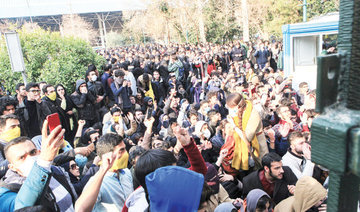
Tehran: Despite demonstrators chanting provocative slogans against Iran’s Islamic rulers, analysts say the roots of the current protests lie in the same anger at economic austerity that has roiled many countries.
Two people have been killed and hundreds arrested in protests that began in second city Mashhad on Thursday.
Though they started over high living costs, they quickly spread across the country and turned against the Islamic system as a whole, with chants of “Death to the dictator” and attacks on symbols of the regime lending them a revolutionary air.
But analysts say the protests are still rooted in bread-and-butter issues as patience runs thin with officials for failing to improve livelihoods.
“It can be an uncomfortable idea for some people to treat Iran the same as other countries,” said Esfandyar Batmanghelidj, an analyst and founder of the Europe-Iran Business Forum.
“But what brings Iranians out on the streets most consistently are normal economic problems — frustration with the lack of jobs, uncertainty about their children’s future,” he told AFP.
He blames the unrest on the austerity measures introduced by President Hassan Rouhani since he came to power in 2013, which included another round of welfare cuts and fuel price rises in the latest budget announced a few weeks ago.
“Rouhani has run austerity budgets with the idea that it’s a tough but necessary pill to swallow to manage inflation and currency problems and try to improve Iran’s attractiveness for investment,” said Batmanghelidj.
“But choosing years of austerity immediately after a very tough period of sanctions is bound to test people’s patience.”
At a cabinet meeting Sunday, Rouhani said government bodies must provide “space for criticism,” but also warned protesters that violence was unacceptable.
As the protests have gathered steam, the government has blamed “hostile elements” based abroad.
But others suspect Rouhani’s hard-line rivals of stoking the initial unrest.
They point to rare statements of support for the protesters from hard-line clerics such as Mashhad’s Friday prayers leader Ayatollah Ahmad Alamolhoda, who described their demands as “justified.”
“There is evidence, particularly in Mashhad, that protests were directed for political gain,” Tehran-based analyst Amir Mohebbian told the Tasnim news agency.
“Naturally they did not expect such a surge. One cannot play with protests,” he added.
Nonetheless, anger over economic issues has been palpable in recent years, and dominated the last election in May.
Minor protests have been bubbling away: in the weeks leading up to the current unrest, the union-linked ILNA news agency reported on hundreds of oil workers and truck drivers protesting the late payment of wages; tractor makers in Tabriz against their factory’s closure; and Tehran tire workers at bonuses being delayed.
A major groundswell of anger has also been building over the collapse of unauthorized lending companies that left millions of investors out of pocket.
These companies mushroomed in the financial free-for-all under former president Mahmoud Ahmadinejad, lending wildly during the construction boom and collapsing when the bubble burst.
Rouhani said in December that such lending companies had captured a quarter of the financial market with three to four million accounts by the time he took power in 2013 and started shutting them down.
“I’m not surprised by these recent protests. For the past two years, we have witnessed street protests against banks and credit institutions,” said Tehran-based political analyst Mojtaba Mousavi.
“Everyone says the protesters right now are from the lower class, but many are middle class people who lost lots of their assets,” he told AFP.
All this has combined with a wider sense that corruption and a rigged system have created immense wealth for a narrow elite, while a stifled media and lack of civil liberties have left few avenues for complaint — a point even hard-liners have begun to accept.
“Our constitution recognizes the right to protest but in practice there is no mechanism to do so,” Gholamreza Mesbahi Moghaddam, spokesman for the conservative Combatant Clergy Association, told the ISNA news agency.
“Officials should listen to the people. The media, too, has a responsibility to cover the protests.”
With no clear leadership structure behind the protests, analysts remain doubtful that they could evolve into a serious threat to the regime.
Some see the shift to political slogans as a boon for the authorities, allowing them to crack down on protesters as anti-social and violent elements.
“The system prefers political protests over economic because they’re easier to control,” said Mousavi.
“People protesting economic issues will give up when it turns political because unrest can only worsen the economic situation of the country.”