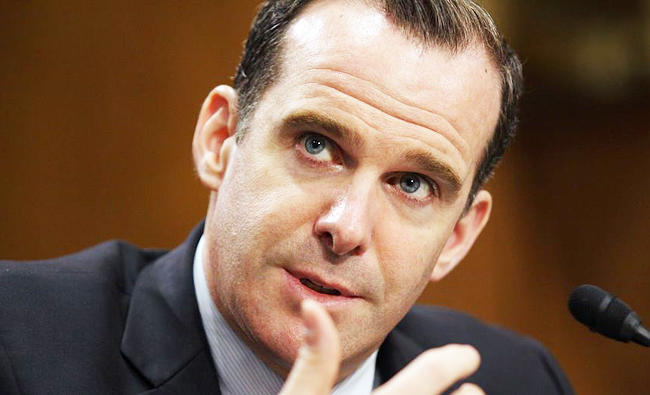
NEW YORK: A senior official from the Trump administration noted Saudi Arabia’s regional stewardship and online anti-terror efforts on Friday in a year-end message about defeating the extremist group Daesh across Iraq and Syria.
In a letter to members of the 74-nation anti-Daesh coalition, Brett McGurk, the special US presidential envoy for the Global Coalition to Defeat ISIS, said the group was on the back foot but warned there is “much left to do in 2018.”
“The US is prepared to remain in Syria until we are certain that ISIS (Daesh) is defeated, stabilization efforts can be sustained, and there is meaningful progress in the Geneva-based political process,” said McGurk.
The envoy of US President Donald Trump pointed to a $300 million funding shortfall for stabilizing and rebuilding Iraq, saying money and other concerns need to be addressed at a coalition meeting in Kuwait City in early 2018.
Iraq’s reconstruction will be buoyed by international agencies and a rapprochement between Saudi Arabia and Iraq, which saw a border crossing open for trade between the two countries in August for the first time since 1990, he said.
McGurk also singled out Saudi Arabia, the UAE and two other countries for being at the “forefront in combating ISIS in cyberspace,” including via the Riyadh-based Global Center for Combating Extremist Ideology – known as Etidal, which means “moderation.”
“The innovative work of the Sawab Center in UAE and the Etidal Center in Saudi Arabia now eclipses extremist content and exposes ISIS’ lies,” added McGurk.
Also on Friday, US Defense Secretary Jim Mattis said he expected to see a larger US civilian presence in Syria, including contractors and diplomats, as the fight against Daesh neared its end and the focus turned toward rebuilding and ensuring the militants do not return.
“What we will be doing is shifting from what I would call an offensive, shifting from an offensive terrain-seizing approach to a stabilizing ... you’ll see more US diplomats on the ground,” Mattis told reporters in Washington.
Mattis previously stated that US forces will stay in Syria as long as Daesh fighters want to fight and prevent the return of an “ISIS 2.0.” His remarks on Friday underscored that the US has no immediate plans to remove troops from Syria despite pressure from the Russians to do just that.

US stresses key Saudi role in crushing Daesh
Foreign women linked to Daesh group in Syrian camp hope for amnesty after government offensive
- Many of the women are either wives or widows of Daesh fighters who were defeated in Syria
- “There were changes in the behavior of children and women. They became more hostile,” the camp’s director said
ROJ CAMP, Syria: Foreign women linked to the Daesh group and living in a Syrian camp housing more than 2,000 people near the border with Iraq are hoping that an amnesty may be on the horizon after a government offensive weakened the Kurdish-led force that guards the camp.
The women spoke to The Associated Press on Thursday in northeast Syria’s Roj camp, where hundreds of mostly women and children linked to Daesh have been held for nearly a decade.
The camp remains under control of the Kurdish-led Syrian Democratic Forces, which until recently controlled much of northeastern Syria. A government offensive this month captured most of the territory the group previously held, including the much larger Al-Hol camp, which is holding nearly 24,000 mostly women and children linked to Daesh.
Many of the women are either wives or widows of Daesh fighters who were defeated in Syria in March 2019, marking the end of what was once a self-declared caliphate in large parts of Iraq and Syria.
The most well-known resident of the Roj camp, Shamima Begum, was 15 when she and two other girls fled from London in 2015 to marry Daesh fighters in Syria. Begum married a Dutch man fighting for Daesh and had three children, who all died.
Last month, Begum lost her appeal against the British government’s decision to revoke her UK citizenship. Begum refused to speak to AP journalists at the camp.
The director of the Roj camp, Hakmiyeh Ibrahim, said that the government’s offensive on northeast Syria has emboldened the camp residents, who now tell guards that soon they will be free and Kurdish guards will be jailed in the camp instead.
“There were changes in the behavior of children and women. They became more hostile,” the camp’s director said. “It gave them hope that the Daesh group is coming back strongly.”
Since former Syrian President Bashar Assad was toppled in a lightning rebel offensive in December 2024, the country’s new army is made up of a patchwork of former insurgent groups, many of them with Islamist ideologies.
The group led by now-interim President Ahmad Al-Sharaa was once linked to Al-Qaeda although Al-Sharaa’s group and Daesh were rivals and fought for years. Since becoming president, Al-Sharaa — formerly known by the nom de guerre Abu Mohammed Al-Golani — has joined the global coalition against Daesh.
Camp residents hope for amnesty
One woman from Tunisia who identified herself only as Buthaina, pointed out that Al-Sharaa was removed from the UN and US lists of terrorists.
“People used to say that Al-Golani was the biggest terrorist. What happened to him later? He became the president of Syria. He is not a terrorist any more,” she said. “The international community gave Al-Golani amnesty. I should be given amnesty too.”
She added, “I did not kill anyone or do anything.”
The camp director said more than 2,300 people are housed in the Roj camp. They include a small number of Syrians and Iraqis, but the vast majority of them — 742 families — come from nearly 50 other countries, the bulk of them from states in the former Soviet Union.
That is in contrast to Al-Hol camp, where most residents are Syrians and Iraqis who can be more easily repatriated. Other countries have largely been unwilling to take back their citizens. Human rights groups have for years cited poor living conditions and pervasive violence in the camps.
The US military has begun moving male Daesh detainees from Syrian prisons to detention centers in Iraq, but there is no clear plan for the repatriation of women and children at the Roj Camp.
“What is happening now is exactly what we have been warning about for years. It is the foreseeable result of international inaction,” said Beatrice Eriksson, the cofounder of the children rights organization Repatriate the Children in Sweden. “The continued existence of these camps is not an unfortunate by-product of conflict, it is a political decision.”
Some women don’t want to go home
Some of the women interviewed by the AP said they want to go back home, while others want to stay in Syria.
“I did not come for tourism. Syria is a Muslim country. Germany is all infidels,” said a German woman who identified herself only as Aysha, saying that she plans to stay.
Another woman, a Belgian who identified herself as Cassandra, said she wants to get out of the camp but would like to stay in the Kurdish-controlled area of Syria.
She said that her French husband was an Daesh fighter killed in the northern city of Raqqa, once considered the de facto capital by Daesh. She said Belgium has only repatriated women who had children, unlike her. She was 18 when she came to Syria, she said.
Cassandra added that when fighting broke out between government forces and Kurdish fighters, she started receiving threats from other camp residents because she had good relations with the Kurdish guards.
Future of the camps in limbo
The government push into northeast Syria led to chaos in some of the more than a dozen detention centers where nearly 9,000 members of Daesh have been held for years.
Syrian government forces are now in control of Al-Aqtan prison near Raqqa as well as the Shaddadeh prison near the border with Iraq, where more than 120 detainees managed to flee amid the chaos before most of them were captured again.
Part of an initial ceasefire agreement between Damascus and the SDF included the Kurdish-led group handing over management of the camps and detention centers to the Syrian government.
Buthaina, the Tunisian citizen, said her husband and her son are held in a prison. She said her husband worked in cleaning and did not fight, while her son fought with the extremists.
She has been in Roj for nine years and saw her other children grow up without proper education or a childhood like other children.
“All we want is freedom. Find a solution for us,” Buthaina said.
She said the Tunisian government never checked on them, but now she hopes that “if Al-Golani takes us there will be a solution.”
She said those accused of crimes should stand trial and others should be set free.
“I am not a terrorist. The mistake I made is that I left my country and came here,” she said. “We were punished for nine years that were more like 90 years.”