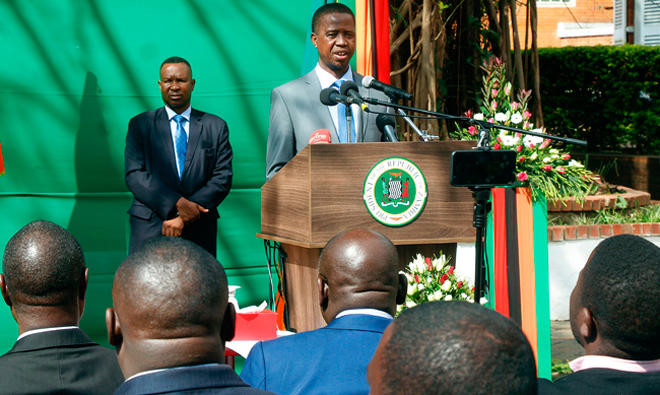
LUSAKA: Zambian President Edgar Lungu has directed the military to help fight the spread of cholera, which has killed 41 people in the nation’s capital and made more than 1,500 others sick since late September.
The outbreak began on Sept. 28 but appeared to die down by Oct. 20, with fewer than five patients reported weekly until Nov. 5. The number of cases then surged, with 136 in the week beginning Nov. 26, the World Health Organization reported.
Presidential spokesman Amos Chanda said in a statement late on Friday that the president believed emergency measures were needed to contain the waterborne disease, including the closure of some markets.
The outbreak was initially confined to densely populated parts of Lusaka where poor sanitation can aid its transmission, but the disease had now spread to low density areas, Chanda said.
“The president is deeply concerned at rampaging advance of the epidemic and has therefore called on the defense forces to join other stakeholders ... and thoroughly clean up Lusaka,” Chanda said.
The outbreak was initially linked to contaminated water from shallow wells but investigations revealed that the spread was being propagated through contaminated food, he said.
“In the last two weeks, three traders from Soweto market have died from cholera and 18 are currently under admission in cholera treatment centers,” Chanda said, referring to Zambia’s largest market.
Chanda said all markets, bars, restaurants and other public places that pose a risk of further transmission of cholera would be closed until they met hygiene standards.
Cholera is spread by ingesting faecal matter and causes acute watery diarrhea. It can be treated with oral rehydration solution but the disease spreads rapidly and can kill within hours if not treated.

Zambia Army to help fight cholera spread
What is Trump’s ‘Board of Peace’?
- The Board of Peace’s charter does not appear to limit its role to the occupied Palestinian territory of Gaza
- Trump will be chairman but also “separately serve as inaugural representative of the United States of America”
BRUSSELS: US President Donald Trump’s government has asked countries to pay $1 billion for a permanent spot on his “Board of Peace” aimed at resolving conflicts, according to its charter seen by AFP.
The board was originally conceived to oversee the rebuilding of war-torn Gaza, but the charter does not appear to limit its role to the occupied Palestinian territory.
What exactly will it do? And who has been invited?
- To what end? -
The Board of Peace will be chaired by Trump, according to its founding charter.
It is “an international organization that seeks to promote stability, restore dependable and lawful governance, and secure enduring peace in areas affected or threatened by conflict,” reads the preamble of the charter sent to countries invited to participate.
It will “undertake such peace-building functions in accordance with international law,” it adds.
- Who’s boss? -
Trump will be chairman but also “separately serve as inaugural representative of the United States of America.”
“The Chairman shall have exclusive authority to create, modify, or dissolve subsidiary entities as necessary or appropriate to fulfill the Board of Peace’s mission,” the document states.
He will pick members of an Executive Board to be “leaders of global stature” to “serve two-year terms, subject to removal by the Chairman.”
He may also, “acting on behalf of the Board of Peace,” “adopt resolutions or other directives.”
The chairman can be replaced only in case of “voluntary resignation or as a result of incapacity.”
- Who can be a member? -
Member states have to be invited by the US president, and will be represented by their head of state or government.
Each member “shall serve a term of no more than three years,” the charter says.
But “the three-year membership term shall not apply to Member States that contribute more than USD $1,000,000,000 in cash funds to the Board of Peace within the first year of the Charter’s entry into force,” it adds.
The board will “convene voting meetings at least annually,” and “each member State shall have one vote.”
But while all decisions require “a majority of Member States present and voting,” they will also be “subject to the approval of the Chairman, who may also cast a vote in his capacity as Chairman in the event of a tie.”
- Who’s already in? -
The White House has said its members will include:
US President Donald Trump, chair
US Secretary of State Marco Rubio
Steve Witkoff, Trump’s special negotiator
Jared Kushner, Trump’s son-in-law
Tony Blair, former UK prime minister
Marc Rowan, billionaire US financier
Ajay Banga, World Bank president
Robert Gabriel, loyal Trump aide on the National Security Council
- Who’s been invited? -
The list of countries and leaders who say they have been invited include, but are not limited to:
Russia’s President Vladimir Putin
Canada’s Prime Minister Mark Carney
Egypt’s President Abdel Fattah El-Sisi
Argentina’s President Javier Milei
Jordan
Brazil
Paraguay
India
Pakistan
Germany
France
Italy
Hungary
Romania
Uzbekistan
Belarus
Greece
Morocco
Slovenia
Poland
- When does it start? -
The charter says it enters into force “upon expression of consent to be bound by three States.”