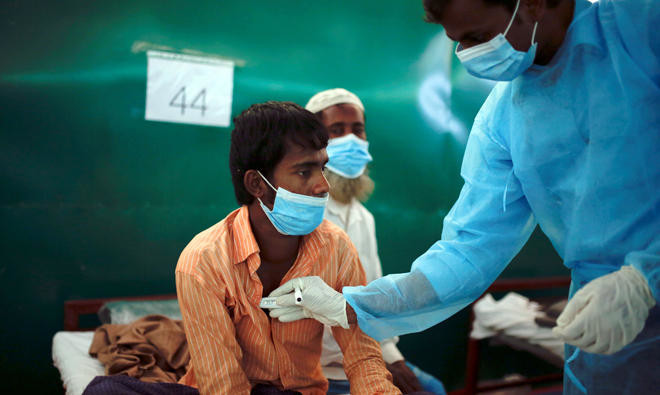
COX’S BAZAR: Health workers in Rohingya refugee camps in Bangladesh are struggling with a shortage of medics able to administer antitoxins to patients infected with diphtheria that has killed nearly two dozen people, aid officials said.
Neighboring Myanmar’s military cracked down on Muslim Rohingya from Rakhine state following Rohingya militant attacks on an army base and police posts on Aug. 25. More than 650,000 Rohingya have fled mainly Buddhist Myanmar to Bangladesh since August, on top of more than 200,000 who fled earlier, according to latest UN data.
Doctors Without Borders (MSF), the lead agency dealing with an outbreak of the bacterial disease in camps sheltering the Rohingya, has treated around 2,000 patients in the past few weeks and is receiving around 100 new cases daily.
The World Health Organization (WHO) describes diphtheria as a widespread, severe infectious disease with epidemic potential and a mortality rate of up to 10 percent. MSF has called diphtheria a disease “long forgotten in most parts of the world thanks to increasing rates of vaccination.”
MSF has managed to provide antitoxins to only around 12 patients daily due to the lack of trained medics, said Crystal van Leeuwen, an MSF emergency medical coordinator now in Cox’s Bazar where the refugee camps are located.
“Once we do have enough people and other organizations start to administer as well, we may get into a situation where we don’t have enough antitoxins anymore,” she told Reuters by phone on Thursday.
“It’s a double-edged sword. We need both the human resources to administer it, and we need more antitoxins at the same time.”
According to a UN report in February, supply of diphtheria antitoxin serum has been limited for many years and the shortage is expected to continue through 2017.
The British government said on Thursday it was sending a team of more than 40 doctors, nurses and firefighters to Cox’s Bazar for six weeks to deal with the diphtheria outbreak following a request by the WHO and Bangladesh government.
The refugees live in densely populated camps and shacks made from bamboo and plastic sheets, with poor access to clean water, sanitation and health services.


Rohingya at risk of deadly diphtheria, face shortage of medics, antitoxins
Rohingya at risk of deadly diphtheria, face shortage of medics, antitoxins

Australia to deploy long-range reconnaissance plane to Gulf
- The government says there are about 115,000 Australian nationals across the Middle East, of whom about 2,600 have returned home.
SYDNEY: Australia will deploy a long-range military reconnaissance plane to the Gulf to protect civilians, Prime Minister Anthony Albanese said Tuesday.
An E-7A Wedgetail aircraft and supporting defense force personnel will be sent for an initial period of four weeks to help “protect and secure the airspace above the Gulf,” Albanese told a news conference.
Australia also plans to provide advanced, medium-range air-to-air missiles to the United Arab Emirates “in response to a request,” the prime minister said.
The UAE, in which there are an estimated 24,000 Australians, has shot down more than 1,500 rockets and drones fired by Iran in reprisal following US-Israeli strikes, he said.
Albanese said he decided to send the advanced radar surveillance plane to the Gulf following a discussion with UAE President Mohammed bin Zayed Al Nahyan.
“The first priority of my government is, and always will be, to keep Australians safe,” the prime minister said.
“Helping Australians means also helping the UAE and other Gulf nations to defend themselves against what are unprovoked attacks,” he added.
“My government has been clear that we’re not taking offensive action against Iran, and we’ve been clear that we are not deploying Australian troops on the ground in Iran.”
The government says there are about 115,000 Australian nationals across the Middle East, of whom about 2,600 have returned home.
“Significant challenges remain, and further work is underway to support those still seeking to leave,” Albanese said.
Australia said last week it had deployed a heavy transport plane and a fuel transport plane to the Middle East as part of plans to get its citizens out of the region.
Canberra has been careful to make clear that its forces are not engaging in offensive operations against Iran.
On Friday, Albanese revealed that Australian military personnel were aboard an American submarine that sank an Iranian navy ship off Sri Lanka.
The personnel were on the submarine as part of training arrangements under AUKUS, a multi-decade defense pact with Britain and the United States, he said, stressing that they did not take part in the attack.


