Zimbabwe ex-army chief who helped oust Mugabe sworn in as Vice President

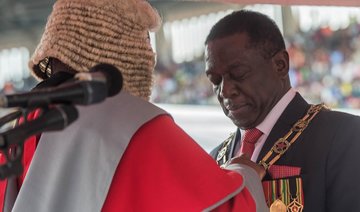
Zimbabwe’s newly appointed Vice President Kembo Mohadi, left, takes the oath of office in front of Chief Justice Luke Malaba, right, during the swearing-in ceremony in Harare, on Thursday. (AFP)
Updated 28 December 2017
Follow

Zimbabwe ex-army chief who helped oust Mugabe sworn in as Vice President

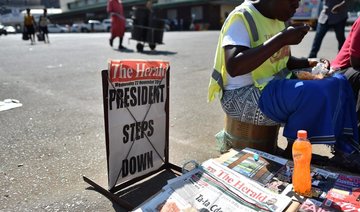
HARARE: Zimbabwe’s former army commander who led a military takeover that helped end Robert Mugabe’s 37-year rule was Thursday sworn in as one of the country’s two vice presidents.
Dressed in a black suit, Gen. Constantino Chiwenga, 61, took the oath of office in Harare, pledging to be “faithful” to Zimbabwe and to “obey, uphold and defend the constitution.”
Chiwenga’s ascent to the country’s second most powerful job has further consolidated the military’s power in the politics of the southern African country.
The new President Emmerson Mnangagwa, dozens of government officials, military and police chiefs as well as traditional leaders, attended the event held on the lawns of the president’s official residence.
Chiwenga retired from the military last week, slightly over a month after the army temporarily took control of the country on Nov. 15, culminating in Mugabe’s resignation six days later.
Mnangagwa, who was humiliated and sacked from his job as vice president by Mugabe in November then took over as head of state.
Mugabe, 93, was ousted from power after the military intervened in response to internal feuding and factionalism in the ruling ZANU-PF party over who would succeed the autocratic leader.
Mugabe’s 52-year-old wife Grace had been positioning herself to follow her husband.
Several other senior army officers have in recent weeks been appointed to ministerial or key positions in the ruling party.
“It was logical. That was to be expected following what happened in November,” Ibbo Mandaza, head of the Southern African Political and Economic Series Trust think-tank, told AFP referring to the temporary military takeover.
President Mnangagwa did not give a speech at the inauguration of his deputies, but told journalists that the responsibility of his deputies would be “to drive the ministers.”
“The performance of the ministers will be reflected by the supervision they give.” he said.
Chiwenga vowed to “work as a team” and “deliver.”
Chiwenga became the public face of the upheaval in Zimbabwe that saw Mugabe eased from power.
It started on Nov. 13, two days before the army was deployed onto the streets, when Chiwenga went on state television to make a rare statement on behalf of the country’s military.
Surrounded by fellow defense chiefs, Chiwenga called on ruling party officials — referring to Grace and her allies — to “stop reckless utterances ... denigrating the military.”
The next day tanks rolled onto the streets of the capital. Just before dawn the following day, two military officers went on state television saying they were not launching a coup but were “targeting criminals around” Mugabe.
Chiwenga and Kembo Mohadi, a veteran politician and long-serving security minister, were then named the ruling party’s vice presidents.
Mohadi was also sworn in as the second vice president on Thursday.
The appointment of Chiwenga and several other senior army officers to government and the ruling party is seen as a reward for the army’s instrumental role in ending Mugabe’s rule.
Two other top military officials were also awarded ministerial posts earlier this month.
Ex-Air Force Chief Perrance Shiri became the new agriculture minister and the general who announced the military takeover, Sibusiso Moyo, is the new foreign minister.


Farmers block Paris streets to protest planned free trade agreement with South American nations

Updated 12 sec ago
Follow

Farmers block Paris streets to protest planned free trade agreement with South American nations

  • The protest piles yet more pressure on President Emmanuel Macron and his government, a day before EU member states are expected to vote on the trade accord

PARIS: French farmers blocked roads into Paris and landmarks such as the Arc de Triomphe on Thursday, in protest against a sweeping trade deal the EU is due to sign with South American nations. 

Farmers from the right-wing Coordination Rurale union called for the protests in Paris amid fears the planned free trade agreement with the Mercosur bloc will flood the EU with cheap food imports.

They also protested high costs and excessive local regulations and demanded an end to a government policy of culling herds of cows in response to a highly contagious cattle disease, which they consider unwarranted.

“We are between resentment and despair. We have a feeling of abandonment, with Mercosur being ‌an example,” Stephane Pelletier, ‌a senior member of the Coordination Rurale union, told Reuters beneath ‌the Eiffel Tower.

The farmers overran police checkpoints to enter the city, driving along the Champs Elysees avenue and blocking the road around the Arc de Triomphe before dawn, before gathering in front of the National Assembly.

National Assembly President Yael Braun-Pivet was booed and jostled when she stepped outside of the assembly’s gates to talk with the Coordination Rurale protesters.

Dozens of tractors obstructed highways leading into the capital ahead of the morning rush hour, including the A13 leading into Paris from the western suburbs and Normandy, causing 150 km of traffic jams, the transport minister said.

Farmers from the FNSEA and young farmers’ unions joined them later at the Eiffel Tower in a calm demonstration.

“We’re going ‌to import products from the rest of the world that don’t ‍meet our standards — that’s not possible, that’s unacceptable. ‍So we’re staying mobilized, we’re carrying on,” Arnaud Rousseau, president of the FNSEA farm union, told reporters, ‍referring to the Mercosur deal.

The protest piles yet more pressure on President Emmanuel Macron and his government, a day before EU member states are expected to vote on the trade accord. Without a majority in parliament, any policy misstep by Macron risks a perilous vote of no confidence in the chamber.

France has long been a stiff opponent of the trade deal.

Even though Paris has won significant last-minute concessions, the trade deal is a political hot potato for the government, with municipal elections in March and the far-right polling strongly ahead of the 2027 elections to replace Macron.

“This treaty is still not acceptable,” government spokesperson Maud Bregeon told France Info radio.

French Farm Minister Annie Genevard said on Wednesday that, even if EU members backed the accord, France would continue to fight against it in the European Parliament, whose approval will also be required for the agreement to enter into force. 

This week, the European Commission proposed making €45 billion of EU funding available to farmers earlier in the bloc’s next seven-year budget and agreed to cut import duties on some fertilizers in a bid to win over countries wavering in their support for Mercosur. 

The deal is backed by countries such as Germany and Spain, and the Commission appeared closer to winning Italy’s backing. 

Rome’s support for the deal would mean the EU had the votes needed to approve ‌the trade accord even without French support.

A vote on the accord is expected on Friday.