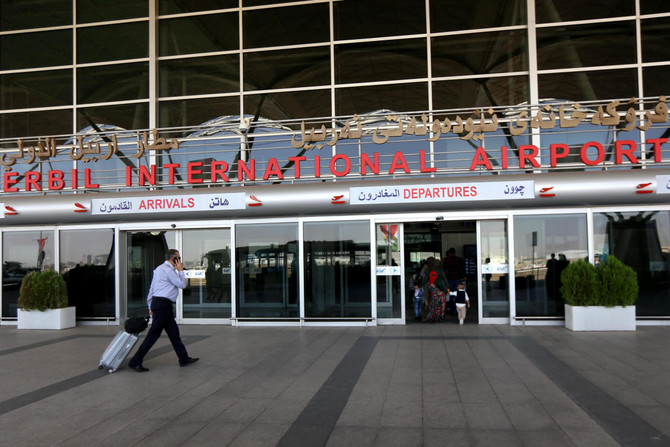
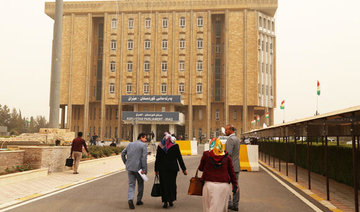
IRBIL: Iraqi authorities have extended through February an international flight ban slapped on the autonomous Kurdish region in response to a controversial independence vote, an airport official said on Thursday.
Baghdad severed Iraqi Kurdistan’s air links to the outside world in late September after it voted overwhelmingly for independence in a non-binding referendum rejected as illegal by the central government.
The flight ban was just part of a battery of penalties inflicted on the Kurds as Baghdad sought to nullify the poll, with federal forces also seizing disputed oil-rich regions in a major blow for their finances.
Talar Faiq Saleh, the director of the airport in Iraqi Kurdistan’s capital Irbil, said the transport ministry in Baghdad had sent a message signalling that international flights were “banned until February 28.”
“Only internal flights are authorized,” she said.
The two-month extension sees Baghdad keeping up the pressure on Iraqi Kurdistan as the fallout from the failed independence push has battered its economy.
A spate of angry protests that have seen the offices of political parties torched in a string of towns has rocked the region this month.
Nechirvan Barzani, the Kurdistan premier, on Thursday denounced what he called “collective punishment imposed by the central government on the entire people of Kurdistan.”
Barzani accused Baghdad of using the air blockade to exert pressure on the country’s northern region ahead of negotiations between the two parties.

Iraq extends Kurdistan international flight ban till February
How activists are bearing witness to the erasure of Palestinian communities in the West Bank
- Activists say intimidation and attacks, often backed by Israeli forces, are forcing Palestinians off their land
- International volunteers describe watching villages unravel amid settler pressure and official inaction
LONDON: Two years ago, a young independent activist known only to his 367,000 Instagram followers as “the.andrey.x” moved to the Palestinian community of Ras Ein Al-Auja in the West Bank.
His mission was to provide what he called a “24/7 protective presence in the village.” But, as his final post from the village attested on Jan. 27, his ultimate role was to bear witness to a sustained campaign of settler violence, ethnic cleansing and the destruction of a community.
Over the past two years, he wrote, “I watched the settlers invade the community 4-5 times every single day, often supported by the army and the police. I watched assault, theft, property destruction, arrests, every type of harassment imaginable.”
Ras Ein Al-Auja has joined the growing list of communities driven from their ancestral homeland by a campaign of terror, which appears to have the open support of Israel’s government.
“Today, the last houses were dismantled,” the young activist wrote. “Ras Ein Al-Auja is gone — 1,000 people ethnically cleansed by Israel. This is Zionism.”
Settlers began establishing outposts in the area more than two years ago. Since then, many Palestinian communities have left. Ras Ein Al-Auja held out longer than most.
One man who finally left the village with his family last week told Israeli newspaper Haaretz that it had become impossible for intimidated residents to graze their sheep and goats.
Villagers say hundreds of animals were stolen, water supplies and power lines sabotaged, armed gangs attacked people and property, land was plowed by settlers, and children playing outside their homes or returning from school were harassed by masked men.
When police or the security forces did intervene, it was usually to arrest Palestinians rather than their tormentors.
Activists such as “the.andrey.x” are not alone. Volunteers from the Israeli activist group “Looking the Occupation in the Eye” have stood by the villagers for the past two years, until last week the organization issued a statement headlined “The Ras Ein Al-Auja community gives in.”
It read: “After standing for two years against an onslaught by the settler leadership and its agents — who were aided by the inaction and support of the army and the police — the last large community in the southern Jordan Valley is giving up. Dozens of families are abandoning land they have lived on for 50 years.”
It added: “The establishment of outposts and daily incursions by youths and herds into the residential compounds of Palestinian residents, alongside the imposition of a siege on the village, broke the resilience of the herding community.”
Ras Ein Al-Auja is just one among countless villages that have been threatened and abandoned. On Jan. 27, settlers reportedly raided a series of communities in Masafer Yatta, attacking residents and setting fire to homes.
The Palestinian Red Cross Society said its medics were pelted with stones when they tried to aid a man with a head wound and a teenage girl with a broken limb in the village of Khirbet Al-Fakhit.
According to Israeli human rights monitor B’Tselem, since the Hamas-led Oct. 7, 2023, attack on southern Israel triggered the war in Gaza, “military attacks and violence by settlers and the military in the West Bank have led to the displacement of Palestinians on a scale not seen since Israel’s occupation of the West Bank in 1967.”
By November last year, it said, at least 44 communities and more than 2,700 people had been driven out, and that tally continues to rise as settlers step up their campaign of intimidation and attacks in 2026.
“The Israeli government, with the help of its settler proxies, is carrying out ethnic cleansing in the West Bank territories,” Looking the Occupation in the Eye added in a statement.
“More and more outposts are being established in the heart of Palestinian communities deliberately, making the peaceful lives of marginalized communities impossible. Ethnic cleansing is a crime against humanity — and it is happening now.”
Around the world, people have been shocked into action on behalf of the Palestinians in the West Bank.
Some have found a way to translate their anger into action through schemes organized by Israeli organizations such as Achvat Amim, which, since 2014, has offered opportunities for concerned Jews to take part in “solidarity visits.”
“The program emerged from a recognition that many people — especially Jews from abroad — were seeking meaningful ways to engage with the reality on the ground beyond short visits, abstract advocacy or distant political debate,” said Elly Oltersdorf, director of outreach and communications for Achvat Amim, which means “solidarity of nations.”
“There were many Israeli and Palestinian organizations doing excellent frontline work, but very few long-term educational frameworks for the international Jewish community that combined political analysis, sustained presence and accountable solidarity.”
Since 2014, several hundred people have taken part in programs ranging from “long-term immersives” lasting three to five months to shorter visits of three to six weeks.
Many participants are in their 20s and 30s, but the programs are not limited to young people and participants have ranged from university students to mid-career professionals, educators, artists and rabbis.
“What unites them,” said Oltersdorf, “is not age, but a willingness to learn, unlearn, and take political responsibility for their relationship to Israel-Palestine.”
The majority come from abroad, mainly North America, Europe and Australia, although up to 10 percent are from Israel. Not everyone who takes part is Jewish.
“While Achvat Amim’s programs are rooted in Jewish community and political responsibility — particularly given global Jewish relationships to Israel — the programs have never been exclusively Jewish,” said Oltersdorf.
“Participants have included people from Christian, Muslim and secular backgrounds, as well as people who do not identify religiously at all.
“What matters is not identity, but a shared commitment to liberation for all, accountability and learning from our Palestinian partners.
“At the same time, Achvat Amim is explicit that much of its work is about engaging Jews, especially diaspora Jews, with the realities carried out in their name. That focus is intentional, not exclusionary.”
Participants in Achvat Amim’s programs “typically arrive with a combination of moral urgency, political confusion and a desire for grounded engagement,” said Oltersdorf.
“Many feel disillusioned with mainstream narratives they were taught, frustrated by distant advocacy that feels disconnected from reality, or compelled by a sense that silence or neutrality is no longer possible.”
For Lila Macbeth, a 43-year-old craniosacral therapist from Minneapolis in the US, taking part in Achvat Amim’s recent three-week Winter Solidarity Visit program, organized in collaboration with Rabbis for Human Rights, was an opportunity to build on her two decades of pro-Palestinian activism, while at the same time learning more about her own faith.
“For the past 20 years, I had a commitment to never come to Israel, to not contribute to the violence that is the occupation of the West Bank and Gaza,” she said.
“Then recently I’ve really connected to Judaism as a very central part of my life. For the first time, I wanted to come here, feel the history and do some Jewish learning.
“But I knew that if I was going to come and be on this land, I really wanted to go to the West Bank and be a protective presence.”
Achvat Amim, she said, really helped her to “understand the history, understand the risks and understand how to show up respectfully as collaborators with Palestinians.”
Macbeth and her fellow volunteers toured Jerusalem, attended workshops on subjects including the Nakba, visited Lifta, the village near Jerusalem that has remained deserted since the Arab community was driven out by Israeli soldiers in 1948, and spent time with Palestinian communities in Masafer Yatta and the Jordan Valley.
From the Palestinians she met, “I have experienced an overwhelming amount of gratitude and hospitality,” she said. “They wanted us to feel so welcome.”
She refuses to accept that the situation in the West Bank is hopeless.
“It feels so easy to think that it’s a lost cause. Even in the very short time that I’ve been in Israel, there have been some really big losses, there have been communities I have visited that have decided to pack up and leave their lands, which feels just tragic.
“But even in situations like that, so many of the Palestinians I’ve interacted with have expressed so much resilience and so much determination and dedication to the bigger fight. So who am I to be hopeless in the face of that?”
She was, she said, “absolutely devastated and heartbroken” when she heard about the Oct. 7, 2023, attack.
“But in the very same moment, I knew with all certainty that what was going to happen to Palestinians in Gaza as retribution was going to be horrific. And it was so much more horrific than I could have imagined.”
Two years on, “the interesting thing about being here in Jerusalem and spending time in the West Bank over the past month, is that during the time when I was watching the news every day about what was happening in Gaza, I had no idea about the escalation of violence that was also happening in the West Bank, which I didn’t learn about until the last month.
Another first-timer on Achvat Amim’s recent three-week Winter Solidarity program was Andrea Burns, a 29-year-old tech worker from New York.
“I was looking to do on-the-ground work and some type of activism,” she said. “I wanted to take personal action on my values and my political beliefs. I’m based in the US, and it’s an understatement to say I’m frustrated about how my tax money is being spent supporting Israel militarily.”
The Jewish environment she grew up in was “pro-Israel, and there wasn’t a lot of education, either in school or in my family or circle of friends. When I was younger, Israel was just viewed positively as a state for the Jewish people.”
It was only when she started graduate school, in about 2018, that she began to learn more about the reality on the ground from international students.
“It was a learning process for me, finding out about the dynamics of the power imbalance, and opening my eyes to the occupation and the apartheid.”
Andrea had visited Israel before. Because she was not raised religiously and wanted to learn more about Judaism, in 2015 she went on a “birthright” visit — free, state- and donor-funded trips for Jews aged 18 to 26, designed to “ensure a vibrant future for the Jewish people by strengthening Jewish identity, Jewish communities, and connection with Israel,” which, she said, “in retrospect is kind of comical, given my current stance on things.”
During the program, “a lot of the time we spent there was just getting to know Palestinian people, seeing and participating in their daily life, getting to know the kids, and also hearing stories of continual settler harassment and violence from outposts that have been set up.”
One visit she made, to Umm Al-Khair in Masafer Yatta, was especially poignant for her. A friend from New York had been in the village in July 2025 when a settler shot dead the popular Palestinian community leader and father of three Odeh Hadalin.
The killing happened when settlers reportedly drove a bulldozer into the village and one of them began firing a handgun.
Yinon Levi, a known extremist and founder of the illegal Meitarim Farm outpost, was placed under house arrest but released after three days when a court accepted his claim that he had acted in self-defense.
Levi had been sanctioned by the US under the Biden administration as a person “undermining peace, security and stability in the West Bank.” The sanctions on Levi, and dozens of other extremist settlers and related organizations, were removed in January last year.
“Many volunteers had spent time in the village and met Odeh over the years,” said Andrea.
“For me, being in the village and meeting his family, who I had learned so much about through friends, felt really special. It was really nice to be there and say, you know, ‘My friend says hi,’ like he was sending his love.”