ANKARA: Turkish-American relations witnessed an unexpected development toward the end of the year.
On Thursday, the announcement by the US Embassy to Turkey of the full resumption of visa services gave a glimmer of hope for the restoration of ties between Ankara and Washington after months of deterioration.
As it did when announcing the reciprocal visa restrictions on Oct. 8 on a tit-for-tat basis, the US Embassy in Ankara and the Turkish Embassy in Washington issued separate statements on their Twitter accounts to announce the reopening of full-capacity visa proceedings for each other’s citizens.
The decision is the result of intense diplomatic contacts between Turkish and American foreign ministers, Mevlut Cavusoglu and Rex Tillerson, in early December, as well as regular communications among technocrats on both sides.
The US had suspended non-immigration visa applications to Turkish nationals after Turkey arrested a local employee at the US consulate in Istanbul and a translator at the US consulate in the southern province of Adana on terrorism charges. Washington has also urged Turkey to release Andrew Brunson, the American pastor who was imprisoned a year ago on terrorism charges.
Up until this latest decision, the slowdown in visa proceedings meant the earliest appointment was scheduled for January 2019.
In the statement issued by the US Embassy to Turkey, the US said that the Turkish government had given high-level assurances “that local employees working at the US diplomatic missions will not be detained or arrested for performing their official duties, and that Turkish authorities will inform the US government in advance if the government of Turkey intends to detain or arrest any member of our local staff in the future.”
It also stated that the Department of State is reassured that “the security posture has improved sufficiently to allow for the full resumption of visa services in Turkey.”
“We continue to have serious concerns about the existing allegations against arrested local employees of our mission in Turkey. We are also concerned about cases against US citizens who have been arrested under the state of emergency. US officials will continue to engage with their Turkish counterparts to seek a satisfactory resolution of these cases,” the statement said.
As a welcoming reaction to the move, Turkey lifted visa restrictions on American nationals, but denied that the Turkish government had given any assurances on ongoing legal cases in Turkey; and accused the US of misinforming the Turkish and American public with these claims.
According to Megan Gisclon, a researcher on US-Turkey relations at the Istanbul Policy Center, relations between the US and Turkey hit rock bottom at the onset of the visa crisis.
“While the joint decision to lift visa restrictions is a promising step forward for bilateral ties, one must also recognize that once you’ve hit rock bottom, there is nowhere to go but up,” Gisclon told Arab News.
“As longtime allies and NATO allies, such a large roadblock cannot permanently exist in government-to-government relations or in people-to-people relations — even despite the many differences between the US and Turkey,” she said.
Gisclon said that the end of the crisis was inevitable, but it was hard to say for certain why it had ended now without further explanation from officials.
“Some are saying that the lifting of visa restrictions took place now to stop Turkey’s alignment with Russia and Iran as quickly as possible; however, this shift has been going on for a while,” she said, adding that the US might be trying to fix broken US-Turkey relations following the rapprochement of Turkey to Iran and the Russia axis in the settlement process of the Syrian conflict.
But according to experts, the visa crisis was the easiest of the problems between the two countries to resolve.
The purchase by Turkey of the Russian S-400 missile system is a significant concern for the Pentagon, which has warned that it could influence Ankara’s operation of F-35 jets and their integration with NATO’s air defense system. The US may reportedly take economic sanctions, especially toward the Turkish defense industry, in retaliation for the S-400 deal.
For Ozgur Unluhisarcikli, Ankara director of the German Marshall Fund of the US, the visa crisis was a symptom of the real problems between Washington and Ankara, and its solution did not indicate that the issues were resolved or would be resolved any time soon.
“Lack of strategic thinking in Washington and the regime survival mode in Ankara makes it very difficult for the two allies to sort out their differences,” Unluhisarcikli told Arab News.
A recent survey conducted by Istanbul Kadir Has University, “2017 Results of the Survey on Turkish Foreign Policy,” found that 66.5 percent of respondents saw the US as presenting the biggest threat to Turkey.


![]()
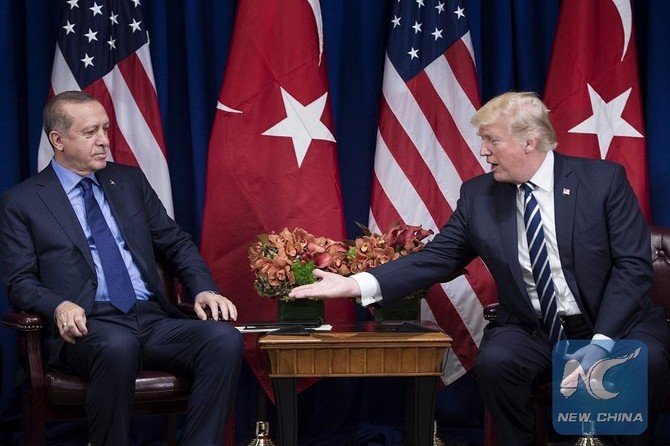
Visa stalemate ends between Ankara and Washington
Visa stalemate ends between Ankara and Washington


Latest updates


© 2026 SAUDI RESEARCH & PUBLISHING COMPANY, All Rights Reserved And subject to Terms of Use Agreement.