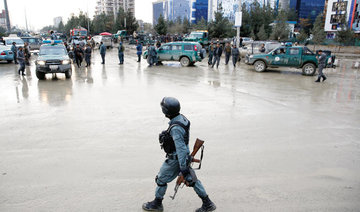
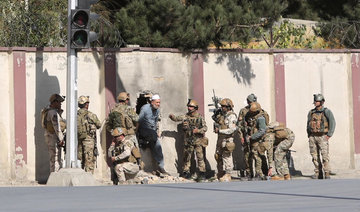
KABUL: Around 40 people were killed and dozens wounded in a suicide blast targeting Shiites in Kabul Thursday, officials said, with chaotic scenes at the city’s hospitals as anguished families sought loved ones.
The Daesh group claimed responsibility for the gruesome assault, which happened in the same building as the Afghan Voice Agency, a media outlet which earlier reports had suggested could have been the target.
Deputy interior ministry spokesman Nasrat Rahimi said the attack — the deadliest since a Shiite mosque bombing in October that killed more than 50 worshippers — was aimed at the Tabayan cultural center in the west of the city.
“The suicide attacker detonated himself during a gathering at Tabayan cultural center causing a lot of casualties,” Rahimi said.
The main explosion was followed by two smaller bomb blasts as victims and survivors were leaving the scene.
Rahimi said the gathering was organized to mark the 38th anniversary of Soviet invasion in Afghanistan. An Afghan Voice Agency journalist said that more than 100 people were at the event in the building’s basement.
There were chaotic scenes at the Istiqlal hospital where ambulances and police pickups brought victims, including women and children. Many of them had suffered severe burns to their faces and bodies, as well as shrapnel wounds, AFP reporters said.
Visibly distressed relatives searching for their loved ones inside the medical facility slapped their heads in fury as they cried and cursed the government for seemingly being unable to end the regular carnage on their streets.
Some were so distraught they crawled on the ground pulling their hair.
AFP reporters saw more than a dozen badly burned bodies lying on the floor in a room inside the hospital and wooden coffins being delivered so families could take away the bodies of their loved ones.
Kabul has become one of the deadliest places in war-torn Afghanistan for civilians in recent months, as the Taliban step up their attacks and Daesh seeks to expand its presence in the country.
Thursday’s assault comes days after a suicide bomber killed six civilians in an attack near an Afghan intelligence agency compound in the city, which was claimed by Daesh.
The Middle Eastern jihadist group has gained ground in Afghanistan since it first appeared in the region in 2015, and has scaled up its attacks in Kabul, including on security installations and the country’s Shiite minority.
A man attending the anniversary ceremony at Tabayan said he heard a “big boom.”
“We do not know the numbers (of casualties). When the explosion happened we immediately fled,” he told Tolo News.
Mohammad Hasan Rezayee, a university student who was also at the ceremony, told Tolo News he had suffered burns to his face in the blast.
“We were inside the hall in the second row when there was an explosion behind us. I did not see the bomber,” he said from his hospital bed.
“After the blast, there was fire and smoke inside the building and everyone was pleading for help.”
The attack drew international condemnation, with NATO’s Resolute Support mission in Afghanistan describing it as “heinous.” Amnesty International said it was further evidence that Kabul was not safe.
“The European governments who insist on this dangerous fiction by forcibly returning Afghans are putting their lives in danger,” Amnesty International’s South Asia director Biraj Patnaik said in a statement.
Photos posted on Afghan Voice Agency’s Facebook page showed the inside of a compound with debris and bodies lying on the ground.
Security in Kabul has been ramped up since May 31 when a massive truck bomb ripped through the diplomatic quarter, killing some 150 people and wounding around 400 others — mostly civilians. No group has yet claimed that attack.
Religious attacks in Afghanistan have skyrocketed in the past two years with the minority Shiite community the main target, the United Nations said in November.
IS, a Sunni extremist group, has claimed most of the attacks on Shiite worshippers as it seeks to stir up sectarian violence in the country.
The Afghan media has also previously been targeted by militants, underlining the risks faced by journalists in the war-torn country.

Around 40 dead in Daesh-claimed attack targeting Shiites in Kabul
Trump set to expand immigration crackdown in 2026 despite brewing backlash
- Trump plans to increase workplace raids despite political risks
- ICE and Border Patrol to receive $170 billion funding boost
WASHINGTON: US President Donald Trump is preparing for a more aggressive immigration crackdown in 2026 with billions in new funding, including by raiding more workplaces — even as backlash builds ahead of next year’s midterm elections. Trump has already surged immigration agents into major US cities, where they swept through neighborhoods and clashed with residents. While federal agents this year conducted some high-profile raids on businesses, they largely avoided raiding farms, factories and other businesses that are economically important but known to employ immigrants without legal status. ICE and Border Patrol will get $170 billion in additional funds through September 2029 — a huge surge of funding over their existing annual budgets of about $19 billion after the Republican-controlled Congress passed a massive spending package in July. Administration officials say they plan to hire thousands more agents, open new detention centers, pick up more immigrants in local jails and partner with outside companies to track down people without legal status.
The expanded deportation plans come despite growing signs of political backlash ahead of next year’s midterm elections.
Miami, one of the cities most affected by Trump’s crackdown because of its large immigrant population, elected its first Democratic mayor in nearly three decades last week in what the mayor-elect said was, in part, a reaction to the president. Other local elections and polling have suggested rising concern among voters wary of aggressive immigration tactics. “People are beginning to see this not as an immigration question anymore as much as it is a violation of rights, a violation of due process and militarizing neighborhoods extraconstitutionally,” said Mike Madrid, a moderate Republican political strategist. “There is no question that is a problem for the president and Republicans.” Trump’s overall approval rating on immigration policy fell from 50 percent in March, before he launched crackdowns in several major US cities, to 41 percent in mid-December, for what had been his strongest issue. Rising public unease has focused on masked federal agents using aggressive tactics such as deploying tear gas in residential neighborhoods and detaining US citizens.
’NUMBERS WILL EXPLODE’
In addition to expanding enforcement actions, Trump has stripped hundreds of thousands of Haitian, Venezuelan and Afghan immigrants of temporary legal status, expanding the pool of people who could be deported as the president promises to remove 1 million immigrants each year – a goal he almost certainly will miss this year. So far, some 622,000 immigrants have been deported since Trump took office in January.
White House border czar Tom Homan told Reuters Trump had delivered on his promise of a historic deportation operation and removing criminals while shutting down illegal immigration across the US-Mexico border. Homan said the number of arrests will increase sharply as ICE hires more officers and expands detention capacity with the new funding.
“I think you’re going to see the numbers explode greatly next year,” Homan said.
Homan said the plans “absolutely” include more enforcement actions at workplaces.
Sarah Pierce, director of social policy at the center-left group Third Way, said US businesses have been reluctant to push back on Trump’s immigration crackdown in the past year but could be prompted to speak up if the focus turns to employers.
Pierce said it will be interesting to see “whether or not businesses finally stand up to this administration.”
Trump, a Republican, recaptured the White House promising record levels of deportations, saying it was needed after years of high levels of illegal immigration under his Democratic predecessor, Joe Biden. He kicked off a campaign that dispatched federal agents to US cities in search of possible immigration offenders, sparking protests and lawsuits over racial profiling and violent tactics.
Some businesses shut down to avoid raids or because of a lack of customers. Parents vulnerable to arrest kept their children home from school or had neighbors walk them. Some US citizens started carrying passports. Despite the focus on criminals in its public statements, government data shows that the Trump administration has been arresting more people who have not been charged with any crimes beyond their alleged immigration violations than previous administrations.
Some 41 percent of the roughly 54,000 people arrested by ICE and detained by late November had no criminal record beyond a suspected immigration violation, agency figures show. In the first few weeks in January, before Trump took office, just 6 percent of those arrested and detained by ICE were not facing charges for other crimes or previously convicted. The Trump administration has taken aim at legal immigrants as well. Agents have arrested spouses of US citizens at their green card interviews, pulled people from certain countries out of their naturalization ceremonies, moments before they were to become citizens, and revoked thousands of student visas.
PLANS TO TARGET EMPLOYERS
The administration’s planned focus on job sites in the coming year could generate many more arrests and affect the US economy and Republican-leaning business owners.
Replacing immigrants arrested during workplace raids could lead to higher labor costs, undermining Trump’s fight against inflation, which analysts expect to be a major issue in the closely watched November elections, determining control of Congress. Administration officials earlier this year exempted such businesses from enforcement on Trump’s orders, then quickly reversed, Reuters reported at the time.
Some immigration hard-liners have called for more workplace enforcement.
“Eventually you’re going to have to go after these employers,” said Jessica Vaughan, policy director for the Center for Immigration Studies, which backs lower levels of immigration. “When that starts happening the employers will start cleaning up their acts on their own.”
The expanded deportation plans come despite growing signs of political backlash ahead of next year’s midterm elections.
Miami, one of the cities most affected by Trump’s crackdown because of its large immigrant population, elected its first Democratic mayor in nearly three decades last week in what the mayor-elect said was, in part, a reaction to the president. Other local elections and polling have suggested rising concern among voters wary of aggressive immigration tactics. “People are beginning to see this not as an immigration question anymore as much as it is a violation of rights, a violation of due process and militarizing neighborhoods extraconstitutionally,” said Mike Madrid, a moderate Republican political strategist. “There is no question that is a problem for the president and Republicans.” Trump’s overall approval rating on immigration policy fell from 50 percent in March, before he launched crackdowns in several major US cities, to 41 percent in mid-December, for what had been his strongest issue. Rising public unease has focused on masked federal agents using aggressive tactics such as deploying tear gas in residential neighborhoods and detaining US citizens.
’NUMBERS WILL EXPLODE’
In addition to expanding enforcement actions, Trump has stripped hundreds of thousands of Haitian, Venezuelan and Afghan immigrants of temporary legal status, expanding the pool of people who could be deported as the president promises to remove 1 million immigrants each year – a goal he almost certainly will miss this year. So far, some 622,000 immigrants have been deported since Trump took office in January.
White House border czar Tom Homan told Reuters Trump had delivered on his promise of a historic deportation operation and removing criminals while shutting down illegal immigration across the US-Mexico border. Homan said the number of arrests will increase sharply as ICE hires more officers and expands detention capacity with the new funding.
“I think you’re going to see the numbers explode greatly next year,” Homan said.
Homan said the plans “absolutely” include more enforcement actions at workplaces.
Sarah Pierce, director of social policy at the center-left group Third Way, said US businesses have been reluctant to push back on Trump’s immigration crackdown in the past year but could be prompted to speak up if the focus turns to employers.
Pierce said it will be interesting to see “whether or not businesses finally stand up to this administration.”
Trump, a Republican, recaptured the White House promising record levels of deportations, saying it was needed after years of high levels of illegal immigration under his Democratic predecessor, Joe Biden. He kicked off a campaign that dispatched federal agents to US cities in search of possible immigration offenders, sparking protests and lawsuits over racial profiling and violent tactics.
Some businesses shut down to avoid raids or because of a lack of customers. Parents vulnerable to arrest kept their children home from school or had neighbors walk them. Some US citizens started carrying passports. Despite the focus on criminals in its public statements, government data shows that the Trump administration has been arresting more people who have not been charged with any crimes beyond their alleged immigration violations than previous administrations.
Some 41 percent of the roughly 54,000 people arrested by ICE and detained by late November had no criminal record beyond a suspected immigration violation, agency figures show. In the first few weeks in January, before Trump took office, just 6 percent of those arrested and detained by ICE were not facing charges for other crimes or previously convicted. The Trump administration has taken aim at legal immigrants as well. Agents have arrested spouses of US citizens at their green card interviews, pulled people from certain countries out of their naturalization ceremonies, moments before they were to become citizens, and revoked thousands of student visas.
PLANS TO TARGET EMPLOYERS
The administration’s planned focus on job sites in the coming year could generate many more arrests and affect the US economy and Republican-leaning business owners.
Replacing immigrants arrested during workplace raids could lead to higher labor costs, undermining Trump’s fight against inflation, which analysts expect to be a major issue in the closely watched November elections, determining control of Congress. Administration officials earlier this year exempted such businesses from enforcement on Trump’s orders, then quickly reversed, Reuters reported at the time.
Some immigration hard-liners have called for more workplace enforcement.
“Eventually you’re going to have to go after these employers,” said Jessica Vaughan, policy director for the Center for Immigration Studies, which backs lower levels of immigration. “When that starts happening the employers will start cleaning up their acts on their own.”
© 2025 SAUDI RESEARCH & PUBLISHING COMPANY, All Rights Reserved And subject to Terms of Use Agreement.