

Militants storm Kabul spy training center

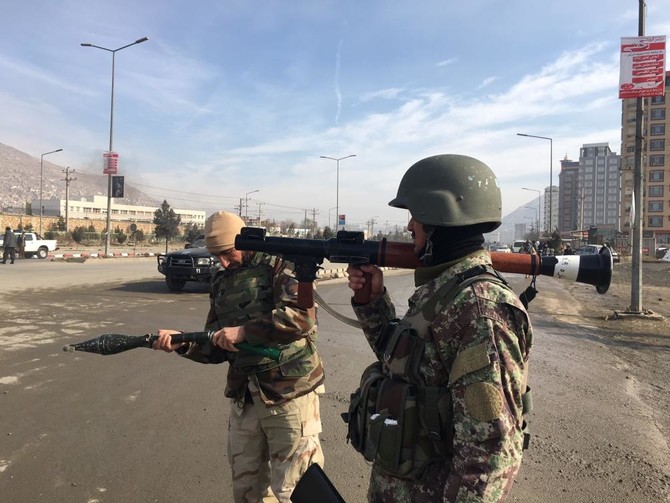
Afghan security personnel arrive at the site of complex attack at an intelligence training center in Kabul, Afghanistan, Monday, Dec. 18, 2017. (AP)
Updated 18 December 2017
Follow

Militants storm Kabul spy training center

KABUL: Militants stormed an intelligence agency training facility in Kabul on Monday, officials said, triggering intense fighting with police in the latest Daesh group attack to hit the Afghan capital.
“Around 10:10 am, a group of armed attackers entered an under-construction building in (the) NDS training center in (the) Afshar area of Kabul,” interior ministry spokesman Najib Danish told AFP, referring to the National Directorate of Security, Afghanistan’s spy agency.
“The fighting is ongoing and we have also launched our operation.”
Nasrat Rahim, a deputy interior ministry spokesman, said the sound of large and small arms fire could be heard from the fighting.
“There are three attackers involved... the clearance operation is ongoing,” said the spokesman, adding there were no immediate reports of any casualties.
Roads to the area were closed and dozens of police and intelligence officers were blocking access to the public. AFP reporters, who were held more than a kilometer away from the scene, saw ambulances and reinforcements headed toward the site.
“I was going toward my school. It (the attack) happened suddenly... the police arrived in the area fast and blocked the roads, not allowing anyone to get to their homes,” Naweed, a student, told AFP.
Daesh claimed responsibility for the attack through its propaganda arm.
“Two IS attackers raid the Afghan intelligence center in Kabul,” the jihadists’ Amaq outlet reported.
The Afghan capital has become one of the deadliest places in the war-torn country for civilians in recent months, as the resurgent Taliban and increasingly Daesh both step up their attacks, targeting security installations and mosques.

Security in Kabul has been ramped up since May 31 when a massive truck bomb ripped through the city’s diplomatic quarter, killing about 150 and wounding around 400 people, mostly civilians.
No group has officially claimed responsibility for that attack, which the government has blamed on the Taliban-allied Haqqani Network.
Monday’s attack represents another blow to beleaguered Afghan forces.
The Taliban have targeted military installations in recent months, including a spate of attacks in October that killed around 150 people.
Afghan forces, already beset by desertions and corruption, have seen casualties soar to what a US watchdog has described as “shockingly high” levels since NATO forces officially ended their combat mission in 2014.
Morale has been further eroded by long-running fears that the militants have insider help — everything from infiltrators in the ranks to corrupt Afghan forces selling equipment to the Taliban.
But Daesh, which has expanded its presence in Afghanistan since it first appeared in the region in 2015, has also dramatically scaled up its attacks in Kabul, including on the country’s Shiite minority.
In November, a suicide attacker blew himself up outside a political gathering in Kabul, killing at least 14 people in an attack claimed by Daesh.

Britain’s Starmer seeks to bolster China ties despite Trump warning

Updated 31 January 2026
Follow

Britain’s Starmer seeks to bolster China ties despite Trump warning

  • “The UK has got a huge amount to offer,” he said in a short speech at the UK-China Business Forum at the Bank of China

SHANGHAI: Visiting Prime Minister Keir Starmer said on Friday Britain has a “huge amount to offer” China, after his bid to forge closer ties prompted warnings from US President Donald Trump.
Starmer’s trip is the first to China by a British prime minister in eight years, and follows in the footsteps of other Western leaders looking to counter an increasingly volatile United States.
Leaders from France, Canada and Finland have flocked to Beijing in recent weeks, recoiling from Trump’s bid to seize Greenland and tariff threats against NATO allies.
Trump warned on Thursday it was “very dangerous” for Britain to be dealing with China.
Starmer brushed off those comments on Friday, noting that Trump was also expected to visit China in the months ahead.
“The US and the UK are very close allies, and that’s why we discussed the visit with his team before we came,” Starmer said in an interview with UK television.
“I don’t think it is wise for the UK to stick its head in the sand. China is the second-largest economy in the world,” he said.
Asked about Trump’s comments on Friday, Beijing’s foreign ministry said “China is willing to strengthen cooperation with all countries in the spirit of mutual benefit and win-win results.”
Starmer met top Chinese leaders, including President Xi Jinping and Premier Li Qiang, on Thursday, with both sides highlighting the need for closer ties.
He told business representatives from Britain and China on Friday that both sides had “warmly engaged” and “made some real progress.”
“The UK has got a huge amount to offer,” he said in a short speech at the UK-China Business Forum at the Bank of China.
The meetings the previous day provided “just the level of engagement that we hoped for,” Starmer said.
He signed a series of agreements on Thursday, with Downing Street announcing Beijing had agreed to visa-free travel for British citizens visiting China for under 30 days, although Starmer acknowledged there was no start date for the arrangement yet.
The Chinese foreign ministry said only that it was “actively considering” the visa deal and would “make it public at an appropriate time upon completing the necessary procedures.”
Starmer hailed the agreements as “symbolic of what we’re doing with the relationship.”
He also said Beijing had lifted sanctions on UK lawmakers targeted since 2021 for their criticism of alleged human rights abuses against China’s Muslim Uyghur minority.
“President Xi said to me that that means all parliamentarians are welcome,” Starmer said in an interview with UK television.
He traveled from Beijing to economic powerhouse Shanghai, where he spoke with Chinese students at the Shanghai International College of Fashion and Innovation, a joint institute between Donghua University and the University of Edinburgh.

- Visas and whisky -

The visa deal could bring Britain in line with about 50 other countries granted visa-free travel, including France, Germany, Australia and Japan, and follows a similar agreement made between China and Canada this month.
The agreements signed included cooperation on targeting supply chains used by migrant smugglers, as well as on British exports to China, health and strengthening a bilateral trade commission.
China also agreed to halve tariffs on British whisky to five percent, according to Downing Street.
British companies sealed £2.2 billion in export deals and around £2.3 billion in “market access wins” over five years, and “hundreds of millions worth of investments,” Starmer’s government said in a statement.
Xi told Starmer on Thursday that their countries should strengthen dialogue and cooperation in the context of a “complex and intertwined” international situation.
Relations between China and the UK deteriorated from 2020 when Beijing imposed a national security law on Hong Kong and cracked down on pro-democracy activists in the former British colony.
However, China remains Britain’s third-largest trading partner, and Starmer is hoping deals with Beijing will help fulfil his primary goal of boosting UK economic growth.
British pharmaceutical group AstraZeneca said on Thursday it would invest $15 billion in China through 2030 to expand its medicines manufacturing and research.
And China’s Pop Mart, makers of the wildly popular Labubu dolls, said it would set up a regional hub in London and open 27 stores across Europe in the coming year, including up to seven in Britain.
Starmer will continue his Asia trip with a brief stop in Japan on Saturday to meet Prime Minister Sanae Takaichi.