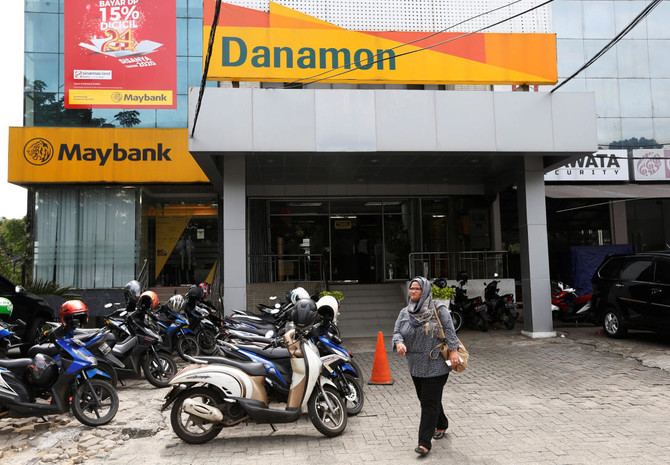
JAKARTA: Shares in PT Bank Danamon Indonesia soared to their highest level in more than 17 years after Japan’s Mitsubishi UFJ Financial Group (MUFG) said it planned to buy a majority stake in the country’s fifth-largest lender.
MUFG said it had agreed with Danamon shareholders to buy 73.8 percent of the bank and would like to raise that to 100 percent as it looks to strengthen its presence in Southeast Asia’s biggest economy.
Danamon’s shares rose as much as 16.7 percent in early trade on Wednesday to 7,000 rupiah per share.
The first stage of the acquisition — a purchase of a 19.9 percent stake from Singapore state investor Temasek — was agreed at 8,323 rupiah per share or 15.88 trillion rupiah ($1.2 billion).

Shares in Indonesia’s Danamon soar to 17-year high after MUFG deal
Saudi Arabia’s venture scene goes global
- 2026 to see more exits, more AI, and a bigger push to tell Saudi’s story abroad
RIYADH: Saudi Arabia’s business landscape is set to see a “record year of liquidity events” in 2026, Philip Bahoshy, CEO of venture data platform MAGNiTT, has told Arab News.
Setting out his expectations for the upcoming 12 months, Bahoshy said he expects a shift from the domination by funding momentum seen in 2025 to one defined by exits.
The CEO thinks Saudi Arabia is “likely to see one, if not two, IPOs happening within the Kingdom,” and alongside public listings he forecast “a record year of merger and acquisition transactions,” positioning M&A as another major route to liquidity for founders
and investors.
Being cautious about using hype-driven labels like unicorns, Bahoshy still expects that 2026 will see the emergence of multiple billion-dollar companies.
All this comes after a year in which Saudi Arabia’s venture capital market increasingly attracted international investors alongside a growing base of local institutional capital, with marquee events helping pull global players into the Kingdom and the wider Gulf Cooperation Council region.
Maturity, focus, appeal
Bahoshy summed up Saudi Arabia’s venture capital market in 2025 in three words — “attractiveness, focus and maturity.”
In his view, the ecosystem is “maturing” after “about five years or six years now of investment,” with capital increasingly reaching “every stage of the funnel.”
Bahoshy said he has long argued the market needs investment “across each stage, early stage, medium stage, late stage,” and he framed 2025 as a year when that breadth became more visible.
He contrasted the current cycle with recent years, noting that “two years back, it was mega deals,” while “last year we saw the underlying ecosystem.”
In 2025, he said, the market showed “a balance of early stage, middle stage and late stage investment,” which he described as “a positive sign of a continually evolving ecosystem.”
Bahoshy also pointed to “focus by the government on problem-solution” as another marker of maturity.
On the international front, he said global players are arriving “not just because it makes sense for political reasons,” but because of “the companies and the scale that they’ve achieved.”
Heading for records
Bahoshy said Saudi Arabia’s venture market closed 2025 with strong momentum, with leading indicators suggesting an unusually active finish to the year.
His remarks point to a market where deal flow remained steady through the back half of the year rather than tapering off, supporting a narrative of sustained fundraising appetite among investors and continued capital formation among startups.
Balancing the funnel
Bahoshy said the spread of activity across mega rounds, later-stage deals, and earlier funding in 2025 was not accidental, but the result of a deliberate effort to “make sure that each step of the stage, the funding stage, has been taken care of.”
In his account, government-backed infrastructure has been built to support the full pipeline, “whether it’s through incubators and accelerators at early stage … accelerator programs that are both private and public,” and “seed funds that continue to get capital from some of the fund to fund structures to support at the seed and series A stages.”
A bigger push to tell Saudi’s story abroad
Beyond deal outcomes, Bahoshy framed 2026 as a year to refine Saudi Arabia’s investor strategy.
He said “a lot of work has been done to bring people to the Kingdom,” and described that as “a credit to the Kingdom.”
In his view, the next phase is expanding outbound engagement — “the type of delegation trips that they do” — citing recent visits to London, Silicon Valley, Korea, and Hong Kong.
He argued the Kingdom has already achieved “the 70 percent, 80 percent attractiveness of bringing people to the Kingdom,” and now needs to “share the story outwards.”
He also expects artificial intelligence to take a much larger share of venture deployment.
“I anticipate that AI will contribute close to 20 to 30 percent or 25 percent plus of all venture capital deployed in the Kingdom,” Bahoshy said.