Indonesia holds cabinet meeting in Bali as volcano threatens tourism

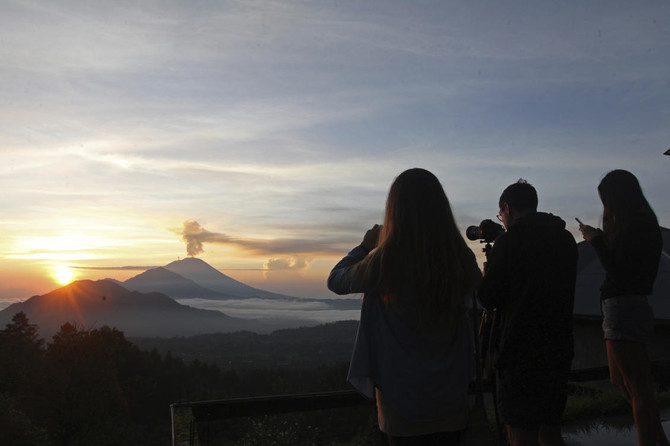
Tourists take photos of the Mount Agung volcano during a sunrise in Kintamani, Bali, Indonesia, Wednesday, Dec. 13, 2017. (AP)
Updated 22 December 2017
Follow

Indonesia holds cabinet meeting in Bali as volcano threatens tourism

JAKARTA: Indonesian President Joko Widodo will on Friday hold his cabinet meeting on the holiday island of Bali in a bid to reassure visitors that there is nothing to worry about from the rumbling Mount Agung volcano.
Authorities last month raised the alert status of Mount Agung in northeastern Bali to the highest level, imposing an exclusion zone of up to 10 km (6 miles) around its crater as it spewed clouds of ash, steam, and other volcanic material.
Widodo will take the unusual step of gathering his cabinet in Bali as part of government efforts to assure visitors that the island is safe to come to and to stave off a major drop off in visitor numbers during the upcoming holiday season.
“For those who have plans to vacation in Bali, there’s no need to doubt or be worried about the status of Mount Agung, Bali is very safe to visit,” Energy Minister Ignasius Jonan said in a Twitter message after visiting an observatory overlooking the volcano, before the cabinet meeting.
President Widodo is expected to make a statement after the cabinet meeting.
The cabinet usually meets at the state palace in the capital Jakarta or on its outskirts in Bogor.
The relatively small island of Bali, famous for its beaches and temples, has an outsized importance for Indonesian tourism. In January-September, Bali received 4.5 million foreign tourist arrivals, nearly half of the 10.5 million arrivals in Indonesia.
Tourism Minister Arief Yahya said this week that Indonesia was expecting an estimated 15 trillion rupiah ($1.11 billion) in lost income and around 1 million fewer tourists because of the volcano, according to daily newspaper Kompas.
Many business operators and hotels have seen cancelations since authorities first raised the alert in September, and most expect the holiday season to be slower than in previous years.
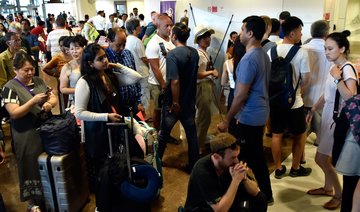
Thousands of tourists were left stranded late last month when a volcanic ash cloud forced the closure of Bali’s airport for several days.
Countries like Australia and Singapore have advised their citizens to be cautious when traveling to Bali.


AlUla’s ancient scripts come alive after dark at Ikmah

The team at ‘Ikmah After Dark: Secrets of the Scribe’ showing a visitor how to carve on a stone. (Supplied)
Updated 04 January 2026
Follow

AlUla’s ancient scripts come alive after dark at Ikmah

  • Gen-Z local Omer Mohammad guided Arab News through the vast outdoor setting of ‘Secrets of the Scribe’

ALULA: Ikmah Mountain, also known as Jabal Ikmah, one of AlUla’s landmark archeological sites, is offering visitors a new experience this week as part of the Winter at Tantora programming, which ends on Jan. 10. 

Near the ancient city of Dadan, Ikmah highlights AlUla’s role as a major cultural and religious center long before the rise of the Nabataeans. It is being activated under the stars in a brand new, old way.

The site, often described as “an open-air library” for its hundreds of ancient inscriptions carved on its canyon walls thousands of years ago, provides visitors with have a chance to etch their own names, using the ancient alphabet, on a block of stone they can take home.

The team at ‘Ikmah After Dark: Secrets of the Scribe’ showing a visitor how to carve on a stone. (Supplied)

Written mainly in Dadanitic and Lihyanite, the ancient texts once recorded religious dedications, laws, names of rulers and traced everyday life, providing rare insights into the beliefs and social structures of early Arabian kingdoms. 

Arab News spoke with Gen-Z local Omer Mohammad, who guided us through the vast outdoor setting of the “Secrets of the Scribe — Ikmah After Dark” experience.

“When the guests arrive, we welcome them ... give them some tea to get refreshed. After that, if the group is big, we split them into two; some of the group goes to go to the carving where they are going to learn how to carve. And the other group is going to go to explore the gorge,” he said. 

Storytelling was such an important thing here 3,000 years ago. People from all over the world used to bring their animals and rest here; it had a river so it had some water and everything.

Omer Mohammad, AlUla local

The gorge is an elevated path with candles lighting the way on both sides.

“In the scripts and descriptions you’re going to see (in the mountains), you will get to know more about Dadani lives and what they used to do here,” he said.

After the hike down, visitors from both groups join at the gathering point where everyone is encouraged to rest, mingle and enjoy small bites such as dates and other goodies, as well as tea. 

While it is a new experience, the tradition is old. 

“Storytelling was such an important thing here 3,000 years ago. People from all over the world used to bring their animals and rest here; it had a river so it had some water and everything,” he said.

Dressed in garb from olden times and speaking in poetic prose, Mohammad and his peers guided us to see the light in the dark night.

“It is significant to me personally to work on this project to get people to come here and get excited (about) what’s happening, enjoy our stories and know more about Dadani life,” he said.

On a personal note, Mohammad is grateful to know more about his own history and wants to continue passing on that newfound knowledge to all generations — both younger and older than his own — and be part of the unfolding story of the land and its people.

“I guess you can say that this is the land of my ancestors. I really love history, and I really would like to know more about history — and my history,” Mohammad said. “But I just learned about this ancient history three years ago when I started working here.

“I never had the experience before, so when I knew more about it, I was so happy. And it was so good. Everyone should come,” he said.