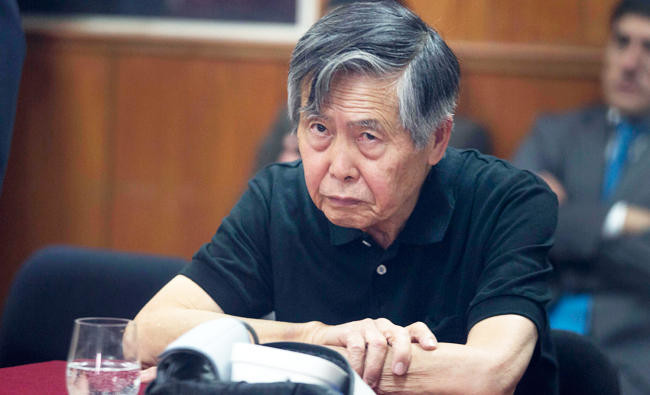
LIMA, Peru: Peru’s president announced Sunday night that he granted a medical pardon to jailed former strongman Alberto Fujimori, who was serving a 25-year sentence for human rights abuses, corruption and the sanctioning of death squads.
President Pedro Pablo Kuczynski released a statement saying he decided to free Fujimori for “humanitarian reasons.”
The 79-year-old Fujimori, who governed from 1990 to 2000, is a polarizing figure in Peru. Some Peruvians laud him for defeating the Maoist Shining Path guerrilla movement, while others loathe him for human rights violations carried out under his government.
His daughter, Keiko Fujimori, narrowly lost Peru’s last presidential election to Kuczynski, and her party dominates congress. Her party mounted an attempt this month to oust Kuczynski over business ties to the Brazilian construction company Odebrecht, which is at the center of a huge Latin American corruption scandal, but the president survived the impeachment vote late Thursday.
Fujimori filed a request seeking a medical pardon more than a year ago, citing deteriorating health. He has said on his Twitter account that he suffers from arrhythmia, for which he has been hospitalized several times this year.
Peruvian law provides that no person convicted of murder or kidnapping can receive a presidential pardon except in the case of a terminal illness. Three previous requests from Fujimori for pardons since 2013 were rejected after doctors said he did not suffer from incurable illness or severe mental disorder
Fujimori would have been in prison until age 93 if he had severed his full sentence.
A former university president and mathematics professor, Fujimori was a political outsider when he emerged from obscurity to win Peru’s 1990 presidential election over writer Mario Vargas Llosa.
Peru was being ravaged by runaway inflation and guerrilla violence when he took office. He quickly rebuilt the economy with mass privatizations of state industries. Defeating the fanatical Shining Path rebels took longer but his fight won him broad-based support.
His presidency collapsed just as dramatically as his rise to power.
After briefly shutting down Congress and putting himself into a third term, Fujimori fled the country in disgrace in 2000 after leaked videotapes showed his spy chief, Vladimiro Montesinos, bribing lawmakers. Fujimori went to Japan, his parents’ homeland, and famously sent in his resignation by fax.
Five years later, he stunned supporters and enemies alike when he flew to neighboring Chile, where he was arrested and extradited to Peru. Fujimori’s goal was run for Peru’s presidency again in 2006, but instead he went to trial and was convicted of abuse of power.

Peru’s president grants medical pardon for jailed Fujimori
Rubio says technical talks with Denmark, Greenland officials over Arctic security have begun
- US Secretary of State on Wednesday appeared eager to downplay Trump’s rift with Europe over Greenland
WASHINGTON: Technical talks between the US, Denmark and Greenland over hatching an Arctic security deal are now underway, Secretary of State Marco Rubio said on Wednesday.
The foreign ministers of Denmark and Greenland agreed to create a working group aimed at addressing differences with the US during a Washington meeting earlier this month with Vice President JD Vance and Rubio.
The group was created after President Donald Trump’s repeated calls for the US to take over Greenland, a Danish territory, in the name of countering threats from Russia and China — calls that Greenland, Denmark and European allies forcefully rejected.
“It begins today and it will be a regular process,” Rubio said of the working group, as he testified before the Senate Foreign Relations Committee. “We’re going to try to do it in a way that isn’t like a media circus every time these conversations happen, because we think that creates more flexibility on both sides to arrive at a positive outcome.”
The Danish Foreign Ministry said Wednesday’s talks focused on “how we can address US concerns about security in the Arctic while respecting the red lines of the Kingdom.” Red lines refers to the sovereignty of Greenland.
Trump’s renewed threats in recent weeks to annex Greenland, which is a semiautonomous territory of a NATO ally, has roiled US-European relations.
Trump this month announced he would slap new tariffs on Denmark and seven other European countries that opposed his takeover calls, only to abruptly drop his threats after a “framework” for a deal over access to the mineral-rich island was reached, with NATO Secretary-General Mark Rutte’s help. Few details of the agreement have emerged.
After stiff pushback from European allies to his Greenland rhetoric, Trump also announced at the World Economic Forum in Davos, Switzerland, last week that he would take off the table the possibility of using American military force to acquire Greenland.
The president backed off his tariff threats and softened his language after Wall Street suffered its biggest losses in months over concerns that Trump’s Greenland ambitions could spur a trade war and fundamentally rupture NATO, a 32-member transatlantic military alliance that’s been a linchpin of post-World War II security.
Rubio on Wednesday appeared eager to downplay Trump’s rift with Europe over Greenland.
“We’ve got a little bit of work to do, but I think we’re going to wind up in a good place, and I think you’ll hear the same from our colleagues in Europe very shortly,” Rubio said.
Rubio during Wednesday’s hearing also had a pointed exchange with Sen. Tim Kaine, D-Virginia, about Trump repeatedly referring to Greenland as Iceland while at Davos.
“Yeah, he meant to say Greenland, but I think we’re all familiar with presidents that have verbal stumbles,” Rubio said in responding to Kaine’s questions about Trump’s flub — taking a veiled dig at former President Joe Biden. “We’ve had presidents like that before. Some made a lot more than this one.”