

Turkey joins Russia and Iran in supporting Syria

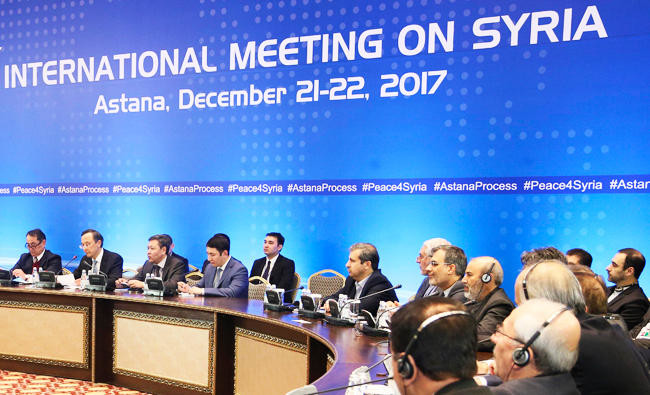
Members of the delegations take part in the peace talks on Syria in Astana, Kazakhstan, in this December 22, 2017 photo. (REUTERS)
Updated 25 December 2017
Follow

Turkey joins Russia and Iran in supporting Syria

ISTANBUL: Russia, Turkey and Iran have reaffirmed their “strong and continued commitment to the sovereignty, independence, unity and territorial integrity of the Syrian Arab Republic”.

The three nations issued the statement giving their support after the Astana summit on Dec. 21-23.

As the Russian Foreign Ministry is currently preparing a list of participants to attend a peace congress in Sochi on Jan. 29-30, it also stated that the congress would not be a platform for those wanting the removal of Syrian President Bashar Assad.

The list is reportedly being prepared by taking into account the positions of the guarantor countries of the Astana peace process, i.e. Russia, Turkey and Iran.

Russian President Vladimir Putin’s special envoy to Syria, Aleksandr Lavrentiev, said that if the opposition intends to attend the Sochi Congress to prioritise its insistence on Assad leaving power, then there is no place for it there.

For experts, the removal of the Assad regime is no longer a priority for Turkey considering the latest developments on the ground, but Ankara is trying to handle this delicate process through the transition process.

Serhat Erkmen, a Middle East expert at the Ankara-based 21st Century Turkey Institute, said that for a while now Turkey has not been insistent on Assad removal's from power.

“At the rhetorical level, Ankara didn’t give up from its objective of leadership change. But, considering the actions in Syria, Assad might act as a counterweight to the People’s Protection Units (YPG) considered by Turkey as a terrorist group,” Erkmen told Arab News.

Assad recently showed a harsh reaction against the YPG and considered them “traitors”.

“But currently Ankara negotiates indirectly with the representatives of the Assad regime during Astana meetings,” Erkmen said.

Mete Sohtaoglu, an Istanbul-based researcher on Middle East politics, thinks that Turkey is no longer insisting on the Assad’s removal from power.

“Ankara is planning to remove Assad in an official manner through ballot boxes in and out of Syria, which will be monitored by the United Nations,” he told Arab News.

However, Bora Bayraktar, a Middle East expert from Istanbul Kultur University, said: “Turkey actually did not soften its stance or step back in its rhetoric regarding Assad regime.

“Ankara understood the reality in Syria and changed its priorities,” Bayraktar told Arab News.

“Turkey is trying to solve the regime problem in Syria through the transition process. It doesn’t have a policy of actively pursuing Assad’s removal from power. It supports the opposition and the drafting of the new constitution,” he added.

For Ankara, Bayraktar said, the priority now is its border security and resolving the issue of YPG and its political wing PYD which is seen as a direct threat to territorial integrity due to their links with the outlawed Kurdistan Workers’ Party (PKK).

As a concession to Ankara, the PYD will reportedly not be invited to the Sochi Congress, but to ensure a broader representation ahead of the political settlement in Syria, other Kurdish representatives will be present.

Trump warns Iran of ‘very traumatic’ outcome if no nuclear deal

Updated 55 min 56 sec ago
Follow

Trump warns Iran of ‘very traumatic’ outcome if no nuclear deal

  • Speaking a day after he hosted Netanyahu at the White House, Trump said he hoped for a result “over the next month”

WASHINGTON: US President Donald Trump threatened Iran Thursday with “very traumatic” consequences if it fails to make a nuclear deal — but Israeli Prime Minister Benjamin Netanyahu said he was skeptical about the quality of any such agreement.
Speaking a day after he hosted Netanyahu at the White House, Trump said he hoped for a result “over the next month” from Washington’s negotiations with Tehran over its nuclear program.
“We have to make a deal, otherwise it’s going to be very traumatic, very traumatic. I don’t want that to happen, but we have to make a deal,” Trump told reporters.
“This will be very traumatic for Iran if they don’t make a deal.”
Trump — who is considering sending a second aircraft carrier to the Middle East to pressure Iran — recalled the US military strikes he ordered on Tehran’s nuclear facilities during Israel’s 12-day war with Iran in July last year.
“We’ll see if we can get a deal with them, and if we can’t, we’ll have to go to phase two. Phase two will be very tough for them,” Trump said.
Netanyahu had traveled to Washington to push Trump to take a harder line in the Iran nuclear talks, particularly on including the Islamic Republic’s arsenal of ballistic missiles.
But the Israeli and US leaders apparently remained at odds, with Trump saying after their meeting at the White House on Wednesday that he had insisted the negotiations should continue.

- ‘General skepticism’ -

Netanyahu said in Washington on Thursday before departing for Israel that Trump believed he was laying the ground for a deal.
“He believes that the conditions he is creating, combined with the fact that they surely understand they made a mistake last time when they didn’t reach an agreement, may create the conditions for achieving a good deal,” Netanyahu said, according to a video statement from his office.
But the Israeli premier added: “I will not hide from you that I expressed general skepticism regarding the quality of any agreement with Iran.”
Any deal “must include the elements that are very important from our perspective,” Netanyahu continued, listing Iran’s ballistic missile program and its support for armed groups such as the Palestinian movement Hamas, Yemen’s Houthi rebels and Hezbollah in Lebanon.
“It’s not just the nuclear issue,” he said.
Despite their differences on Iran, Trump signaled his strong personal support for Netanyahu as he criticized Israeli President Isaac Herzog for rejecting his request to pardon the prime minister on corruption charges.
“You have a president that refuses to give him a pardon. I think that man should be ashamed of himself,” Trump said on Thursday.
Trump has repeatedly hinted at potential US military action against Iran following its deadly crackdown on protests last month, even as Washington and Tehran restarted talks last week with a meeting in Oman.
The last round of talks between the two foes was cut short by Israel’s war with Iran and the US strikes.
So far, Iran has rejected expanding the new talks beyond the issue of its nuclear program. Tehran denies seeking a nuclear weapon, and has said it will not give in to “excessive demands” on the subject.