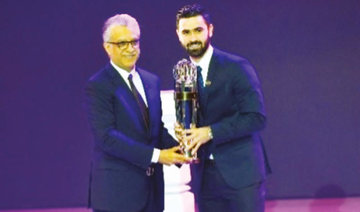
PLAYER OF THE YEAR — OMAR KHRIBIN
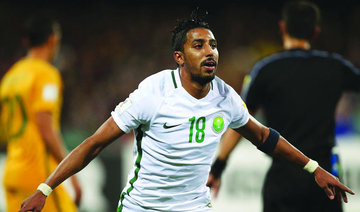
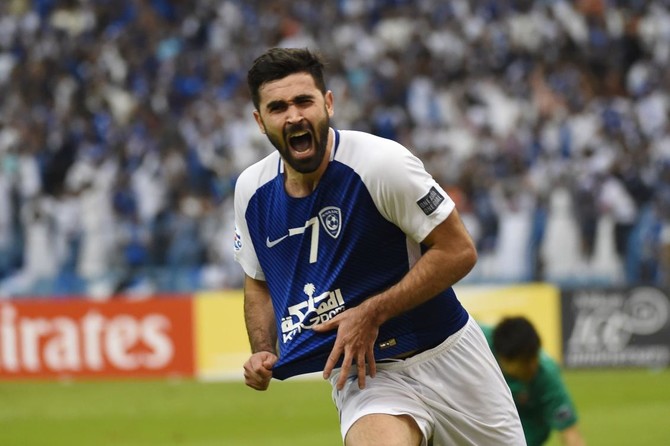
This has been a vintage year for forward in the Middle East and it is to be hoped that some of the best in the region show their worth at the World Cup. Syria won’t be there but Omar Khribin really made a name for himself this year. A striker who can do everything, he almost shot his war-torn country to the biggest sporting event. His performances helped the Qasioun Eagles to the playoffs and he almost single handedly guided Syria past Australia and had his 120th minute free-kick in the second leg not hit the post, then things would now be very different.
It was the same story in the Asian Champions League. The tournament top-scorer was inspirational as Al-Hilal made the final and he scored in the first leg. An injury in the second held him back, and that may just have been the difference between the Riyadh team getting the trophy and returning home from Japan empty handed.
TEAM OF THE YEAR — WYDAD CASABLANCA
It has been a vintage year for Moroccan football. Not only did the national team qualify for the 2018 World Cup but Wydad Casablanca were crowned as the winners of the CAF Champions League, squeezing past Al-Ahly of Egypt in a memorable final. It was a second continental title for the Casablanca club, coming a quarter of a century after their first.
Wydad may not have been the most entertaining team in the competition, with Al-Ahly more crowd-pleasing in that aspect, but their discipline, tactical organization and flexibility made a difference when it counted. Conceding just six goals in the entire tournament showed that the old adage of defending winning titles can be true.
MATCH OF THE YEAR — Al-Rayyan (Qatar) 3-4 Al-Hilal (KSA)
If you are going to have a seven-goal thriller then the final game in the group stage of the 2017 Asian Champions League is a decent place to stage it. Al-Hilal traveled to the home of Al-Rayyan needing a point to secure a place in the knockout stage. The Qatari hosts had to win. Both teams had chances until the Saudi Arabians took the lead just before the break through Romanian midfielder Nicolas Milesi.
Ten minutes after the restart, however, Sebastian Soria equalized and on the hour, Rodrigo Tabata put Al Rayyan ahead to give them one foot in the last 16. Just six minutes later, however, Omar Khribin levelled to make it 2-2 and soon after, Milesi got his second to put Al Hilal ahead once more. Sergio Garcia made equalized for the Qataris with seven minutes remaining and once again, the nerves were jangling back in Riyadh only for Khirbin to score once more and give Al-Hilal the points and the place in the knockout stage.
MANAGER OF THE YEAR — HENK TEN CATE
The Dutchman deserves an award for lasting two years in charge of Al-Jazira in the United Arab Emirates where the turnover of coaches in the country is so high. He did deliver a second league championship for the Abu Dhabi outfit but there was disappointment in the Asian Champions League and a group stage exit. But Ten Cate really came into his own at the Club World Cup in December.
Al-Jazira were rank outsiders and had to go through the playoff against Auckland City to earn a quarter-final tie with Urawa Reds, the clever and disciplined champions of Asia from Japan. Al-Jazira won 1-0 for the second game in succession despite having much less possession.
Then came a semifinal with Real Madrid, the mighty 12-time European champions who had won three out of the last four of their continental titles. For many, this was the biggest club in the world. Yet Al-Jazira scored in the first half despite having one third of the share of the ball. And had there not been a harsh offside call early in the second half, the lead could well have been 2-0. It took two second-half goals from Cristiano Ronaldo and Gareth Bale to give the Spanish a tight win. Al-Jazira performed much better than South American champions Gremio against Real Madrid thanks, in part, to a great coaching performance.
GOAL OF THE YEAR —
Doris Fuakumputu for Al-Muharraq (Bahrain) vs Nejmeh (Lebanon), 2017 AFC Cup Group Stage, March 13, 2017
There are few things more satisfying than seeing a long-range shot into the roof of the net over the despairing dive of the goalkeeper. Fuakumputu has been around in the Middle East for years in Saudi Arabia, Kuwait and now Bahrain but this was his finest hour. He picked up the ball far from goal, turned and then in a single motion fired a rocket home in delicious fashion. Throw in a somersault celebration in addition and you have a goal to remember. It was pure instinct, delivering something beautiful and unexpected and there are few sights better in football than that.
TEAM OF THE YEAR:
(4-3-3)
GK: Khasif (Al-Shabab, UAE);
DF: Mohamed Ounajem (Wydad Casablanca, Morocco) Osama Hawsawi (Al-Hilal, Saudi Arabia) Samal Saeed (Al-Quwa Al-Jawiya, Iraq) Ali Maaloul, (Al-Ahly, Eygpt)
MF: Xavi (Al-Sadd, Qatar), Omar Abdulrahman (Al-Ain, UAE) Brachim Mekkach (Wydad Casablanca, Morocco)
FW: Omar Khribin (Al-Hilal, KSA) Achraf Bencharki (Wydad Casablanca, Morocco) Ahmed El Sheikh (Al-Ahly, Egypt)