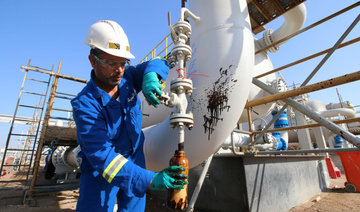
BAGHDAD: Iraq on Sunday invited companies to submit statements of interest in building a new pipeline from the northern city of Kirkuk to Turkey’s Mediterranean port of Ceyhan.
The new 350-kilometer (220-mile) pipeline will carry up to one million barrels a day, the state-run Oil Projects Company said. A 305-kilometer (190-mile) gas pipeline to feed pumping stations, tanks and other service installations will be included in the project, it said.
The new line will be built alongside an existing 1.6 million barrel-per-day pipeline, which runs through restive Sunni areas and has been idle since it was badly damaged by militant attacks in 2014.
Iraqi forces drove the Daesh group from the area earlier this year, but the militants are expected to continue to launch insurgent-style attacks.
Interested companies have until January 24 to submit applications for pre-qualification before receiving the final tender documents. Authorities did not provide a timeline for the project, which will be offered under a build-own-operate-transfer scheme. At least 25 percent of the project will be owned by Iraqi entities.
Iraqi forces seized the disputed city of Kirkuk from Kurdish forces in October. The Kurds, who had taken control of Kirkuk and other disputed areas when Daesh swept into Iraq three years ago, exported oil through their own pipeline to Turkey.
The fields around Kirkuk currently produce around 140,000 barrels a day, all of which goes to refineries, Oil Ministry spokesman Assem Jihad said Sunday.
Iraq has the world’s fourth-largest oil reserves. This year, it added 10 billion barrels, bringing its total reserves up to 153.1 billion barrels.
Oil and other infrastructure suffered widespread damage during the fighting against Daesh. The costs of the war, along with low oil prices, have taken a heavy toll on Iraq’s economy.

Iraq plans new Kirkuk-Ceyhan oil pipeline
Saudi banks to maintain strong lending growth in 2026: S&P Global
RIYADH: Banks operating in Saudi Arabia are expected to sustain strong lending growth in 2026, driven by sustained financing demand tied to Vision 2030 projects, according to S&P Global.
In its latest report, the credit rating agency said the Kingdom’s banks are expected to extend $65 billion to $75 billion in new corporate loans in 2026, compared with $70 billion in the year to Nov. 30.
This steady momentum in corporate lending will be fueled by high investments, primarily in the Kingdom’s real estate and utilities sectors.
Earlier this month, another report by Fitch Ratings also underscored the healthy state of Saudi Arabia’s banking system, stating that credit growth and high net interest margins are supporting the profitability of banks in the Kingdom.
Fitch added that capital adequacy edged up to 20 percent, while non-performing loans fell to an all-time low of 1.1 percent in the first three quarters of 2025.
In its latest report, S&P Global Ratings said it “projects that Saudi banks will maintain strong lending growth fueled by the financing needs relating to Vision 2030. Banks will also continue to tap external funding sources to fund their growth.”
According to the analysis, an additional area of growth for banks is retail lending, especially mortgages, particularly as interest rates continue to decline.
“Retail lending — of which mortgages constitute roughly half — rose by 5 percent in the year to Nov. 30, 2025, and we anticipate that it will increase by nearly $20 billion in 2026 from $18 billion as of Nov. 30, 2025,” said the report.
S&P Global also expects banks’ lending books to continue performing strongly, with growth of 10 percent in 2026, compared with 11 percent in the year to Nov. 30.
How will Saudi banks fund this growth?
According to S&P Global, the Saudi government and its related entities are expected to continue injecting deposits into the banking system to support credit growth in the future.
Government and government-related entity deposits reached 32 percent of total deposits by November, up from almost 20 percent in 2020, outpacing the growth in private-sector deposits.
The report, however, noted that deposits were not sufficient to fully fund the expansion of the lending book.
“We foresee that banks will continue to resort to external debt to bridge the gap. This will lead to a rise in net external debt as a proportion of total loans from 6 percent as of November 2025, which we view as manageable,” said the report.
It added: “Stronger liquidity in the international capital markets and lower interest rates will also help. The latter could encourage banks to either start actively divesting mortgages to Saudi Real Estate Refinance Co., or issuing residential mortgage-backed securities to create financing headroom on their balance sheets.”
Profitability and capitalization
According to S&P Global, the profitability of Saudi banks is expected to remain strong in 2026, but will likely decline slightly due to lower interest rates.
Banks in Saudi Arabia are also projected to continue to invest in digitalization to further optimize their operating efficiency.
“We expect that strong lending growth will partly mitigate the pressure on net interest margins, which we believe will contract only slightly. This contraction, coupled with a higher cost of risk, means that we expect banks’ return on average assets to dip slightly to 2.2 percent in 2026,” said the report.
The capitalization of Saudi banks also remains strong, as rated banks in the Kingdom had a Tier 1 capital adequacy ratio of 18.4 percent on Sept. 30 and an average S&P Global Ratings-calculated risk-adjusted capital ratio of 13.1 percent at year-end 2024.
The report also underscored the importance of private capital financing in Saudi Arabia’s financial ecosystem.
“Private capital financing represents a very small proportion of Saudi Arabia’s overall debt stock — 2 percent based on S&P Global Market Intelligence data. Nevertheless, it has grown tenfold since 2020, reaching $3.7 billion in 2024,” said S&P Global.
It added: “Substantial funding needs arising from Vision 2030 and growth in the small-to-midsize-enterprise sector present key opportunities for private capital financing to offer loans to the domestic market in collaboration with banks.”
Future outlook and economic growth prospects
According to the report, all Saudi bank ratings carry stable outlooks, and it is likely to remain unchanged in 2026.
Regarding the downside, S&P Global said that geopolitical turmoil and a material and extended decline in oil prices could pose risks to the rating of these financial institutions.
Economic growth prospects remain broadly supportive in Saudi Arabia, with both non-oil and hydrocarbon-related activities playing a role.
Supporting this growth are rising household consumption, increased oil output following a relaxation of OPEC+ quotas, and the Public Investment Fund’s significant investments in diversification projects, which reach above $40 billion annually.
Earlier in January, the World Bank said that the Kingdom’s gross domestic product is expected to grow by 4.3 percent in 2026 and 4.4 percent in 2027, up from an estimated 3.8 percent in 2025.
The International Monetary Fund, in January, also raised its 2026 growth forecast for Saudi Arabia to 4.5 percent, citing higher oil output, resilient domestic demand, and continued economic reforms.
The revised projection marks a 0.5 percentage point upgrade from the IMF’s October report, according to the fund’s latest World Economic Outlook Update.
The Kingdom’s economy is expected to have grown 4.3 percent in 2025, with expansion set to ease to 3.6 percent in 2027, added the IMF.