Oman opens sprawling oryx reserve to ecotourists ahead of new tourism push

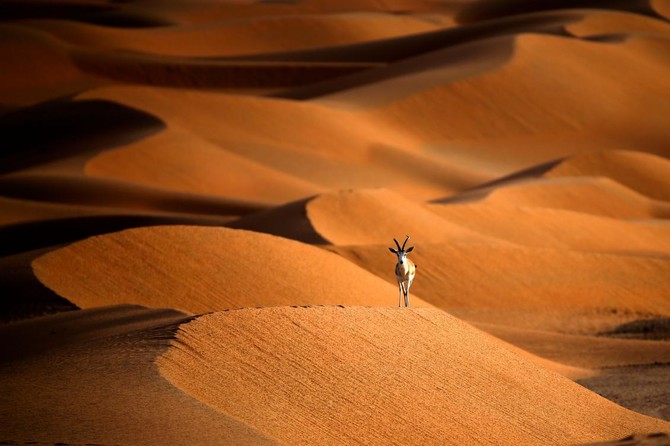
A sand gazelle at an Arabian Oryx Sanctuary in Umm Al-Zamool, some 290 kilometers south of Abu Dhabi near the border with Oman and Saudi Arabia. Oman is looking to carve itself a new niche in ecotourism by opening up a sanctuary for one of the desert’s most fabled creatures. (AFP)
Updated 23 December 2017
Follow

Oman opens sprawling oryx reserve to ecotourists ahead of new tourism push

Haima, OMAN: The Gulf sultanate of Oman is looking to carve itself a new niche in ecotourism by opening up a sanctuary for one of the desert’s most fabled creatures — the Arabian oryx.
Once extinct in the wild, the rare member of the antelope family famed for its elegant horns has been dragged back from the precipice in a sprawling reserve fenced off for decades from the public.
That changed last month when authorities for the first time officially opened the sanctuary to visitors — part of a broader bid by Oman to boost tourism as oil revenues decline.
On a recent outing, wildlife rangers in SUVs patrolled the sandy plains of the reserve in central Oman’s Haima province, spotting groups of grazing oryx and other indigenous species.
For years, the main goal has been a basic one — ensuring the oryx can survive by focusing on “helping the animals here reproduce and multiply,” said sanctuary spokesman Hamed bin Mahmoud Al-Harsousi.
But now, as numbers have ticked up from just 100 some two decades ago to almost 750 today, the authorities began eyeing another role for the reserve.
“There has been more interest in its tourism potential — to take advantage of its uniqueness and rare animals,” Harsousi told AFP.
The story of the Arabian oryx — sometimes referred to as the Arabian “unicorn” due to its distinctive profile — is one of miraculous survival.
Hunted prolifically, the last wild member of the species was killed in Oman by suspected poachers in 1972.
The species only clung to existence thanks to a program to breed them in captivity and in the early 1980s a batch of 10 were released into Oman’s Arabian Oryx Sanctuary.
Since then, regenerating the oryx has been an often precarious process.
The Omani sanctuary sprawls over 2,824 square kilometer (1,100 sq miles) of diverse terrain — from flat plains to rocky slopes and sandy dunes.
Its own fate has been nearly as tortured as that of the oryx it houses.
In 2007, the sanctuary became the first place ever to be removed from UNESCO’s World Heritage list as the government of Oman turned most of it over to oil drilling.
Now, as oil prices have plunged over the past few years, it is the wildlife once again that has become an increasing priority for the authorities.
Harsousi puts the current number of Arabian oryx in the sanctuary at 742 and says that other species are flourishing there too.
“In the past three years, we have been able to increase the number of the Arabian gazelle, known as sand gazelles, from 300 to about 850,” he added.
In addition to the animals, there are 12 species of trees that provide a habitat for diverse birds.
Oman has been on a push to transform itself into a tourist draw — pitching its beach resorts to luxury travelers and desert wilderness to the more adventurous.
Officials in the sultanate told AFP that a major tourism plan would be announced within a matter of weeks.
Those working at the oryx sanctuary hope that it can help play a lead role in luring visitors to the country.
But there are also fears that greater openness could see the return of an old foe — hunters.
With that in mind security is being kept tight, said Abdullah Ghassab Obaid, a wildlife guard at the reserve.
“Thirty guards and a police patrol are working to provide security in the reserve to prevent any infiltration.”


Cruise Saudi strengthens global ties as Celestyal makes maiden calls to Jeddah

Updated 10 December 2025
Follow

Cruise Saudi strengthens global ties as Celestyal makes maiden calls to Jeddah

JEDDAH: Saudi Arabia is accelerating its push to become a global cruise hub, with Cruise Saudi — a wholly owned Public Investment Fund subsidiary — expanding international partnerships to draw more travelers to the Kingdom’s Red Sea and Arabian Gulf ports.

The latest milestone came as award-winning Greek cruise line Celestyal completed its first-ever calls to Jeddah, signaling rising global interest in Saudi Arabia’s cultural and natural attractions.

The visits form part of Cruise Saudi’s strategy to build a year-round cruise ecosystem that supports tourism growth, boosts local supply chains, and contributes to the Kingdom’s broader economic diversification.

Three UNESCO World Heritage Sites — AlUla, Jeddah Historic District, and Al-Ahsa Oasis — are now accessible by sea, with curated shore excursions designed to deepen visitor engagement.

Cruise Saudi aims to welcome 1.3 million cruise passengers annually by 2035, creating 50,000 direct and indirect jobs and positioning the Kingdom as a premier international cruise destination.

The 1,360-passenger Celestyal Discovery arrived in Jeddah on Dec. 5, following the 1,260-passenger Celestyal Journey, which made its maiden call on Nov. 29. The Journey concluded a seven-night Athens–Jeddah itinerary with stops in Turkiye and Egypt, marked by a traditional plaque exchange ceremony attended by Cruise Saudi executives, port officials and Celestyal representatives.

Passengers were welcomed with traditional Saudi hospitality and toured Jeddah’s historic Al-Balad district, bustling souks, and cultural sites. Some Muslim travelers also visited Makkah to perform Umrah.

“We are honored to celebrate our maiden call in Jeddah alongside our partners at Cruise Saudi, marking the beginning of a long and effective relationship,” said Lee Haslett, chief commercial officer at Celestyal.

He added that Jeddah’s role as “the cultural heart of Saudi Arabia” presents strong potential for cruise tourism.

Barbara Buczek, chief destination experiences officer at Cruise Saudi, told Arab News: “This maiden Red Sea sailing highlights the strong appeal of the region and aligns with Cruise Saudi's commitment to developing seamless, high-quality cruise experiences in Saudi Arabia.”

She noted that Celestyal’s expanded itineraries reflect rising demand for distinctive Red Sea and Arabian Gulf voyages.

Since its launch in 2021, Cruise Saudi has activated five cruise ports, introduced Aroya Cruises, the Kingdom’s first homegrown cruise line, and established Aman at Sea, an ultra-luxury JV with Aman Group set to launch in 2027. The company manages the full value chain — from terminals and berths to curated excursions — and has already welcomed more than 600,000 passengers of over 120 nationalities.

Celestyal, which carries more than 140,000 passengers annually across two refurbished vessels, is aligning with the Kingdom’s Vision 2030 ambition to transform coastal tourism. After departing Jeddah, both Celestyal ships continued to Abu Dhabi to begin the company’s second Arabian Gulf season.

Aroya Cruises has also launched a new seasonal program featuring stops in Mykonos, Athens, Crete, and coastal cities in Turkiye, expanding on a successful inaugural season that attracted over 95,000 guests.

The growing activity underscores Saudi Arabia’s emergence as a world-class cruise destination, supported by modern infrastructure, expanding routes, and experiences that highlight the Kingdom’s culture, heritage and hospitality.