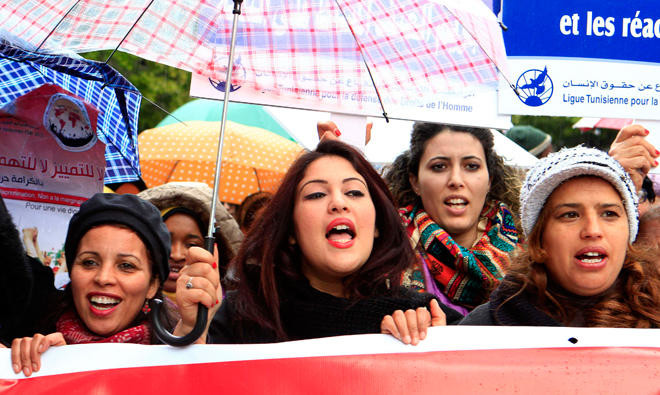
TUNIS: Tunisia’s minister for women said on Friday more needs to be done to promote female civil servants to top jobs after a study showed that few reach the most senior positions.
Just 37 percent of Tunisia’s 630,000 civil servants are women, said Khaoula Labidi, who coordinated the study, a joint French-funded project by the country’s presidency and UN Women.
She said that was “very high compared to other countries in North Africa and the Middle East,” but added that men hold three quarters of prestigious, better-paid “director general” positions.
Labidi said women who reached medium-level positions faced a “glass ceiling” preventing them from advancing further.
“We want to pierce this glass ceiling to allow competent women — and there are many — to access these high-level positions,” she said.
Women’s Minister Naziha Labidi acknowledged the need “to do everything so these women can reach decision-making positions,” adding that a strategy had been developed to put women on a par with men in such roles by 2020.
Tunisia is seen as a pioneer in the Arab world in terms of women’s rights, adopting a penal code in 1956, which granted rights to women and abolished polygamy.
This summer, the Parliament also passed a law designed to “end all violence against women,” strengthening protection and help for victims, in a move welcomed by rights groups.
It will provide for judicial and psychological assistance for victims of domestic violence and removes a controversial article that allows men to escape punishment for rape if they marry their victim.
Tunisian society remains deeply divided between conservatives and social liberals.
Rights groups say women are still discriminated against, and around half say they have been subject to at least one form of violence in their lives.

Tunisian women struggle to reach senior public roles

France, allies preparing bid to ‘gradually’ reopen Strait of Hormuz: Macron
ABOARD FRENCH AIRCRAFT CARRIER CHARLES DE GAULLE: France and its allies are preparing a “defensive” mission to reopen the strategically vital Strait of Hormuz, President Emmanuel Macron said Monday as the Middle East war entered its second week.
The French leader landed by helicopter on the Charles de Gaulle aircraft carrier, dispatched to the Mediterranean after US-Israeli strikes on Iran on February 28 triggered a war that has sown regional chaos and which threatens to spill into other parts of the world.
Macron said during a visit to Cyprus earlier in the day that the Hormuz mission would be aimed at escorting container ships and tankers in order to gradually reopen the strait “after the end of the hottest phase of the conflict.”
“This is essential for international trade, but also for the flow of gas and oil, which must be able to leave this (Gulf) region once again,” Macron said during a visit to the island to discuss regional security.
Speaking alongside Cypriot President Nikos Christodoulides and Greek Prime Minister Kyriakos Mitsotakis, Macron said a “purely defensive, purely support mission” will be put together by European and non-European states.
The European Union on Monday said it was ready to “enhance” its operations to protect maritime traffic in the Middle East.
The EU has been discussing reinforcing its naval mission in the Red Sea after the US-Israeli attacks on Iran triggered a broader regional war.
Maritime traffic in the Strait of Hormuz, a key Gulf waterway through which a fifth of global crude passes, has all but halted since the war broke out.
Macron visited Cyprus after the EU member was targeted by Iranian-made drones last week.
The French leader said an attack on Cyprus was an attack on all of Europe.
“When Cyprus is attacked, it is Europe that is attacked,” he said.
The drone attack in Cyprus led to France’s deployment of the Charles de Gaulle carrier to the Mediterranean, as well as a frigate and air defense units to the island.
Paris has insisted its stance in the region is “strictly defensive.”
- Bombing won’t bring change -
The initial US-Israeli strikes on Iran killed supreme leader Ali Khamenei, and the Islamic republic on Monday named his son, Mojtaba Khamanei, as his successor — an appointment US President Donald Trump said he was “not happy” with.
Aboard the Charles de Gaulle, Macron said the conflict’s duration depended on what US-Israeli objectives were, warning that “profound” changes to the Iranian leadership could not occur “through American-Israeli bombings alone.”
“We are putting ourselves in a position to last,” he said, adding that the war, “in this intense phase,” could last “several days, perhaps several weeks.”
The flagship Charles de Gaulle may eventually be deployed to the Strait of Hormuz as part of the announced mission, Macron said.
A French frigate was already taking part in the EU’s Operation Aspides, which was launched in the Red Sea in 2024 to prevent attacks on trade vessels by Iran-backed Houthi rebel forces.
Macron earlier said that France would contribute “in the long term” with two frigates to Operation Aspides.
“What we want to do is to ensure freedom of navigation and maritime security,” he said.
Separately, the French president on Monday morning spoke to Israeli Prime Minister Benjamin Netanyahu about the situation in the Middle East and Lebanon, the Elysee said.
The French leader landed by helicopter on the Charles de Gaulle aircraft carrier, dispatched to the Mediterranean after US-Israeli strikes on Iran on February 28 triggered a war that has sown regional chaos and which threatens to spill into other parts of the world.
Macron said during a visit to Cyprus earlier in the day that the Hormuz mission would be aimed at escorting container ships and tankers in order to gradually reopen the strait “after the end of the hottest phase of the conflict.”
“This is essential for international trade, but also for the flow of gas and oil, which must be able to leave this (Gulf) region once again,” Macron said during a visit to the island to discuss regional security.
Speaking alongside Cypriot President Nikos Christodoulides and Greek Prime Minister Kyriakos Mitsotakis, Macron said a “purely defensive, purely support mission” will be put together by European and non-European states.
The European Union on Monday said it was ready to “enhance” its operations to protect maritime traffic in the Middle East.
The EU has been discussing reinforcing its naval mission in the Red Sea after the US-Israeli attacks on Iran triggered a broader regional war.
Maritime traffic in the Strait of Hormuz, a key Gulf waterway through which a fifth of global crude passes, has all but halted since the war broke out.
Macron visited Cyprus after the EU member was targeted by Iranian-made drones last week.
The French leader said an attack on Cyprus was an attack on all of Europe.
“When Cyprus is attacked, it is Europe that is attacked,” he said.
The drone attack in Cyprus led to France’s deployment of the Charles de Gaulle carrier to the Mediterranean, as well as a frigate and air defense units to the island.
Paris has insisted its stance in the region is “strictly defensive.”
- Bombing won’t bring change -
The initial US-Israeli strikes on Iran killed supreme leader Ali Khamenei, and the Islamic republic on Monday named his son, Mojtaba Khamanei, as his successor — an appointment US President Donald Trump said he was “not happy” with.
Aboard the Charles de Gaulle, Macron said the conflict’s duration depended on what US-Israeli objectives were, warning that “profound” changes to the Iranian leadership could not occur “through American-Israeli bombings alone.”
“We are putting ourselves in a position to last,” he said, adding that the war, “in this intense phase,” could last “several days, perhaps several weeks.”
The flagship Charles de Gaulle may eventually be deployed to the Strait of Hormuz as part of the announced mission, Macron said.
A French frigate was already taking part in the EU’s Operation Aspides, which was launched in the Red Sea in 2024 to prevent attacks on trade vessels by Iran-backed Houthi rebel forces.
Macron earlier said that France would contribute “in the long term” with two frigates to Operation Aspides.
“What we want to do is to ensure freedom of navigation and maritime security,” he said.
Separately, the French president on Monday morning spoke to Israeli Prime Minister Benjamin Netanyahu about the situation in the Middle East and Lebanon, the Elysee said.
© 2026 SAUDI RESEARCH & PUBLISHING COMPANY, All Rights Reserved And subject to Terms of Use Agreement.