Ugandan army says it attacked rebel camps in DR Congo

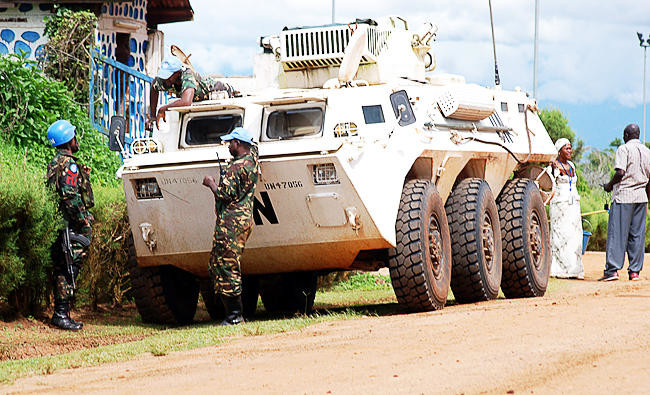
This file photo taken on October 23, 2014 United Nations Organization Stabilization Mission in the Democratic Republic of Congo (MONUSCO) stand near a UN armored vehicle in Beni. (AFP)
Updated 23 December 2017
Follow

Ugandan army says it attacked rebel camps in DR Congo

KAMPALA: Uganda’s army said Friday that it had launched attacks on a shadowy rebel group in the eastern Democratic Republic of Congo (DR Congo), where the militants killed 14 UN peacekeepers earlier this month.
“Shared intelligence between Uganda and the DR Congo confirmed that the Allied Democratic Forces (ADF) terrorists which recently carried out attacks on UN peacekeepers... were planning to conduct hostile activities against Uganda,” the army said in a statement.
“In a pre-emptive move, this afternoon UPDF (Ugandan People’s Defense Force) conducted attacks on their camps in Eastern DRC.”
The ADF, a Ugandan rebel group dominated by Muslim militants operating in the DR Congo, was behind an attack that left 14 Tanzanian peacekeepers dead two weeks ago, according to the UN.
The ADF started out with the aim of overthrowing Uganda’s President Yoweri Museveni, who was seen as hostile to Muslims. But it went on to absorb other rebel factions and started carrying out attacks in 1995.
Gradually pushed westwards by the Ugandan army, the ADF relocated most of its activities to the DR Congo.
It was also blamed for an ambush on UN peacekeepers in eastern DR Congo in October, which killed two peacekeepers and wounded 12.
It has also been accused by Kinshasa and the UN peacekeeping mission MONUSCO of killing more than 700 people in the Beni region since October 2014.
Kinshasa has insisted on a militant motive to the killings, but many observers and experts say that there has been no proven link with the global militancy underground, and that this is a “simplistic” explanation for their acts.
Many ADF recruits — drawn from Tanzania, Burundi, Kenya and as far as Somalia — are young Muslims.
A group run by US researcher Jason Stearns published a report claiming that several distinct groups “appear to be involved in the massacres,” including soldiers from the regular army.
The government rejected the claims and Stearns was expelled from the DR Congo after the report’s release.
Beni’s Mayor Bwanakawa Nyonyi told AFP last year that he believed the massacres were carried out by a nebulous group, with politically motivated “Congolese hands” behind them.
In explaining the violence, some have cited struggles for control of trafficking in various industries like timber, agricultural produce or minerals in a region with extremely rich resource potential.


Supporters of Venezuelan opposition leader María Corina Machado march in cities worldwide

Updated 07 December 2025
Follow

Supporters of Venezuelan opposition leader María Corina Machado march in cities worldwide

  • Machado went into hiding and has not been seen in public since January

CARACAS: Supporters of Venezuelan opposition leader María Corina Machado demonstrated Saturday in several cities worldwide to commemorate her Nobel Peace Prize win ahead of the prestigious award ceremony next week.
Dozens of people marched through Madrid, Utrecht, Buenos Aires, Lima and other cities in support of Machado, whose organization wants to use the attention gained by the award to highlight Venezuela’s democratic aspirations. The organization expected demonstrations in more than 80 cities around the world on Saturday.
The crowd in Lima carried portraits of Machado and demanded a “Free Venezuela.” With the country’s yellow, blue and red flag draped over their backs or emblazoned on their caps, demonstrators clutched posters that read, “The Nobel Prize is from Venezuela.”
Venezuelan Verónica Durán, who has lived in Lima for eight years, said Machado’s Nobel Peace Prize is celebrated because “it represents all Venezuelans, the fallen and the political prisoners in their fight to recover democracy.”
The gatherings come at a critical point in the country’s protracted crisis as the administration of US President Donald Trump builds up a massive military deployment in the Caribbean, threatening repeatedly to strike Venezuelan soil. Venezuela’s President Nicolás Maduro is among those who see the operation as an effort to end his hold on power, and the opposition has only added to this perception by reigniting its promise to soon govern the country.
“We are living through times where our composure, our conviction, and our organization are being tested,” Machado said in a video message shared Tuesday on social media. “Times when our country needs even more dedication because now all these years of struggle, the dignity of the Venezuelan people, have been recognized with the Nobel Peace Prize.”
Machado won the award Oct. 10 for her struggle to achieve a democratic transition in the South American nation, winning recognition as a woman “who keeps the flame of democracy burning amid a growing darkness.”
Machado, 58, won the opposition’s primary election and intended to run against Maduro in last year’s presidential election, but the government barred her from running for office. Retired diplomat Edmundo González, who had never run for office before, took her place.
The lead-up to the July 28, 2024, election saw widespread repression, including disqualifications, arrests and human rights violations. It all increased after the country’s National Electoral Council, which is stacked with Maduro loyalists, declared him the winner despite credible evidence to the contrary.
González sought asylum in Spain last year after a Venezuelan court issued a warrant for his arrest.
Meanwhile, Machado went into hiding and has not been seen in public since Jan. 9, when she was briefly detained after joining supporters in what ended up being an underwhelming protest in Caracas, Venezuela’s capital. The following day, Maduro was sworn in for a third six-year term.