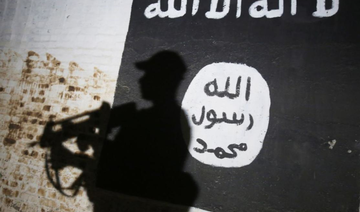
LONDON: British Prime Minister Theresa May on Friday told British forces in Cyprus that they should be “proud” of helping to crush Daesh in the Middle East – but at home the war on terror is far from over.
In London, Paris and Brussels, this year’s Christmas celebrations are tinged with public unease over the threat of more of the kind of attacks that have blighted European capitals throughout 2017.
Speaking at Britain’s RAF Akrotiri, May said the base was the “epicenter” of operations against Daesh.
Akrotiri has been used as a staging post for attacks against Daesh, now largely defeated after attempting to set up a caliphate across swathes of Iraq and Syria.
But while the spread of Daesh may have been thwarted abroad, a spate of attacks across Europe during 2017, means the fight goes on.
In the UK, the threat of terrorism and the fear of terrorism itself, remain very real.
The British government’s threat level is currently set at “severe” after briefly reaching “critical” in May and September this year.
According to a statement from Britain’s MI5 security service: “The UK is a high-priority target for Islamic extremists and they pose a significant threat to our country and to our interests and citizens abroad.”
MI5 also states: “The majority of terrorist attack plots in this country have been planned by British residents. British nationals who have fought for extremist groups overseas continue to return to the UK, increasing the risk of terrorist attacks.
“Using skills acquired overseas, they may organize attacks under direction from outside the UK, or on their own initiative, or they might radicalize others to do so.
“While the majority of returners will not mount attacks in the UK, the large numbers involved mean it is likely that at least some of them will attempt to do so.”
Thousands of Daesh fighters have already returned to their home countries, a recent report by The Soufan Center (TSC) found.
At least 425 Daesh members have so far returned to the UK – the largest contingent in Europe.
Following five major terror attacks in in the UK in 2017, including the deaths of 22 people at pop concert in Manchester in May, the British public has been on high alert for terror incidents.
On Thursday in London, road closures were set up around Hyde Park Corner after an abandoned vehicle was spotted near the grounds of Buckingham Palace. Bomb squad personnel were seen inspecting a car near the tube station which turned out to be a false alarm.
London’s Oxford Street in November witnessed similar scenes of panic that saw residents fleeing a supposed terrorist attack. The incident was quickly resolved, yet the panic that erupted is a reminder of terrorism’s lasting psychological impact.
Britain’s Counter Terrorism Policing Unit (CTPU ) advises that “while still rare, terrorist attacks can happen at anytime and without warning.”
The anti-terrorism body’s official guidelines advise the general public to be vigilant and report any suspicious behavior to the police immediately.

May hails terror victory overseas amid festive season unease at home
Venezuelans await political prisoners’ release after government vow
- Rights groups estimate there are 800 to 1,200 political prisoners held in Venezuela
CARACAS: Venezuelans waited Sunday for more political prisoners to be freed as ousted president Nicolas Maduro defiantly claimed from his US jail cell that he was “doing well” after being seized by US forces a week ago.
The government of interim president Delcy Rodriguez on Thursday began to release prisoners jailed under Maduro in a gesture of openness, after pledging to cooperate with Washington over its demands for Venezuelan oil.
The government said a “large” number would be released — but rights groups and the opposition say only about 20 have walked free since, including several prominent opposition figures.
Rights groups estimate there are 800 to 1,200 political prisoners held in Venezuela.
Rodriguez, vice president under Maduro, said Venezuela would take “the diplomatic route” with Washington, after Trump claimed the United States was “in charge” of the South American country.
“Venezuela has started the process, in a BIG WAY, of releasing their political prisoners. Thank you!” Trump said in a post late Saturday on his Truth Social platform.
“I hope those prisoners will remember how lucky they got that the USA came along and did what had to be done.”
Maduro and his wife Cilia Flores were captured in a dramatic January 3 raid and taken to New York to stand trial on drug-trafficking and weapons charges, to which they pleaded not guilty.
Anxiety over prisoners
A detained police officer accused of “treason” against Venezuela died in state custody after a stroke and heart attack, the state prosecution service confirmed on Sunday.
Opposition groups said the man, Edison Jose Torres Fernandez, 52, had shared messages critical of Maduro’s government.
“We directly hold the regime of Delcy Rodriguez responsible for this death,” Justice First, part of the Venezuelan opposition alliance, said on X.
Families on Saturday night held candlelight vigils outside El Rodeo prison east of Caracas and El Helicoide, a notorious jail run by the intelligence services, holding signs with the names of their imprisoned relatives.
Prisoners include Freddy Superlano, a close ally of opposition figurehead Maria Corina Machado. He was jailed after challenging Maduro’s widely contested re-election in 2024.
“He is alive — that was what I was most afraid about,” Superlano’s wife Aurora Silva told reporters.
“He is standing strong and I am sure he is going to come out soon.”
Maduro meanwhile claimed he was “doing well” in jail in New York, his son Nicolas Maduro Guerra said in a video released Saturday by his party.
The ex-leader’s supporters rallied in Caracas on Saturday but the demonstrations were far smaller than Maduro’s camp had mustered in the past, and top figures from his government were notably absent.
The caretaker president has moved to placate the powerful pro-Maduro base by insisting Venezuela is not “subordinate” to Washington.
Pressure on Cuba
Vowing to secure US access to Venezuela’s vast crude reserves, Trump pressed top oil executives at a White House meeting on Friday to invest in Venezuela, but was met with a cautious reception.
Experts say Venezuela’s oil infrastructure is creaky after years of mismanagement and sanctions.
Washington has also confirmed that US envoys visited Caracas on Friday to discuss reopening their embassy there.
Trump on Sunday pressured Caracas’s leftist ally Cuba, which has survived in recent years under a US embargo thanks to cheap Venezuelan oil imports.
He urged Cuba to “make a deal” or face unspecified consequences, warning that the flow of Venezuelan oil and money to Havana would stop now that Maduro was gone.
Cuba’s President Miguel Diaz-Canel retorted on X that the Caribbean island was “ready to defend the homeland to the last drop of blood.”
“No one tells us what to do.”
Venezuela’s government in a statement called for “political and diplomatic dialogue” between Washington and Havana.
“International relations should be governed by the principals of international law — non-interference, sovereign equality of states and the right of peoples to govern themselves.”