

Rare Qur’an editions in Madinah exhibition

1 / 3
2 / 3
3 / 3
Updated 22 December 2017
Follow

Rare Qur’an editions in Madinah exhibition

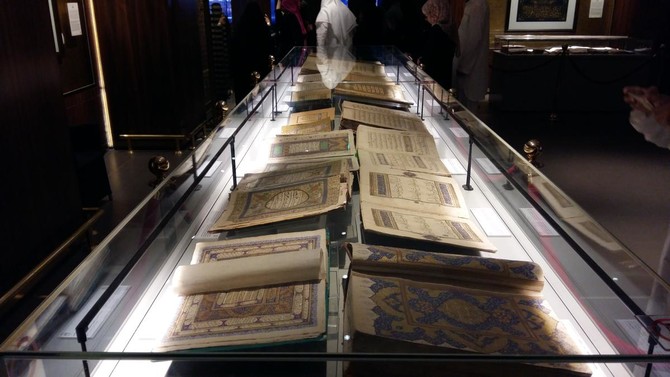
MADINAH: The Qur’an exhibition held in Madinah, in cooperation with Samaya Holding, aims to introduce the content of the Qur’an accurately according to a system of techniques which follows a museum exhibition style.

The exhibition involves the participation of the King Fahd Complex for the Printing of the Holy Qur’an, the General Presidency for the affairs of the Grand Mosque and the Prophet’s Mosque, King Abdul Aziz Foundation for Research and Archives, King Abdul Aziz General Library in Madinah, King Saud University, and King Abdul Aziz University.

The sub-goals include the call for learning and teaching Qur’an; highlighting the greatness of the Qur’an; understanding the history of Qur’an, displaying the special technologies of the Qur’an; and demonstrating the efforts of the Kingdom in caring for the Qur’an.

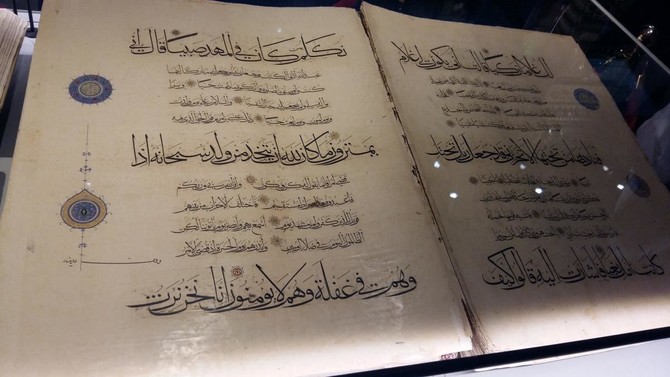
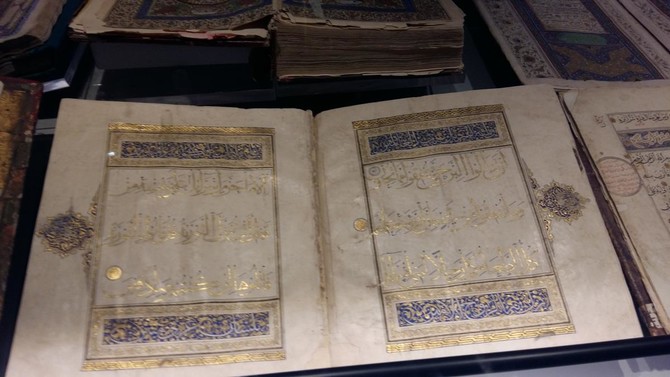
Hamzah Abdul-Karim, the supervisor of the exhibition, told Arab News that the Qur’an exhibition contains many manuscripts and modern technologies which suit the needs of society, including manuscripts written on gazelle’s skin and others written by Hafez Osman, who wrote 106 manuscripts of the Qur’an and passed away while writing the 107th.

Another unique manuscript was written by Ghulam Mohiuddin about 200 years ago, which was carried on four camels from Afghanistan to Madinah due to its heavy weight. The manuscript is one-and-a-half meters long and one meter wide, and weighs 154 kilograms. There is a translation in Persian at the bottom of each page.

Abdul-Karim added that the exhibition is held in 12 halls, and there are interpreters to many languages including English, French, Persian, Turkish, Urdu, Indonesian, Pashtu and Malawian. He also noted that a large number of pilgrims visit the exhibition during Umrah and Hajj seasons, with the number of visitors reaching 10.000 daily during Hajj season. Moreover, people from around 150 nations visited the exhibition.

Visitors to the Qur’an exhibition in Madinah have been amazed at the talents of the Egyptian Qur’an calligrapher Hani Al-Tawil who displays his skills to visitors. Tawil told Arab News that he masters the Naskh and Diwani styles of the Arabic alphabet, as well as six other types of calligraphy.
 

Saudi Arabia, Estonia strengthen cyber defense cooperation

Updated 09 February 2026
Follow

Saudi Arabia, Estonia strengthen cyber defense cooperation

  • Renowned for its leadership in digital governance, Estonia sees cybersecurity as central to its partnership potential with Saudi Arabia, building on years of regional engagement through its technology firms

RIYADH: Estonia aims to deepen defense, cybersecurity, and artificial intelligence cooperation with Saudi Arabia as both nations look to advance technology‑driven defense and cybersecurity capabilities.

Hanno Pevkur, Estonia’s minister of defense, told Arab News at the World Defense Show in Riyadh on Monday that Estonia’s defense industry is eager to contribute to the Kingdom’s fast‑growing defense ecosystem.

“In the modern world, cooperation built on trust and technology is the best defense,” he said. “It is important for us to be here because we clearly see there is a possibility to increase cooperation, not only bilaterally between Saudi Arabia and Estonia, but across the region.”

At Estonia’s pavilion, a cooperation agreement was signed between an Estonian company and a Saudi firm during the show, he noted.

Pevkur also said Estonia’s defense sector has expanded rapidly in recent years, driven by technological innovation and partnership.

“Our defense industry is growing very rapidly, and we continue to see strong momentum,” he said.

He said Estonia’s strengths lie in digital and smart‑system integration rather than large‑scale weapons production.

“We will not build airplanes or tanks, but what we can do is integrate robotics, automation and drones to make existing systems smarter,” he said.

The minister said effective defense collaboration must link businesses and governments to achieve meaningful results.

“When we want to have real cooperation, we need it on all levels,” he said. “The biggest client for any defense company is the government, so we must treat this as one ecosystem where the public and private sectors work hand in hand.”

Renowned for its leadership in digital governance, Estonia sees cybersecurity as central to its partnership potential with Saudi Arabia, building on years of regional engagement through its technology firms.

Pevkur said several Estonian companies, including Nortal, have already assisted Gulf governments in developing open IT and digital‑service systems.

“As the most digitalized nation in the world, almost every service in Estonia can be done online, except getting married,” he said. “But with such digitalization, we also need strong cyberdefense.”

He said data protection and digital resilience are treated as matters of national sovereignty in Tallinn, the capital of Estonia.

“Data is what we own. When someone steals that data, it becomes a serious threat,” he added. “That is why cyberdefense is not just about technology, it is about trust, sovereignty and protection.”

Pevkur said Saudi Arabia’s advances in AI offer promising opportunities for collaboration.

“I know that Saudi Arabia is doing great work when it comes to AI,” he said. “For us, as a small country with limited human resources, AI is essential not just for defense but for everyday life.”

Pevkur added that Estonia has launched a national AI strategy to promote responsible development and closer coordination between government and industry. One Estonian company, he said, has developed a system that allows a single operator to control hundreds of drones through AI.

“It is quite easy to put a weapon into the hands of a robot, but we also need to define who is accountable for its actions,” he said.

“The big question for the future is whether we can allow a war to be fought entirely by AI, or if humans must always make the final ethical decisions.”

He said in his conclusion that governments must reach a common understanding on how AI will be used and regulated on the battlefield.