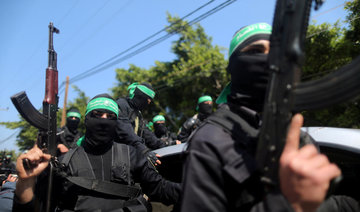
GAZA CITY: A senior leader in Palestinian movement Hamas warned on Thursday of the potential collapse of a reconciliation agreement made with political rivals Fatah.
“The reconciliation is collapsing and everyone must intervene to save it,” Yahya Sinwar, the Gaza head of Hamas, told a meeting of young people.
“We took major steps to achieve reconciliation and we offered a lot of concessions, but the reconciliation is still in the same place.”
Under an Egyptian-brokered deal Hamas was meant to hand over control of Gaza to the internationally recognized Palestinian government, which is dominated by Fatah, by Dec. 10.
But the deadline passed and Hamas still maintains control in the Palestinian enclave.
The Palestinian government, based in the West Bank, has assumed responsibility at checkpoints between Gaza and neighbors — Israel and Egypt — but Hamas is still fully in control of the police and security apparatuses.
Fatah officials accused Hamas of refusing to give up real power, while Hamas said Fatah was not really committed to the process.
A key sticking point was the future of Hamas’s vast armed wing.
Hamas seized control of Gaza in a 2007 near civil war.
The UN has warned failure of the reconciliation would risk another round of conflict.
Hamas, designated a terrorist organization by Israel, the US and others, has fought three wars with the Jewish state since 2008.

Hamas warns of Palestinian reconciliation collapse
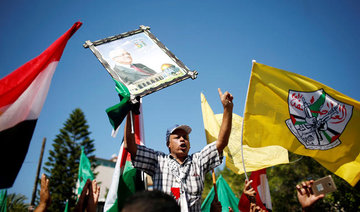
Syria Kurds chief says ‘all efforts’ being made to salvage deal with Damascus
- Abdi said the Syrian Democratic Forces (SDF), the Kurds’ de facto army, remained committed to the deal
- The two sides were working toward “mutual understanding” on military integration and counter-terrorism
DAMASCUS: Syrian Kurdish leader Mazloum Abdi said Thursday that “all efforts” were being made to prevent the collapse of talks on an agreement with Damascus to integrate his forces into the central government.
The remarks came days after Aleppo saw deadly clashes between the two sides before their respective leaders ordered a ceasefire.
In March, Abdi signed a deal with Syrian President Ahmed Al-Sharaa to merge the Kurds’ semi-autonomous administration into the government by year’s end, but differences have held up its implementation.
Abdi said the Syrian Democratic Forces (SDF), the Kurds’ de facto army, remained committed to the deal, adding in a statement that the two sides were working toward “mutual understanding” on military integration and counter-terrorism, and pledging further meetings with Damascus.
Downplaying the year-end deadline, he said the deal “did not specify a time limit for its ending or for the return to military solutions.”
He added that “all efforts are being made to prevent the collapse of this process” and that he considered failure unlikely.
Abdi also repeated the SDF’s demand for decentralization, which has been rejected by Syria’s Islamist authorities, who took power after ousting longtime ruler Bashar Assad last year.
Turkiye, an important ally of Syria’s new leaders, sees the presence of Kurdish forces on its border as a security threat.
In Damascus this week, Turkish Foreign Minister Hakan Fidan stressed the importance of the Kurds’ integration, having warned the week before that patience with the SDF “is running out.”
The SDF control large swathes of the country’s oil-rich north and northeast, and with the support of a US-led international coalition, were integral to the territorial defeat of the Daesh group in Syria in 2019.
Syria last month joined the anti-IS coalition and has announced operations against the jihadist group in recent days.