SEOUL: A North Korean soldier escaped to the South on Thursday across the heavily-guarded Demilitarized Zone that divides the peninsula, triggering gunfire on both sides of the tense border in the second defection in successive months.
The “low-ranking” soldier was spotted by South Korean soldiers using surveillance equipment as he crossed the land border near Yeoncheon in thick fog and made his way to a guard post, a spokesman for Seoul’s defense ministry said.
There were no shots at the time, he said, but about 80 minutes later South Korean troops fired around 20 rounds from a K-3 machine gun to warn off Northern guards who approached the border apparently looking for their comrade.
Two bursts of gunfire were later heard in the North, the spokesman said, but there were no indications of any bullets crossing the border.
The incident came a month after a rare and dramatic defection by a Northern soldier under a hail of bullets from his own side at Panmunjom, the truce village where opposing forces confront each other across a concrete dividing line.
On that occasion the defector drove to the heavily-guarded border at speed and ran across the border as North Korean troops fired at him. He was hit at least four times.
Footage showed the badly injured man being pulled to safety by two South Korean soldiers who crawled to reach him just south of the demarcation line.
He has since been recovering in hospital in the South.
Yeoncheon, where Thursday’s defection happened, is in the midwestern part of the DMZ, in Gyeonggi province.
Away from Panmunjom, the rest of the 4-kilometer-wide DMZ bristles with barbed wire and is littered with minefields, making any crossing extremely hazardous.
The latest defection was the fourth by a soldier across the DMZ this year.
But Kim Dong-Yub, defense analyst at the Institute for Far Eastern Studies at Kyungnam University in Seoul, said the sample size was too small to draw conclusions about a trend.
Two North Korean civilians also defected this week after being found drifting in a rickety engineless boat off the South’s eastern coast, Yonhap news agency reported, citing the Unification Ministry, which handles relations with the North.
They were spotted by a South Korean surveillance aircraft and picked up by a nearby navy vessel, it said.
The developments bring this year’s total for the number of people defecting directly to the South to 15, a Joint Chiefs of Staff tally showed — three times as many as in 2016.
Around 30,000 North Koreans have fled repression and poverty in their homeland to reach the South over the decades since the end of the 1950-53 Korean War.
According to Unification ministry data, 1,418 did so in 2016, but in the first 10 months of this year numbers fell 16.8 percent.
Analyst Kim said: “The North’s chronic food shortages, which in the past were the prime reason for North Koreans to flee from the country, have not been so bad in recent years.”
The vast majority of defectors go first to China, with which the North shares a long border, and where they face the risk of being repatriated to an uncertain fate if caught. They travel on to the South later, usually via another country.
In November’s Panmunjom incident, footage showed a North Korean guard briefly crossing the border in hot pursuit before retreating.
The US-led United Nations Command said the North’s forces had violated the 1953 cease-fire that ended Korean War hostilities both by physically crossing the line and firing weapons over it.
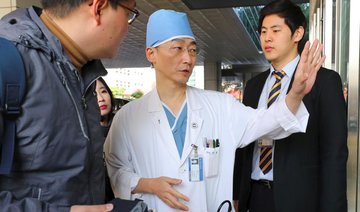
The North Korean soldier, 24-year-old Oh Chong-Song, underwent multiple operations for his gunshot wounds at Ajou University Hospital in Seoul and was transferred to a military hospital last week, Yonhap said.
He has recovered enough to get to his feet and walk with help, it added, and has written a letter of thanks to the medical staff who treated him.
Oh wants to become a lawyer, said his surgeon Lee Cook-Jong, who gave him a law book.
“He said while in the North, he was unable to study much because of his military duty,” Lee was quoted as saying. “I just hope he will become a good citizen, whatever kind of occupation he chooses.”


![]()

Another North Korean soldier defects via demilitarized zone
Another North Korean soldier defects via demilitarized zone

Latest updates


Recommended


© 2026 SAUDI RESEARCH & PUBLISHING COMPANY, All Rights Reserved And subject to Terms of Use Agreement.