JEDDAH: The Saudi-led Arab Coalition in Yemen will keep the Houthi-controlled Hodeidah port open for a month despite a missile attack on Riyadh that was intercepted on Tuesday.
The coalition said on Wednesday it was “keen to maintain humanitarian aid to the brotherly Yemeni people.” Two days after a missile fired at Riyadh was intercepted on Nov. 4, Saudi Arabia and its allies closed air, land and sea access to Yemen to prevent the flow of arms from Iran to the Houthis.
The Iran-backed militia must surrender their weapons before the start of any peace talks, Yemen’s President Abed Rabbo Mansour Hadi said on Tuesday night. Other conditions are the restoration of his government to power and the handover of state institutions.
“We do not have a partner with whom we can reach peace,” Hadi said at a meeting with foreign ambassadors at his residence in Riyadh.
Dialogue had become impossible since the Houthis assassinated Yemen’s former President Ali Abdullah Saleh, who had sought a cease-fire deal with Saudi Arabia, Hadi said. “They have proved that they do not tend toward peace... and any attempt at peace before their weapons are seized is a waste of time.”
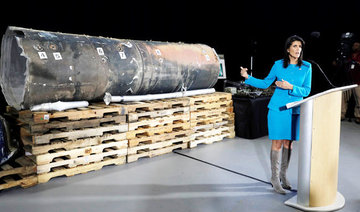
Tuesday’s Houthi attack on Al-Yamamah Palace in Riyadh sparked global outrage. Iran has also been criticized for its support of the militia to foment unrest in Yemen. The US ambassador to the UN, Nikki Haley, urged the Security Council on Tuesday to punish Iran for its “dangerous violations” of UN resolutions and “destabilizing behavior.”
Tuesday’s missile attack “bears all the hallmarks of previous attacks using Iranian-provided weapons,” Haley said.
“This is not the first time the Houthis have fired missiles at civilians in a G-20 country. And unless we act, it won’t be the last. It is only a matter of time before one of these missiles hits the target. If we don’t do something, we will miss the opportunity to prevent further violence from Iran.”
Haley said a new report from the UN Secretary-General Antonio Guterres — the fourth such report on the progress of Iran’s compliance with Resolution 2231 — was “the most damning yet” and urged the council to consider “a few options we can use to put pressure on Iran to adjust their behavior.”
The resolution endorses the 2015 nuclear deal with Iran, but also imposes restrictions on Tehran’s use and export of ballistic missiles. The report was compiled before the latest missile attacks on Saudi Arabia, but Haley said it still contained evidence of Iranian involvement in illegal activities.
“The report describes a dual English-Farsi keyboard that was part of the guidance system of an unmanned surface vehicle used against the Saudi coalition in Yemen. That was just one of several pieces of evidence that points to the Iranian manufacture of the detonation and guidance systems of the weapon,” she said. “There is plenty more.”
She also referred to the recovery of a number of weapons “from attacks and planned attacks on a G-20 country” which were “made by Iranian weapons industries tied to the Iranian Revolutionary Guards Corps (IRGC).”
“We must speak with one voice in dealing with Iranian threats to peace,” Haley said. “While we do so, we must also make it clear that the Iranian people are not the problem. The Iranian people are victims of their own government.”
Haley also recognized that many UN member states had “put a lot of effort into the nuclear agreement with Iran.” However, she said: “That should not allow us to look the other way at the very serious non-nuclear items like sales of arms, ballistic missile testing, and support for terrorism.
“The international community must demonstrate that we are committed to ensuring accountability for the full spectrum of Iran’s malign behavior.”


![]()
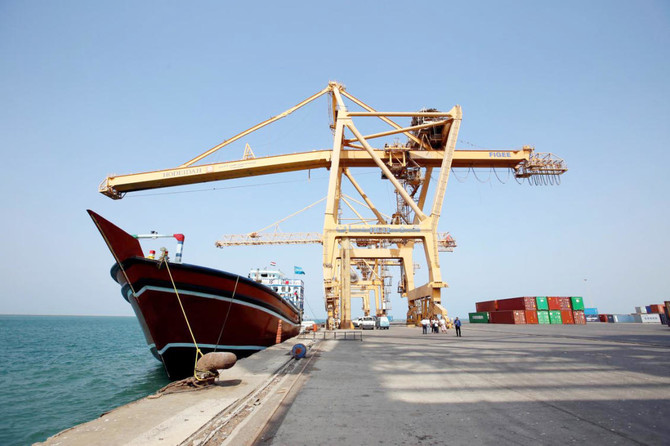
Vital Yemen port to stay open for a month
Vital Yemen port to stay open for a month

Latest updates


© 2026 SAUDI RESEARCH & PUBLISHING COMPANY, All Rights Reserved And subject to Terms of Use Agreement.