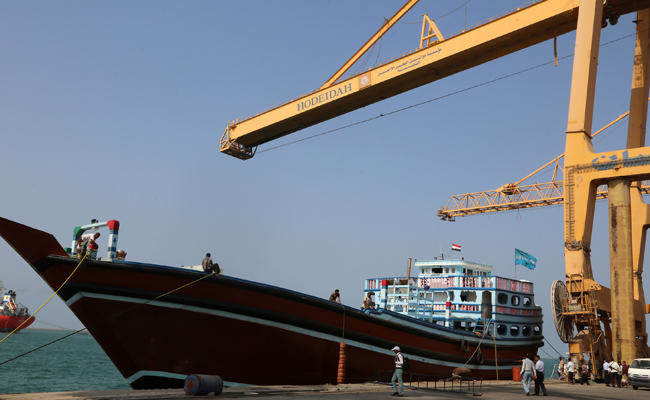
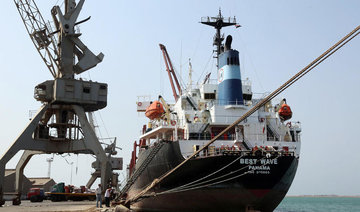
DUBAI: A ship carrying 5,500 tons of flour docked in Yemen’s Hodeidah port in the Red Sea on Sunday, the first after more than two weeks of a blockade by a Saudi-led coalition fighting the Houthi movement, local officials said.
Saudi Arabia and its allies closed air, land and sea access to the Arabian Peninsula country on Nov. 6, to stop what it calls a flow of arms to the Houthis from Iran. The action came after Saudi Arabia intercepted a missile fired toward its capital Riyadh.
Iran has denied supplying the Houthis with weapons.
The delivery is the first aid to arrive through Hodeidah port, controlled by the Houthis, after the coalition allowed a flight carrying humanitarian aid workers to the Yemeni capital of Sanaa on Saturday.
“The ship is 106 meters long and carries 5,500 tons of flour,” one of the Yemeni officials said.
Aid agencies said the blockade had worsened the humanitarian crisis in Yemen where the war has left an estimated 7 million people facing famine and killed more than 10,000 people.
The coalition gave clearance for UN flights in and out of Sanaa from Amman on Saturday, involving the regular rotation of aid workers.
After re-opening Sanaa airport, UNICEF has also sent vaccines there.
The charity Save the Children said an estimated 20,000 Yemeni children under the age of five were joining the ranks of the severely malnourished every month, “an average of 27 children every hour.” (Writing by Aziz El Yaakoubi)

Saudi-led coalition allows first aid ship into Yemen’s Hodeidah port
Israel demolishes residential building in east Jerusalem
- Israeli bulldozers tore through a four-story residential building displacing scores of Palestinians
JERUSALEM: Israeli bulldozers tore through a four-story residential building in east Jerusalem on Monday, displacing scores of Palestinians in what activists said was the largest such demolition in the area this year.
The building, located in the Silwan neighborhood near the Old City, comprised a dozen apartments housing approximately 100 people, many of them women, children and elderly residents.
It was the latest in a series of buildings to be torn down as Israeli officials target what they describe as unauthorized structures in annexed east Jerusalem.
“The demolition is a tragedy for all residents,” Eid Shawar, who lives in the building, told AFP.
“They broke down the door while we were asleep and told us we could only change our clothes and take essential papers and documents,” said the father of five.
With nowhere else to go, Shawar said his seven-member family would have to sleep in his car.
Three bulldozers began ripping into the structure early on Monday as residents looked on, their clothes and belongings scattered across nearby streets, an AFP journalist saw.
Israeli police cordoned off surrounding roads, with security forces deployed across the area and positioned on rooftops of neighboring houses.
Built on privately owned Palestinian land, the building had been slated for demolition for lacking a permit, activists said.
Palestinians face severe obstacles in obtaining building permits due to Israel’s restrictive planning policies, according to activists, an issue that has fueled tensions in east Jerusalem and across the occupied West Bank for years.
- ‘Ongoing policy’ -
The building’s destruction “is part of a systematic policy aimed at forcibly displacing Palestinian residents and emptying the city of its original inhabitants,” the Jerusalem governorate, affiliated with the Ramallah-based Palestinian Authority, said in a statement.
“Any demolition that expels residents from their homes constitutes a clear occupation plan to replace the land’s owners with settlers.”
The Jerusalem municipality, which administers both west and east Jerusalem, has previously said demolitions are carried out to address illegal construction and to enable the development of infrastructure or green spaces.
In a statement, the municipality said the demolition of the building was based on a 2014 court order, and “the land on which the structure stood is zoned for leisure and sports uses and construction, and not for residential purposes.”
Activists, however, accuse Israeli authorities of frequently designating areas in east Jerusalem as national parks or open spaces to advance Israeli settlement interests.
The demolition was “carried out without prior notice, despite the fact that a meeting was scheduled” on Monday to discuss steps to legalize the structure, the Israeli human rights groups Ir Amin and Bimkom said in a statement, calling it the largest demolition of 2025.
“This is part of an ongoing policy. This year alone, around 100 east Jerusalem families have lost their homes,” they added.
The status of Jerusalem remains one of the most contentious issues in the Israeli-Palestinian conflict.
Israel occupied east Jerusalem, including the Old City, in the 1967 Arab-Israeli war, and swiftly annexed the area.
Silwan begins at the foot of the Old City, where hundreds of Israeli settlers live among nearly 50,000 Palestinians.
The building, located in the Silwan neighborhood near the Old City, comprised a dozen apartments housing approximately 100 people, many of them women, children and elderly residents.
It was the latest in a series of buildings to be torn down as Israeli officials target what they describe as unauthorized structures in annexed east Jerusalem.
“The demolition is a tragedy for all residents,” Eid Shawar, who lives in the building, told AFP.
“They broke down the door while we were asleep and told us we could only change our clothes and take essential papers and documents,” said the father of five.
With nowhere else to go, Shawar said his seven-member family would have to sleep in his car.
Three bulldozers began ripping into the structure early on Monday as residents looked on, their clothes and belongings scattered across nearby streets, an AFP journalist saw.
Israeli police cordoned off surrounding roads, with security forces deployed across the area and positioned on rooftops of neighboring houses.
Built on privately owned Palestinian land, the building had been slated for demolition for lacking a permit, activists said.
Palestinians face severe obstacles in obtaining building permits due to Israel’s restrictive planning policies, according to activists, an issue that has fueled tensions in east Jerusalem and across the occupied West Bank for years.
- ‘Ongoing policy’ -
The building’s destruction “is part of a systematic policy aimed at forcibly displacing Palestinian residents and emptying the city of its original inhabitants,” the Jerusalem governorate, affiliated with the Ramallah-based Palestinian Authority, said in a statement.
“Any demolition that expels residents from their homes constitutes a clear occupation plan to replace the land’s owners with settlers.”
The Jerusalem municipality, which administers both west and east Jerusalem, has previously said demolitions are carried out to address illegal construction and to enable the development of infrastructure or green spaces.
In a statement, the municipality said the demolition of the building was based on a 2014 court order, and “the land on which the structure stood is zoned for leisure and sports uses and construction, and not for residential purposes.”
Activists, however, accuse Israeli authorities of frequently designating areas in east Jerusalem as national parks or open spaces to advance Israeli settlement interests.
The demolition was “carried out without prior notice, despite the fact that a meeting was scheduled” on Monday to discuss steps to legalize the structure, the Israeli human rights groups Ir Amin and Bimkom said in a statement, calling it the largest demolition of 2025.
“This is part of an ongoing policy. This year alone, around 100 east Jerusalem families have lost their homes,” they added.
The status of Jerusalem remains one of the most contentious issues in the Israeli-Palestinian conflict.
Israel occupied east Jerusalem, including the Old City, in the 1967 Arab-Israeli war, and swiftly annexed the area.
Silwan begins at the foot of the Old City, where hundreds of Israeli settlers live among nearly 50,000 Palestinians.
© 2025 SAUDI RESEARCH & PUBLISHING COMPANY, All Rights Reserved And subject to Terms of Use Agreement.