Troops lock down Iraqi Kurdistan’s second city after riots

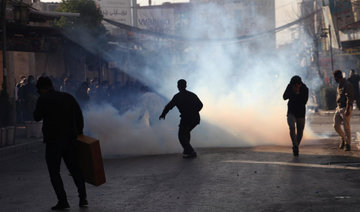
Above, Iraqi Kurdish security forces stand guard during a protest in Sulaimaniyah on December 19. Protesters have vented their anger against all five of the autonomous Kurdish region’s main political parties, who organized the September referendum. (AFP)
Updated 20 December 2017
Follow

Troops lock down Iraqi Kurdistan’s second city after riots

SULAIMANIYAH, Iraq: Heavily armed troops and anti-riot police locked down Iraqi Kurdistan’s second city Sulaimaniyah on Wednesday after two days of protests killed five people and wounded nearly 200 across the region.
Armored personnel carriers, water cannon and trucks mounted with machine guns were stationed at all of the city’s main crossroads, an AFP correspondent reported.
There was virtually no traffic and most shops were closed, particularly around the central Saray Square, the epicenter of the protests against the disastrous fallout from an independence referendum.
The September vote delivered a resounding “yes” for independence, but drew sweeping reprisals from Baghdad which dealt a heavy blow to Kurdistan’s already flagging economy.
Protesters have vented their anger against all five of the autonomous Kurdish region’s main political parties, not just the Kurdistan Democratic Party (KDP) of former regional president Masoud Barzani, who organized the fateful referendum.
In the town of Rania, 130 kilometers (80 miles) north of Sulaimaniyah, where the five protesters were killed on Tuesday, demonstrators defied a heavy security presence to take to the streets for a third straight day.
The crowd turned its anger on the offices of the Goran party, which control the governor’s office in Sulaimaniyah province, pelting it with stones, witnesses said.
Demonstrators had already torched the offices of the KDP, its historical rival the Patriotic Union of Kurdistan and the Islamic Union on Tuesday. They also seized the mayor’s office.
Prime minister Nechirvan Barzani, the ex-president’s nephew, issued an appeal for calm from Germany where he was on a visit on Tuesday.
“The region is going through a difficult period. Your frustrations are understandable and I hear them,” he said.
“But violence is unacceptable. I ask you to hold peaceful demonstrations.”


The UN says Al-Hol camp population has dropped sharply as Syria moves to relocate remaining families

Updated 15 February 2026
Follow

The UN says Al-Hol camp population has dropped sharply as Syria moves to relocate remaining families

  • Forces of Syria’s central government captured the Al-Hol camp on Jan. 21 during a weekslong offensive against the SDF, which had been running the camp near the border with Iraq for a decade

DAMASCUS: The UN refugee agency said Sunday that a large number of residents of a camp housing family members of suspected Daesh group militants have left and the Syrian government plans to relocate those who remain.
Gonzalo Vargas Llosa, UNHCR’s representative in Syria, said in a statement that the agency “has observed a significant decrease in the number of residents in Al-Hol camp in recent weeks.”
“Syrian authorities have informed UNHCR of their plan to relocate the remaining families to Akhtarin camp in Aleppo Governorate (province) and have requested UNHCR’s support to assist the population in the new camp, which we stand ready to provide,” he said.
He added that UNHCR “will continue to support the return and reintegration of Syrians who have departed Al-Hol, as well as those who remain.”
The statement did not say how residents had left the camp or how many remain. Many families are believed to have escaped either during the chaos when government forces captured the camp from the Kurdish-led Syrian Democratic Forces last month or afterward.
There was no immediate statement from the Syrian government and a government spokesperson did not respond to a request for comment.
At its peak after the defeat of IS in Syria in 2019, around 73,000 people were living at Al-Hol. Since then, the number has declined with some countries repatriating their citizens. The camp’s residents are mostly children and women, including many wives or widows of IS members.
The camp’s residents are not technically prisoners and most have not been accused of crimes, but they have been held in de facto detention at the heavily guarded facility.
Forces of Syria’s central government captured the Al-Hol camp on Jan. 21 during a weekslong offensive against the SDF, which had been running the camp near the border with Iraq for a decade. A ceasefire deal has since ended the fighting.
Separately, thousands of accused IS militants who were held in detention centers in northeastern Syria have been transferred to Iraq to stand trial under an agreement with the US
The US military said Friday that it had completed the transfer of more than 5,700 adult male IS suspects from detention facilities in Syria to Iraqi custody.
Iraq’s National Center for International Judicial Cooperation said a total of 5,704 suspects from 61 countries who were affiliated with IS — most of them Syrian and Iraqi — were transferred from prisons in Syria. They are now being interrogated in Iraq.