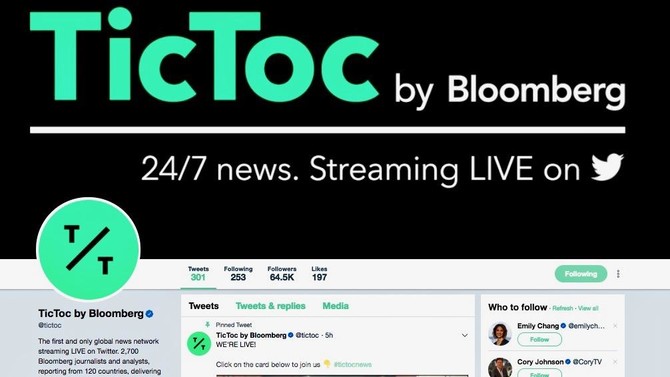
LONDON: Twitter and Bloomberg have joined forces to launch TicToc, claimed to be the “first-ever” global social media news service.
The TicToc platform sees Bloomberg journalists curating news on a Twitter-based platform featuring a live screen of breaking news to its left side and a stream of tweets down the right side for news posts, analysis and input from Twitter users.
Bloomberg Media and Twitter said in a joint statement: “The news experience is designed to be interactive, rich with Twitter content and consumable on any device. Coverage will focus on general interest news worldwide.”
The plan for TicToc is to target “the next generation of on-the-go, mobile-first news consumers” with Bloomberg using its network of 2,700 journalists across 120 countries, combining them with the immediacy of Twitter and its evolving place as a go-to platform for breaking news.
Launched on Monday, TicToc was immediately into action reporting on a train derailment near Seattle in the US
Other stories covered were Theresa May addressing parliament on Brexit in the UK, as well as Cyril Ramaphosa winning the leadership battle for the ANC in South Africa.
The service is expected to evolve rapidly, but business and finance — Bloomberg’s traditional output — will feature heavily on TicToc, even though it has launched with a “general interest” mandate.
Bloomberg told Arab News that it “excels” at coverage of finance and business, so there will always be a strong business component to its coverage, as well as TicToc featuring important global news.
The team behind TocToc is growing, with Bloomberg telling Arab News it expects to expand it to 50 people, comprised of editors, producers, social media analysts, product developers, engineers, designers and marketers.
Twitter was not immediately available for comment.


Twitter and Bloomberg launch breaking news service
Twitter and Bloomberg launch breaking news service


Israel extends foreign media ban law until end of 2027
- Order replaces temporary emergency legislation that allowed authorization of so-called ‘Al Jazeera bill’
- Extension of temporary order empowers Communications Ministry to restrict foreign channels deemed to cause ‘real harm to state security’
LONDON: Israel’s Knesset approved late Monday an extension of the temporary order empowering the Communications Ministry to shut down foreign media outlets, pushing the measure through until Dec. 31, 2027.
The bill, proposed by Likud lawmaker Ariel Kallner, passed its second and third readings by a 22-10 vote, replacing wartime emergency legislation known as the “Al Jazeera Law.”
Under the extended order, the communications minister — with prime ministerial approval and security cabinet or government ratification — can restrict foreign channels deemed to cause “real harm to state security,” even outside states of emergency.
Measures include suspending broadcasts, closing offices, seizing equipment, blocking websites, and directing the defense minister to block satellite signals, including in the West Bank, without disrupting other channels.
Administrative orders last 90 days, with possible extensions. Unlike the temporary measure, the new law does not require court approval to shut down a media outlet.
The move has drawn sharp criticism from human rights and media groups, who warn it entrenches restrictions on Arab and foreign outlets amid a broader erosion of press freedoms.
“Israel is openly waging a battle against media outlets, both local and foreign, that criticize the government’s narrative; that is typical behavior of authoritarian regimes,” International Federation of Journalists General Secretary Anthony Bellanger said in November after the bill’s first reading.
“We are deeply concerned about the Israeli parliament passing this controversial bill, as it would be a serious blow to free speech and media freedom, and a direct attack on the public’s right to know.”
In a parallel development, the Israeli Cabinet unanimously approved on Monday the shutdown of Army Radio (Galei Tzahal) after 75 years, with operations ceasing on March 1, 2026.
In a statement, Attorney General Gali Baharav-Miara warned the decision “undermines public broadcasting in Israel and restricts freedom of expression,” lacking a legal basis.


