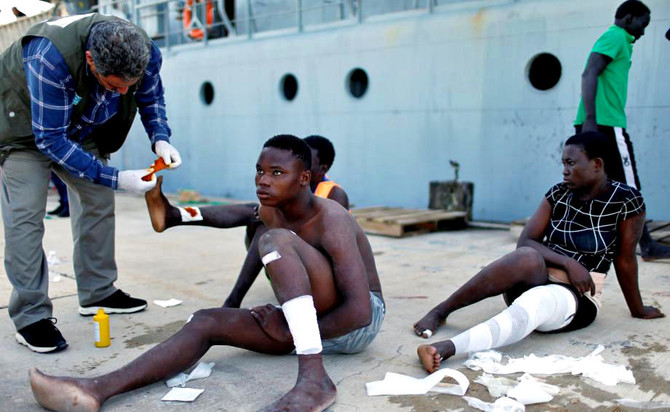
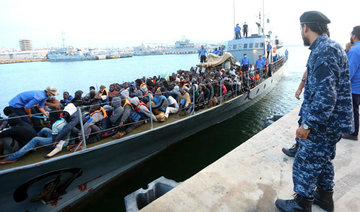
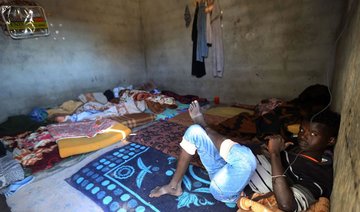
TRIPOLI: Around 36,000 child migrants, including 14,000 who are unaccompanied, need help in Libya, a major transit hub for migrants trying to reach Europe, UN agencies said Monday.
Out of about 400,000 migrants in Libya, nine percent are children, the UN children’s agency UNICEF and the International Organization for Migration said in a joint statement.
UNICEF and the IOM described the number of unaccompanied children among those needing assistance as shocking.
So far this year, nearly 15,000 unaccompanied children have reached Italy after crossing the Mediterranean, they said.
But 400 died trying to make the treacherous journey, and many more were abused, exploited and detained.
In response, the two agencies said they had joined forces and agreed an “action plan” focusing on child protection, education, water, sanitation and health.
“This collaboration will ensure that child rights are put at the heart of all assistance in Libya,” a statement said.
In 2018, the IOM aims to repatriate 30,000 migrants as part of a voluntary return program, including many children, and around 15,000 have been sent back this year.
“We will be able to collectively work to ensure that all children, no matter their status, are able to gain an education, be protected and receive the basic services they deserve,” said Abdel-Rahman Ghandour, UNICEF special representative in Libya.
Last month, US television network CNN broadcast video footage appearing to show migrants being sold as slaves near the Libyan capital Tripoli.

UN: 36,000 child migrants need aid in Libya
Hundreds mourn in Syria’s Homs after deadly mosque bombing
- Officials have said the preliminary investigations indicate explosive devices were planted inside the mosque but have not yet publicly identified a suspect
HOMS: Hundreds of mourners gathered Saturday despite rain and cold outside of a mosque in the Syrian city of Homs where a bombing the day before killed eight people and wounded 18.
The crowd gathered next to the Imam Ali ibn Abi Talib Mosque in the Wadi Al-Dhahab neighborhood, where the population is predominantly from the Alawite minority, before driving in convoys to bury the victims.
Officials have said the preliminary investigations indicate explosive devices were planted inside the mosque but have not yet publicly identified a suspect.
A little-known group calling itself Saraya Ansar Al-Sunna claimed responsibility for the attack in a statement posted on its Telegram channel, in which it indicated that the attack intended to target members of the Alawite sect, an offshoot of Shia Islam whom hard-line Islamists consider to be apostates.
The same group had previously claimed a suicide attack in June in which a gunman opened fire and then detonated an explosive vest inside a Greek Orthodox church in Dweil’a, on the outskirts of Damascus, killing 25 people as worshippers prayed on a Sunday.
A neighbor of the mosque, who asked to be identified only by the honorific Abu Ahmad (“father of Ahmad“) out of security concerns, said he was at home when he heard the sound of a “very very strong explosion.”
He and other neighbors went to the mosque and saw terrified people running out of it, he said. They entered and began trying to help the wounded, amid blood and scattered body parts on the floor.
While the neighborhood is primarily Alawite, he said the mosque had always been open to members of all sects to pray.
“It’s the house of God,” he said. “The mosque’s door is open to everyone. No one ever asked questions. Whoever wants to enter can enter.”
Mourners were unable to enter the mosque to pray Saturday because the crime scene remained cordoned off, so they prayed outside.
Some then marched through the streets chanting “Ya Ali,” in reference to the Prophet Muhammad’s cousin and son-in-law whom Shiite Muslims consider to be his rightful successor.