BRUSSELS: Around 15,000 African migrants will be repatriated from Libya in the next two months under an emergency plan to stop abuses there, EU foreign policy chief Federica Mogherini said Thursday.
European and African leaders announced the plan for accelerated “voluntary” deportations at a summit in Abidjan two weeks ago, but did not set a timetable for repatriating those left in Libyan government detention centers.
Mogherini, ahead of an EU summit, said the repatriations should be done by February.
“In only two months we hope and we expect to manage to assist the voluntary return of 15,000 people,” she told reporters in Brussels.
The EU and the African Union (AU) are working with the UN International Organization for Migration, and the Libyan authorities to arrange for the returns to their home countries in sub-Saharan Africa.
In the last year, 16,000 people have returned home, but EU and AU leaders agreed in Abidjan to accelerate returns following CNN television footage of a slave market in Libya, where smugglers and criminal networks act with impunity.
It provoked an international furor on top of reports of rape, torture and beatings of migrants in Libya, including in detention camps under the control of the UN-backed government of Libyan Prime Minister Fayez Al-Sarraj.
The EU faced accusations from rights groups that it created conditions for such abuses via its cooperation with Sarraj to detain migrants using Libya as a jumping board to Italy, the main entry point to Europe.
EU, UN and AU officials all admit it wil be a major challenge to repatriate or protect the 700,000 migrants in Libya, most of whom are in areas outside government control.
Amira El Fadil, the AU’s commissioner for social affairs, told the press conference the key was finding a political solution to the chaos and violence in Libya.
Mogherini, a former Italian foreign minister, said 2,000 migrants have been returned to their homes since the Abidjan summit.
The EU’s top diplomat also announced another €100 million for the multi-billion euro Africa trust fund, with the money to finance flights from Libya and to help the migrants resettle.
Mogherini said she would also ask EU member states at a summit dinner to contribute more to the trust fund.
Four eastern EU countries which have triggered criticism for refusing to admit refugees — Hungary, Poland, the Czech Republic and Poland — announced €35 million for the trust fund to bolster the EU’s external borders and Libya’s frontiers.

15,000 migrants to exit Libya in two months, EU says
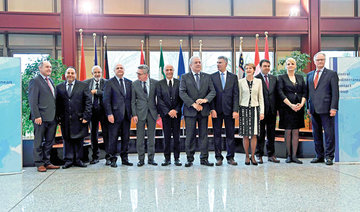
First responders enter devastated Aleppo neighborhood after days of deadly fighting
- The US-backed SDF, which have played a key role in combating the Daesh group in large swaths of eastern Syria, are the largest force yet to be absorbed into Syria’s national army
ALEPPO, Syria: First responders on Sunday entered a contested neighborhood in Syria’ s northern city of Aleppo after days of deadly clashes between government forces and Kurdish-led forces. Syrian state media said the military was deployed in large numbers.
The clashes broke out Tuesday in the predominantly Kurdish neighborhoods of Sheikh Maqsoud, Achrafieh and Bani Zaid after the government and the Syrian Democratic Forces, the main Kurdish-led force in the country, failed to make progress on how to merge the SDF into the national army. Security forces captured Achrafieh and Bani Zaid.
The fighting between the two sides was the most intense since the fall of then-President Bashar Assad to insurgents in December 2024. At least 23 people were killed in five days of clashes and more than 140,000 were displaced amid shelling and drone strikes.
The US-backed SDF, which have played a key role in combating the Daesh group in large swaths of eastern Syria, are the largest force yet to be absorbed into Syria’s national army. Some of the factions that make up the army, however, were previously Turkish-backed insurgent groups that have a long history of clashing with Kurdish forces.
The Kurdish fighters have now evacuated from the Sheikh Maqsoud neighborhood to northeastern Syria, which is under the control of the SDF. However, they said in a statement they will continue to fight now that the wounded and civilians have been evacuated, in what they called a “partial ceasefire.”
The neighborhood appeared calm Sunday. The United Nations said it was trying to dispatch more convoys to the neighborhoods with food, fuel, blankets and other urgent supplies.
Government security forces brought journalists to tour the devastated area, showing them the damaged Khalid Al-Fajer Hospital and a military position belonging to the SDF’s security forces that government forces had targeted.
The SDF statement accused the government of targeting the hospital “dozens of times” before patients were evacuated. Damascus accused the Kurdish-led group of using the hospital and other civilian facilities as military positions.
On one street, Syrian Red Crescent first responders spoke to a resident surrounded by charred cars and badly damaged residential buildings.
Some residents told The Associated Press that SDF forces did not allow their cars through checkpoints to leave.
“We lived a night of horror. I still cannot believe that I am right here standing on my own two feet,” said Ahmad Shaikho. “So far the situation has been calm. There hasn’t been any gunfire.”
Syrian Civil Defense first responders have been disarming improvised mines that they say were left by the Kurdish forces as booby traps.
Residents who fled are not being allowed back into the neighborhood until all the mines are cleared. Some were reminded of the displacement during Syria’s long civil war.
“I want to go back to my home, I beg you,” said Hoda Alnasiri.