Afghanistan’s Balkh governor steps down amid heightened tension

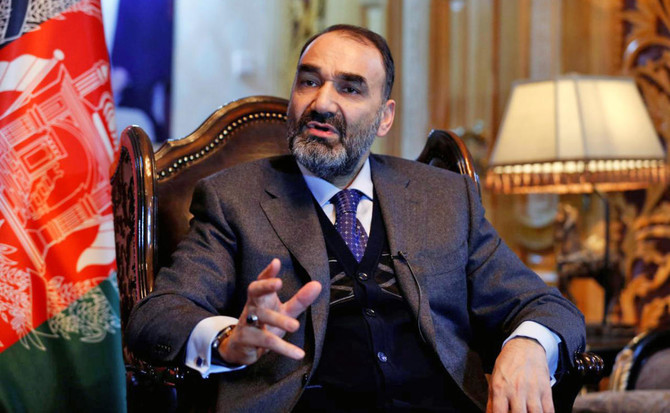
In this file photo, governor of the Balkh province, Atta Mohammad Noor, speaks during an interview in Kabul, Afghanistan, Jan.25, 2017. (REUTERS)
Updated 18 December 2017
Follow

Afghanistan’s Balkh governor steps down amid heightened tension

KABUL: The powerful governor of Afghanistan’s northern Balkh province, Atta Mohammed Noor, has stepped down following months of tension with President Ashraf Ghani — and days after being warned by his party supporters of his dismissal.
The presidential palace stated on Monday that Ghani had accepted “Atta’s resignation, which he had offered some time back.”
Noor, an ethnic Tajik and a leader of Jamiat-e-Islami (JI), was appointed in office by former President Hamid Karzai in 2004, but he has reportedly been under pressure for some time to resign.
A source close to Noor told Arab News that the long-serving governor of Balkh had agreed early this year to step down if Ghani accepted some of his conditions, including an increased role for his party in key national and international issues, which also involved appointments and dismissal of ministers.
He said Ghani did not accept Noor’s conditions and made a “hasty” move that could likely compel the JI to call for a boycott of Ghani’s government, as the JI leaders vowed days back during a meeting with Noor.
Salahuddin Rabbani, the country’s foreign minister, who is also a JI leader, will also step down along with other members of the party who serve in various government capacities, “putting legitimacy of the government in question,” the source said.
The fate of JI’s senior leader, Dr. Abdullah Abdullah, who serves as the chief executive in Ghani’s administration, is also in limbo, he added.
Noor managed to generate revenues for his province by building relations with Uzbekistan, which gave him a good reputation among the population of Balkh and turned his constituency into a model city in Afghanistan, both in terms of reconstruction and security, while much of the rest of the country suffers from violence and crime.
The JI has for long held clout in Afghanistan’s economy and politics. Former President Hamid Karzai also tried to replace Noor once but failed because of the party’s stature. Dr. Abdullah Abdullah was the JI’s presidential candidate during the 2014 elections and became the chief executive under a US-brokered deal with Ghani.
Many in Afghanistan’s political circles allege that Ghani tried to reduce the JI’s influence in recent months, mostly by replacing its prominent figures.
Earlier in summer this year, Ghani stopped First Vice President Gen. Abdul Rashid Dostum from returning to Afghanistan. Dostum is another factional leader from Balkh to announce the formation of an opposition alliance with Noor and another senior member of Ghani’s government.
Weeks ago, Noor accused Ghani’s government of barring his plane from traveling to Kandahar, where a group of opposition parties and parliamentarians had gathered to discuss the shortcomings in Ghani's administration and express concern over alleged government meddling in the 2018 parliamentary elections and the 2019 presidential polls, in which Ghani is highly expected to run for the office again.
Dostum, Noor and many of those who had gathered in Kandahar accuse Ghani of monopolizing power and nepotism — an allegation denied by Ghani, who seems to be under pressure from the US and Western donors to bring reforms in his government.
Ghani chose to replace Noor with Mohammed Dawood, who has served as commander of the JI in the past.
Noor’s departure adds further to the already deepening political tension in the government over Taliban insurgents and Daesh affiliates making headway in the battle arena and with the growing calls for convocation of a grand traditional assembly “Loya Jirga,” which may decide on the formation of an interim government and the fate of the US forces in Afghanistan.


Carney says Canada has no plans to pursue free trade agreement with China as Trump threatens tariffs

Updated 26 January 2026
Follow

Carney says Canada has no plans to pursue free trade agreement with China as Trump threatens tariffs

TORONTO: Canadian Prime Minister Mark Carney said Sunday his country has no intention of pursuing a free trade deal with China. He was responding to US President Donald Trump’s threat to impose a 100 percent tariff on goods imported from Canada if America’s northern neighbor went ahead with a trade deal with Beijing.
Carney said his recent agreement with China merely cuts tariffs on a few sectors that were recently hit with tariffs.
Trump claims otherwise, posting that “China is successfully and completely taking over the once Great Country of Canada. So sad to see it happen. I only hope they leave Ice Hockey alone! President DJT”
The prime minister said under the free trade agreement with the US and Mexico there are commitments not to pursue free trade agreements with nonmarket economies without prior notification.
“We have no intention of doing that with China or any other nonmarket economy,” Carney said. “What we have done with China is to rectify some issues that developed in the last couple of years.”
In 2024, Canada mirrored the United States by putting a 100 percent tariff on electric vehicles from Beijing and a 25 percent tariff on steel and aluminum. China had responded by imposing 100 percent import taxes on Canadian canola oil and meal and 25 percent on pork and seafood.
Breaking with the United States this month during a visit to China, Carney cut its 100 percent tariff on Chinese electric cars in return for lower tariffs on those Canadian products.
Carney has said there would be an initial annual cap of 49,000 vehicles on Chinese EV exports coming into Canada at a tariff rate of 6.1 percent, growing to about 70,000 over five years. He noted there was no cap before 2024. He also has said the initial cap on Chinese EV imports was about 3 percent of the 1.8 million vehicles sold in Canada annually and that, in exchange, China is expected to begin investing in the Canadian auto industry within three years.
Trump posted a video Sunday in which the chief executive of the Canadian Vehicle Manufacturers’ Association warns there will be no Canadian auto industry without US access, while noting the Canadian market alone is too small to justify large scale manufacturing from China.
“A MUST WATCH. Canada is systematically destroying itself. The China deal is a disaster for them. Will go down as one of the worst deals, of any kind, in history. All their businesses are moving to the USA. I want to see Canada SURVIVE AND THRIVE! President DJT,” Trump posted on social media.
Trump’s post on Saturday said that if Carney “thinks he is going to make Canada a ‘Drop Off Port’ for China to send goods and products into the United States, he is sorely mistaken.”
“We can’t let Canada become an opening that the Chinese pour their cheap goods into the U.S,” US Treasury Secretary Scott Bessent said on ABC’s “This Week.”
“We have a , but based off — based on that, which is going to be renegotiated this summer, and I’m not sure what Prime Minister Carney is doing here, other than trying to virtue-signal to his globalist friends at Davos.”
Trump’s threat came amid an escalating war of words with Carney as the Republican president’s push to acquire Greenland strained the NATO alliance.
Carney has emerged as a leader of a movement for countries to find ways to link up and counter the US under Trump. Speaking in Davos before Trump, Carney said, “Middle powers must act together because if you are not at the table, you are on the menu” and he warned about coercion by great powers — without mentioning Trump’s name. The prime minister received widespread praise and attention for his remarks, upstaging Trump at the World Economic Forum.
Trump’s push to acquire Greenland has come after he has repeatedly needled Canada over its sovereignty and suggested it also be absorbed into the United States as a 51st state. He posted an altered image on social media this week showing a map of the United States that included Canada, Venezuela, Greenland and Cuba as part of its territory.