JEDDAH: The UN-backed political agreement on Libya signed two years ago is still active and Libyans should work together to implement it, a leading Libyan politician told Arab News on Sunday.
“The agreement is not bound to a timeframe,” said Fadil Al Amin, Chairman of the Libyan National Council for Economic and Social Development.
“Its mandate is to work with all political actors in Libya to reach a settlement that can pave the way for a political process, based on which the country can … end the violence that has been rampaging for years, and end the people’s suffering.”
All Libyans should be up to their national responsibilities and redouble efforts to work together in a spirit of compromise, and to engage urgently and constructively in the inclusive political process, Al-Amin said.
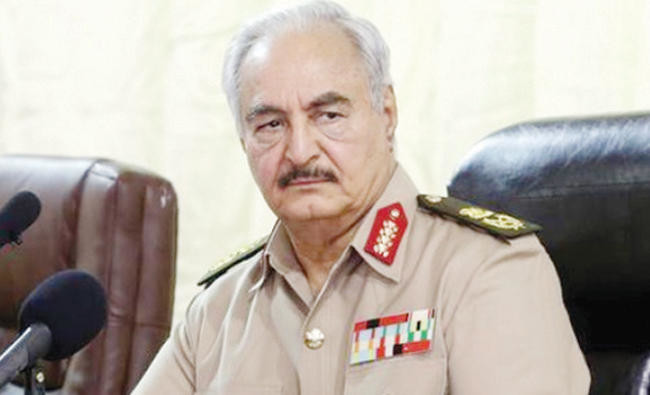
He was responding to remarks on Sunday by Khalifa Haftar, Libya’s powerful military strongman, who said the political deal had expired and the mandate of the UN-backed Government of National Accord had therefore run out.
In a televised speech Haftar, who has never recognized the Government of National Accord’s (GNA) authority, said the “expiry of the Libyan political accord” marked a “historic and dangerous turning point.”
“All bodies resulting from this agreement automatically lose their legitimacy, which has been contested from the first day they took office,” he said.
The agreement was signed in Skhirat, Morocco, in December 2015. The UN Security Council said last week that it remained “the only viable framework for ending the political crisis in Libya.”
“The implementation of the agreement remains the key to organizing elections and ending the political transition, while refusing to set deadlines that would impede the political process sponsored by the United Nations,” the council said. “There is no military solution to the crisis.”
“The Security Council reiterates that two years since the signing of the Libyan Political Agreement (LPA) on 17 December 2015 in Skhirat, the LPA remains the only viable framework to end the Libyan political crisis and that its implementation remains key to holding elections and finalizing the political transition. The council emphasizes the continuity of the LPA throughout Libya’s transitional period and rejects incorrect deadlines that only serve to undermine the United Nations‑facilitated political process.”
The council reaffirmed its endorsement of the UN’s Action Plan for an inclusive Libyan‑owned political process under the leadership of the UN as presented by the Special Representative of the Secretary‑General, Ghassan Salamé, in New York in September, in order to deliver the establishment of stable, unified, representative and effective governance under the framework of the LPA.
Libyans were “fed up with violence” and hoped for “a political solution, for reconciliation and for harmony,” Salame said on Sunday.
“I urge all parties to heed their voices and refrain from any actions that could undermine the political process,” he said.


![]()
2015 political deal on Libya ‘still in force’
2015 political deal on Libya ‘still in force’
Latest updates


© 2026 SAUDI RESEARCH & PUBLISHING COMPANY, All Rights Reserved And subject to Terms of Use Agreement.