BENGHAZI: Eastern Libyan military commander Khalifa Haftar, whose forces control parts of the country, said on Sunday he would listen to the “will of free Libyan people,” in the strongest indication so far that he might run in elections expected next year.
Haftar styles himself as a strongman capable of ending the chaos that has gripped Libya since the overthrow of Muammar Qaddafi in 2011.
His comments, made at a military graduation ceremony, recall those of Egypt’s Gen. Abdel Fattah El-Sisi when he was testing the ground before becoming presidential candidate. El-Sisi was eventually elected in 2014.
Just as El-Sisi built up wide support after toppling Egypt’s President Mohamed Mursi in 2013, supporters of Haftar speak of a similar situation developing in Libya, with rallies held in some eastern cities calling on him to run.
“We declare clearly and unequivocally our full compliance with the orders of the free Libyan people, which is its own guardian and the master of its land,” Haftar said in a speech.
He spoke in the eastern city of Benghazi, from where his forces managed to expel militants during a three-year battle.
Haftar, a general from the Qaddafi era, also dismissed a series of UN-led talks to bridge differences between Libya’s two rival administrations, one linked to him in the east and one backed by the UN in the capital Tripoli.
“All the dialogues starting from Ghadames and ending in Tunis and going through Geneva and Skhirat (in Morocco) were just ink on paper,” he said, listing host cities of UN talks.
The UN launched a new round of talks in September in Tunis between the rival factions to prepare for presidential and parliamentary elections in 2018, but they broke off after one month without any deal.
A major obstacle to progress was the issue of Haftar’s own rule. He remains popular among some Libyans in the east weary of the chaos but faces opposition from many in western Libya.
In his speech, Haftar said his forces, known as the Libyan National Army (LNA), could be only placed under an authority that had been elected by the Libyan people, in a further indication that he might take part in the election.
The large North African country has been in turmoil since Qaddafi’s downfall gave space to militants and smuggling networks that have sent hundreds of thousands of migrants across the Mediterranean to Europe.
Haftar is just one of many players in Libya, which is controlled by armed groups divided along political, religious, regional and business lines.


![]()
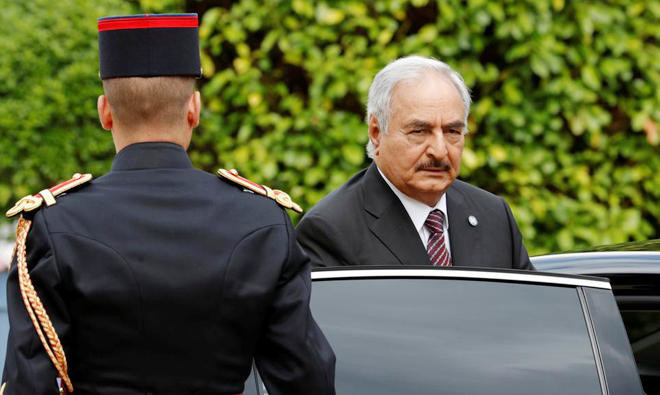
Haftar likely to run in Libyan polls expected next year
Haftar likely to run in Libyan polls expected next year
Latest updates


© 2026 SAUDI RESEARCH & PUBLISHING COMPANY, All Rights Reserved And subject to Terms of Use Agreement.