BEIRUT: The Syrian regime and loyal armed militias are continuing to prevent thousands of displaced Palestinians from returning to their homes in Yarmouk refugee camp, south of Damascus, five years after their displacement.
According to the Saudi Press Agency, Palestinian civil society organizations said in a statement that the tragedy of Yarmouk camp began to appear in 2012 when Assad regime began shelling and siege of the camp.
Since the beginning of the events in Yarmouk, the camp has been subjected to a severe siege and heavy shelling that led to the displacement of more than 80 percent of the camp’s children.
The Palestinian Working Group for Syria documented 1,333 victims of Yarmouk refugee camp during the war.
Some 85,000 Palestinian refugees have arrived from Syria to Europe, while the number of Palestinian refugees, from the camp, in Lebanon is estimated at 31,000, 17,000 in Jordan, 6,000 in Egypt, 8,000 in Turkey and 1,000 displaced Palestinians in Gaza.
Meanwhile, sources said Assad’s Russian allies want to convert military gains into a settlement that stabilizes the shattered nation and secures their interests in the region.
According to Reuters, a year after the opposition’s defeat in Aleppo, Syrian regime forces backed by Russia and Iran have recovered large swathes of territory as Daesh’s “caliphate” collapses.
As UN-backed talks in Geneva fail to make any progress, Russia is preparing to launch its own political process in 2018. President Vladimir Putin declared mission accomplished for the military on a visit to Russia’s Syrian air base this week, and said conditions were ripe for a political solution.
Though Washington still insists Assad must go, a senior Syrian opposition figure told Reuters the US and other governments that have backed the rebellion had finally “surrendered to the Russian vision” on ending the war.
The view in Damascus is that this will preserve Assad as president. A regime official in Damascus said: “It is clear a track is underway, and the Russians are overseeing it.”
“There is a shift in the path of the crisis in Syria, a shift for the better,” the official said. But experts struggle to see how Russian diplomacy can bring lasting peace to Syria, encourage millions of refugees to return, or secure Western reconstruction aid.
There is no sign that Assad is ready to compromise with his opponents. The war has also allowed his other big ally, Iran and its Revolutionary Guard, to expand its regional influence, which Tehran will not want to see diluted by any settlement in Syria. Having worked closely to secure Assad, Iran and Russia may now differ in ways that could complicate Russian policy.
Assad and his allies now command the single largest chunk of Syria, followed by US-backed Kurdish militias who control much of northern and eastern Syria and are more concerned with shoring up their regional autonomy than fighting Damascus.
Anti-regime fighters still cling to patches of territory: A corner of the northwest at the Turkish border, a corner of the southwest at the Israeli frontier, and the Eastern Ghouta near Damascus. Eastern Ghouta and the northwest are now in the firing line.
“The Revolutionary Guards clearly feel they have won this war and the hard-liners in Iran are not too keen on anything but accommodation with Assad, so on that basis it is a little hard to see that there can be any real progress,” said Rolf Holmboe, a former Danish ambassador to Syria.
“Assad cannot live with a political solution that involves any real power sharing,” said Holmboe. “The solution he could potentially live with is to freeze the situation you have on the ground right now.”
Russia struck deals with Turkey, the US and Jordan that contained in the war in the west, indirectly helping Assad’s advances in the east, and Washington pulled military aid from the fighters.
Western governments still hope to effect change by linking reconstruction aid to a credible political process leading to “a genuine transition.”
While paying lip service to the principle that any peace deal should be concluded under UN auspices, Russia aims to convene its own peace congress in the Black Sea resort of Sochi. The aim is to draw up a new constitution followed by elections.
The senior Syrian opposition figure said the US and other states that had backed their cause had all given way to Russia. Sochi, not Geneva, would be the focal point for talks.
“This is the way it has been understood from talking to the Americans ...,” the opposition figure said. “It is clear that this is the plan, and there is no state that will oppose this ... because the entire world is tired of this crisis.”


![]()
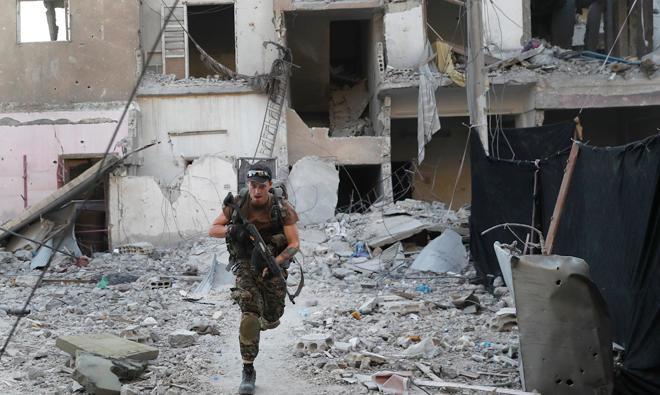
Syrian regime prevents return of Palestinian refugees to Yarmouk camp
Syrian regime prevents return of Palestinian refugees to Yarmouk camp

Latest updates


© 2026 SAUDI RESEARCH & PUBLISHING COMPANY, All Rights Reserved And subject to Terms of Use Agreement.