BANGALORE: Less than a year after the controversial Bodyline series that England won 4-1 in Australia (1932-33), Douglas Jardine led the first side to tour India, then still the jewel in the British Empire’s crown. But unlike the team that had beaten India at Lord’s in 1932, this had few household names.
Bryan Valentine may have finished his seven-Test career with an average of 64.85, but unlike Hedley Verity, the legendary left-arm spinner who was killed in WWII, or Jardine himself, his wasn’t a name that rolled easily off the tongue. It was his punishing first innings hundred, however, that paved the way for a nine-wicket victory in the first Test at the Bombay Gymkhana.
As the years passed, and India became independent, the attitudes toward touring what VS Naipaul called the land of a million mutinies didn’t change. Len Hutton, Fred Trueman, Peter May and Brian Statham were among the titans who never played a Test in India. It was not until 1976-77 that an almost full-strength team led by Tony Greig toured, and won 3-1.
Australia were different. In the 1950s, Indian cricket fans were privileged to watch the likes of Neil Harvey, Alan Davidson and Richie Benaud. A decade later, Bob Simpson, Billy Lawry and Ian Chappell also toured. Yet, as Gideon Haigh has written so eloquently in The Summer Game, touring India then was such a harsh exercise that most viewed it as a hardship assignment. And after they won 3-1 in India in 1969-70, Australia didn’t send a strong side for close to two decades. Greg Chappell, Dennis Lillee and Rodney Marsh never played a game in India.
It is in this context that India’s membership of cricket so-called Big Three should be viewed. Having been treated as second-class citizens for so long when England and Australia set the sport’s agenda, India have replicated that behavior since taking the administrative throne themselves.
Consider a simple example. In November 2000, India’s players took the short flight across the eastern border to be part of Bangladesh’s inaugural Test. The invite for Bangladesh to tour India for a Test didn’t go out till earlier this year. This, despite the India-Pakistan rivalry being waylaid by political differences, and India-Sri Lanka coming to epitomise viewer fatigue.
Much was made of India, England and Australia trying to carve up the ICC’s financial pie among themselves nearly four years ago. That attempt may have been rebuffed, to an extent, but little can be done to alter itineraries that are increasingly centered around matches between these teams. When it comes to games, South Africa are added to this list of heavy hitters for the simple reason that they have been competitive in most conditions over the past decade. Once they lose the box-office appeal of AB de Villiers, Dale Steyn and Hashim Amla, it could be a different story.
In the current cycle of matches, scheduled between the 2015 and 2019 World Cups, India will end up playing 23 of 46 Tests against England, Australia or South Africa. By the end of the ongoing Ashes, Australia would have contested 17 of 35 games against the other three. The figures for England will be 23 of 43, with a five-Test home series against India to come in the summer of 2018.
In the new Future Tours Program that is currently being chalked out and ratified, India will play 19 home Tests between 2019 and 2023. As many as 12 of those will be against England, Australia and South Africa. The away figures are 12 out of 18. The numbers for England and Australia will be similarly skewed.
Much has been made of India’s readiness to host Afghanistan in 2018-19 for their maiden Test. But that will ultimately mean nothing if the seeds of a meaningful and regular rivalry are not sown. “It is with us the prerogative of how many do we play and with who,” said Rahul Johri, the chief executive of the Board of Control for Cricket in India (BCCI), in a recent interview with ESPNCricinfo. “We are looking at good content for the Indian fans, the cricketers, for the broadcasters, for all the stakeholders. It is our responsibility to ensure the best possible content and context.”
Hopefully, he and his fellow administrators will remember the days when India dined off scraps from the top table, and ensure that they don’t treat Bangladesh, Afghanistan, and other nations where there is immense passion for the game, with the same callous disregard.
Don’t count on it though.


![]()
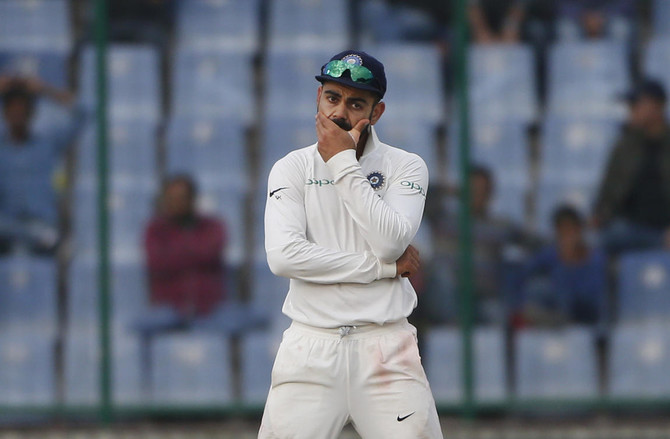
India, Australia and England are calling too many shots in Test cricket
India, Australia and England are calling too many shots in Test cricket
Latest updates


© 2026 SAUDI RESEARCH & PUBLISHING COMPANY, All Rights Reserved And subject to Terms of Use Agreement.