Luxottica CEO exits eyewear giant ahead of Essilor merger

Luxottica’s planned merger with France’s Essilor still needs antitrust approval in the US, China and Brazil. (Reuters)
Updated 16 December 2017
Follow

Luxottica CEO exits eyewear giant ahead of Essilor merger

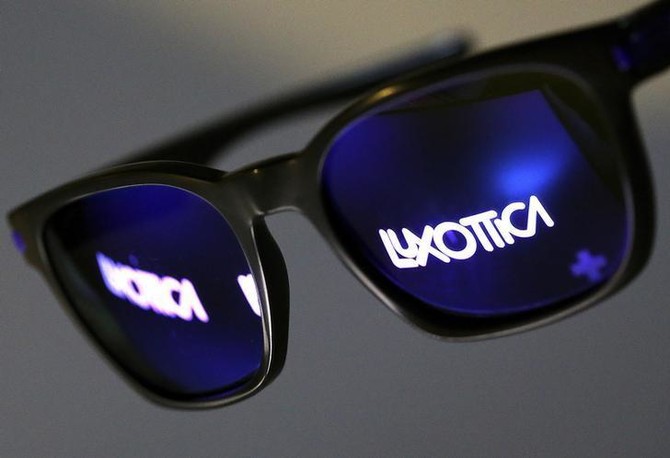
MILAN: Italy’s Luxottica has parted ways with its fourth chief executive in three years as Chairman Leonardo Del Vecchio prepares the eyewear group he founded for a planned merger with France’s Essilor.
Luxottica, the biggest maker of spectacles, agreed in January to merge with the top lens manufacturer to create a €46 billion (SR203.65 billion) group with a global shop network and brands from Ray Ban to Giorgio Armani and Burberry.
Luxottica said on Friday Massimo Vian, CEO for product and operations would step down three months before the expiry of the current board’s mandate as it simplified its structure ahead of the merger.
Vian’s responsibilities will be handed to both Del Vecchio and his close aide Deputy Chairman Francesco Milleri, who will also take on the position of CEO.
“The post-merger integration of Essilor and Luxottica is fast approaching,” EXANE BNP Paribas said in a note.
EU regulators are set to clear the merger without asking for concessions, sources familiar with the matter said on Thursday. The deal still needs antitrust approval in the US, China and Brazil.
Del Vecchio, 82, told the Corriere della Sera newspaper on Saturday that Milleri would replace him at the merged group if anything happened to him. Milleri, 58, started working with Luxottica as an IT consultant and earned the trust of Del Vecchio, becoming over time his right-hand man.
Del Vecchio and Essilor CEO Hubert Sagnières are set to share powers at EssilorLuxottica for the first three years as, respectively, executive chairman and executive vice-chairman.
Sagnières, 62, told the Financial Times last week the group would look to hire a chief executive at some point.
“Sagnières has ruled himself out — as too old — which is a not too subtle indication that Del Vecchio is not in the game either,” EXANE said. “Investors shouldn’t expect a smooth post-merger integration path.”
Del Vecchio returned to the helm of Luxottica in 2014, taking on executive powers as chairman. One of Italy’s richest men, Del Vecchio is also known for his top-down management style, taking key decisions without broad consultation.
He has presided over an overhaul of the business he founded in 1961, boosting digital investments while also expanding the retail network, centralizing distribution in China and fighting online discounts of top brand Ray Ban in the US.
He owns 62.5 percent of Luxottica and will be the single biggest shareholder in the merged group
“In the past three years ... I’ve fixed and improved Luxottica to keep up with the times. And I was able to do it thanks to Francesco Milleri ... he shared every important decision,” Del Vecchio told Corriere.
Vian had been appointed at the top within a dual-CEO structure put in place in October 2014, after Luxottica lost two bosses in six weeks due to frictions with Del Vecchio. Vian had remained as the only CEO after co-head Adil Mehboob Khan left in January 2016.
An engineer who had joined in 2005, Vian will pocket a gross €6.3 million in addition to severance pay, Luxottica said.


Saudi banks post 2.5% loan growth in Q3 as corporate credit leads: Alvarez & Marsal 

Updated 20 sec ago
Follow

Saudi banks post 2.5% loan growth in Q3 as corporate credit leads: Alvarez & Marsal 

RIYADH: Saudi Arabia’s 10 largest listed banks recorded a 2.5 percent increase in net loans and advances in the third quarter from the previous three months, underscoring sustained lending momentum in the Kingdom, a new analysis showed. 

The growth was driven by corporate lending, which rose 3 percent during the period and accounted for roughly 59 percent of total loans, according to Alvarez & Marsal’s latest KSA Banking Pulse report. 

This steady lending momentum aligns with the wider trend observed in the Gulf Cooperation Council region, where corporate lending continues to gain traction as economies diversify away from hydrocarbons. 

In November, S&P Global Ratings said banks across the GCC are expected to maintain stable credit fundamentals in 2026, even as the region faces potential geopolitical and economic shocks.

The rating agency added that the sector’s outlook is supported by broadly steady profitability, solid capitalization, and resilient asset quality. 

Commenting on the findings, Sam Gidoomal, managing director and head of Middle East Financial Services at Alvarez & Marsal, said: “Saudi banks continued to demonstrate operational resilience during the third quarter of 2025, supported by stable lending activity, disciplined cost management, and improving asset quality.” 

Retail lending in the Kingdom increased by 1.7 percent quarter on quarter during the period, according to the report. 

Deposit growth moderated to 2.2 percent, down from 2.7 percent in the second quarter. 

“The deceleration in deposits was largely attributable to SNB, which recorded a 2.9 percent quarter on quarter decline, driven by a sharp 7.9 percent quarter on quarter contraction in time deposits,” the report stated. 

Government-related entity deposits saw a marginal decline in the third quarter, with their share falling to 31.2 percent of total deposits. 

Operating income among Saudi banks increased by 1.8 percent in the third quarter, moderating slightly from the 2 percent rise recorded over the previous three months. 

Net interest income was broadly flat, edging up 0.1 percent quarter on quarter, while fee and commission income rose 3.8 percent during the same period. 

Aggregate net income increased by 2.8 percent in the third quarter, compared with 3.4 percent growth in the previous three months. 

“Despite margin compression, the sector’s strong capital position and consistent efficiency gains position banks well as they prepare for an evolving interest-rate environment in 2026,” added Gidoomal. 

Net interest margins contracted by 7 basis points to 2.73 percent, reflecting continued pressure from rising funding costs, the report said. 

Banks also demonstrated stronger cost discipline, with operating expenses declining 0.9 percent quarter on quarter, marking a third consecutive improvement in efficiency. The aggregate cost-to-income ratio fell 80 basis points to 28.7 percent in the third quarter. 

Return on equity edged higher by 6 basis points to 15.5 percent, while return on assets remained steady at 2.1 percent, underscoring sustained sector resilience. 

Asset quality strengthened further, with the non-performing loan ratio declining to 0.94 percent and the coverage ratio rising to 158.1 percent. 

“Saudi banks are maintaining solid financial foundations despite periods of global market volatility,” said Quentin Mulet-Marquis, managing director, Financial Services at Alvarez & Marsal.  

He added: “Strong earnings, low NPL rates, and comfortable capital buffers underpin investor confidence, while healthy valuation multiples and competitive dynamics continue to support growing appetite for mergers and acquisitions activity in the sector.”  

The Saudi banks analyzed in the Alvarez & Marsal report are Saudi National Bank, Al Rajhi Bank, and Riyad Bank, as well as Saudi British Bank, and Banque Saudi Fransi. 

Other banks covered include Arab National Bank, Alinma Bank, and Bank Albilad, alongside Saudi Investment Bank, and Bank Aljazira. 

Earlier in December, a separate report by S&P Global said Saudi Arabia’s private credit market is set to expand rapidly as the Kingdom seeks to bridge funding gaps linked to its Vision 2030 transformation agenda. 

The report noted that the Kingdom’s public and private sector debt — including bank lending, bond and sukuk issuance, and private capital financing — grew at a compound annual rate of 12 percent between 2021 and 2024.