France flays Assad for ‘mass crimes’

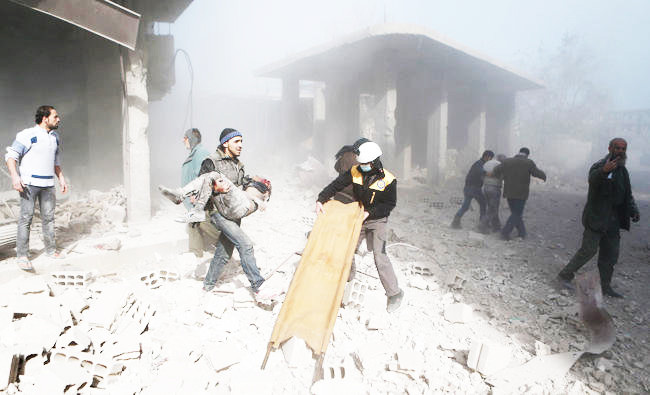
A Syrian man carries the body of a child who was killed in a reported air strike in the rebel-controlled town of Hamouria, in the eastern Ghouta region on the outskirts of the capital Damascus, in this December 3, 2017 photo. (AFP)
Updated 16 December 2017
Follow

France flays Assad for ‘mass crimes’

PARIS: France on Friday accused Syria of doing nothing to reach a peace agreement after almost seven years of war and said it was “committing mass crimes” in the Eastern Ghouta region where 400,000 people are besieged by government forces.
“The Assad regime never entered in any negotiation since the beginning of the civil war,” France’s Ambassador to the US Gerard Araud said on Twitter, adding: “They don’t look for a political compromise but for the eradication of their enemies.”
There is no alternative to a negotiated political solution agreed by both parties under the auspices of the UN,” Alexandre Giorgini, deputy Foreign Ministry spokesman, told reporters in a daily briefing, reiterating Paris’ support for UN special envoy for Syria Staffan de Mistura and appearing to dismiss a separate Russian initiative planned in Sochi next year.
“We deplore the attitude of the Syrian regime, which has refused to engage in the discussion. The Syrian regime is responsible for the lack of progress in the negotiations,” he said.
The UN says about 400,000 civilians are besieged and face “complete catastrophe” because aid deliveries by the Syrian regime were blocked and hundreds of people who need urgent medical evacuation have not been allowed outside the enclave.
“By denying humanitarian access, the Damascus regime is responsible for mass crimes, particularly through the use of the siege as a weapon of war,” Giorgini said.
Meanwhile, over half of the Syrian refugees in Lebanon are now living in extreme poverty, and the vast majority live below the poverty line, the UN’s refugee agency said Friday.
According to the UN, more than a million Syrians have sought refuge in Lebanon since the war in their country erupted in March 2011.
The massive influx has tested Lebanon, a country of just four million citizens that already struggled with overstretched resources before the arrival of Syrian refugees.
Over the last six years of the war, the refugee population has sunk further into debt and poverty, UNHCR said, with 58 percent of households now living in extreme poverty, defined as less than $2.87 per person a day.
That is an increase of five percent since last year, UNHCR said in an annual survey.
The survey found 76 percent of refugees were living below the poverty line, defined as less than $3.84 per person a day, and that nearly 90 percent of refugees were in debt.
“Syrian refugees in Lebanon are barely keeping afloat,” said UNHCR’s Lebanon representative Mireille Girard said.
“Most families are extremely vulnerable and dependent on aid from the international community.”
One bright spot in the survey was a large jump in school enrolment of refugee children aged 6-14, with 70 percent now registered at school, up from around just half. But the report found just 12 percent of adolescent refugees had finished their education.


Iran war chokes aid corridors, obstructing global relief efforts

Updated 3 sec ago
Follow

Iran war chokes aid corridors, obstructing global relief efforts

  • “People in dire need of assistance ⁠will have to ⁠wait longer for food,” said Bauer
  • Tents, tarpaulins and lamps destined for Gaza and the West Bank have become stuck in the supply chain, the IOM said

GENEVA: Key humanitarian air, sea and land routes are being constricted by disruption from the war in the Middle East, delaying life-saving shipments to some of the world’s worst crises, 10 aid officials have told Reuters.
The US–Israeli war on Iran entered its seventh day on Friday, convulsing global markets and disrupting supply chains with airspace closures and the halt of shipping through the critical Strait of Hormuz.
Aid to Gaza and Sudan is grinding to a halt and costs are soaring for help to the hundreds of millions suffering hunger crises around the world.
“People in dire need of assistance ⁠will have to ⁠wait longer for food,” said Jean-Martin Bauer, Director of Food Security at the World Food Programme.
Already, tents, tarpaulins and lamps destined for the Israeli-occupied Palestinian territories of Gaza and the West Bank have become stuck in the supply chain, the International Organization for Migration said.

DUBAI AID HUB HOBBLED BY AIR AND SEA RESTRICTIONS
Aid groups say higher operational costs are straining budgets already facing massive donor cuts. The IOM said shipping firms were demanding emergency surcharges of approximately $3,000 per ⁠container.
Humanitarian groups stocking goods for rapid regional deployment at warehouses in Dubai’s Humanitarian Hub face challenges moving supplies onto transit routes.
The International Federation of Red Cross and Red Crescent Societies cannot move trauma kits to help the Iranian Red Crescent with search and rescue from its Dubai hub, where they sit in a estimated 1 million Swiss franc ($1.28 million) pre-positioned emergency stockpile, said Cecile Terraz, a director at the IFRC.
The group cannot move stock through Jebel Ali port — the region’s largest container terminal, which was set on fire by the debris of an intercepted missile — from where cargo normally moves onto planes or into the Strait of Hormuz.
The World Health Organization’s Dubai hub operations are also frozen, regional director Hanan Balkhy said, obstructing ⁠50 emergency requests from 25 ⁠countries and hampering operations such as polio vaccination.
Ripple effects farther afield are also likely.
Famine-struck Sudan is particularly exposed due to additional restrictions since February 28 on the Suez Canal and the Bab el-Mandeb Strait at the southern entrance to the Red Sea, the UNHCR said.
“We are particularly concerned about Africa,” said a spokeswoman, adding that some cargoes were being sent around the Cape of Good Hope. The route takes up to three weeks longer.
Costs for fuel, transportation and insurance are also rising, and Terraz said the IFRC may have to cut deliveries to the Iranian Red Crescent.
Emma Maspero, senior manager in Copenhagen of the supply division of the UN children’s body UNICEF, said she hoped flights carrying perishable humanitarian goods such as vaccines could be prioritized amid the airspace restrictions.