Nawaz Sharif vindicated as Supreme Court refuses to reopen Hudaibiya Paper Mills case

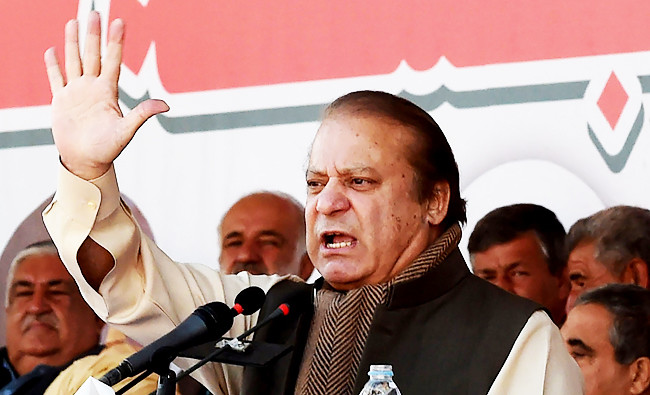
Former prime minister of Pakistan Nawaz Sharif . (AFP)
Updated 15 December 2017
Follow

Nawaz Sharif vindicated as Supreme Court refuses to reopen Hudaibiya Paper Mills case

ISLAMABAD: Pakistan’s Supreme Court on Friday unanimously rejected the appeal to reopen the 17-year old corruption case against ousted Premier Nawaz Sharif and his family members.
In an appeal, the National Accountability Bureau (NAB ) sought to re-open the case commonly known as the Hudaibiya Paper Mills.
The country’s anti-graft body, NAB, alleges that the Sharif family used the company in the 1990s to launder about $10 million out of Pakistan; Sharif and his family members deny the allegation.
The court order has brought some relief for Nawaz Sharif and his younger brother Shahbaz Sharif who was also accused in the case. The Supreme Court disqualified Nawaz Sharif from office in July this year due to concealment of financial assets and that forced him to step down.
Pakistan has been in political turmoil since Nawaz Sharif’s judicial ouster, which was largely flayed by the ruling Pakistan Muslim League-Nawaz (PML-N) party members who called the ouster a conspiracy against a democratically elected government.
National Assembly Speaker Ayaz Sadiq is the latest member of the political corps and senior government officials to speak of an alleged conspiracy to derail democracy in Pakistan. He expressed his fear that the current assemblies may not be able to complete their full terms.
In an interview this week, Sadiq said he has “enough information to believe that a conspiracy was being hatched” to “disrupt the (democratic) system.” This was quoted on a local television channel and he added that the recent sit-in protests by far-right activists in different cities were also part of this “greater plan.”
According to the media, Sadiq also hinted at the involvement of external forces in political maneuvering to destabilize the government and stressed that the US would eventually question political stability in Pakistan if such “experiments went unabated.” His statements have caused great concern, not only among politicians but among the general public as well.
The government is already facing difficulty in getting the constitutional amendment passed by the Upper House, Senate, which is required for delimitation of constituencies after the recent population census — a prerequisite for holding next year’s elections on schedule. Any delay in elections would essentially mean an interim setup taking over until constitutional requisites were fulfilled.
Prime Minister Shahid Khaqan Abbasi, however, said he was optimistic that the assemblies would complete their term.
After a meeting with Nawaz Sharif in London on Thursday, Abbasi confidently said: “Our government will have smooth sailing and an interim government will be formed in June.”
As the opposition party Pakistan Tehrik-e-Insaf (PTI) demands snap elections alleging governmental incompetence and corruption, religious groups oppose the government over an amendment which the government calls a clerical error. While opposition parties are forging different alliances to add to the mounting pressure on the government, Pakistan appears unsure of its political course.


 

China foreign minister blasts Middle East war, urges US to manage ties

Updated 57 min 3 sec ago
Follow

China foreign minister blasts Middle East war, urges US to manage ties

  • Wang Yi: ‘A strong fist does not mean strong reason. The world cannot return to the law of the jungle’

BEIJING: China’s top diplomat condemned on Sunday the war in the Middle East and urged the United States to iron out its differences with Beijing.
Foreign Minister Wang Yi told a press conference in the Chinese capital that the war, which was sparked by US and Israeli strikes on Iran, “should never have happened.”
“A strong fist does not mean strong reason. The world cannot return to the law of the jungle,” he told reporters.
He was speaking during China’s annual political gathering, which began this week, known as the “Two Sessions.”
The parallel meetings of China’s parliament and political consultative body are closely watched for clues as to the priorities of top leaders, in the face of a precarious geopolitical landscape
Wang addressed a range of issues, including a trade war with the United States, regional tensions in the South China Sea, as well as wars in the Middle East and Ukraine.
“This year is indeed a big year for Sino-US relations,” Wang said.
‘Manage differences’
Ties between China and the United States have been strained since US President Donald Trump returned to the White House last year, followed by a trade war that saw the two countries impose tit-for-tat tariffs on each other’s products.
“We observe certain country erecting tariff barriers and pursuing decoupling and supply chain disruption,” Wang said on Sunday.
“These actions are akin to trying to extinguish a fire with fuel. Ultimately, they will backfire and harm itself.”
While China and the United States “cannot change each other,” he said, “we can change the way we interact with each other.”
Wang urged both sides to “create a suitable environment, manage existing differences, and eliminate unnecessary interference.”
But a wide range of disagreements remain.
Beijing has blasted US and Israeli military strikes on Iran, with which it has diplomatic and trade ties.
It has in particular condemned the killing of the country’s supreme leader Ayatollah Ali Khamenei.
Wang also maintained that China’s relations with Moscow, which have been criticized by Western countries for sustaining the war in Ukraine, remained “steadfast and unshakeable.”
China ‘gym’
China has sought to profit off Trump’s volatile foreign policies, positioning itself as a reliable alternative to once traditional US allies.
Leaders from France, Canada, Finland and the United Kingdom, among others, have flocked to Beijing, recoiling from Trump’s bid to seize Greenland and tariff threats against fellow NATO members.
Wang welcomed the visits on Sunday, saying “we have noticed that more and more insightful Europeans agree that China is not a competitor, but a global partner.”
“We welcome our European friends to step out of the ‘small attic’ of protectionism and come to the ‘gym’ of the Chinese market, where they can strengthen their muscles and enhance their competitiveness,” he said.
In the spirit of warming relations, China has doled out visa-free travel agreements to around 50 countries including France, Germany, and the United Kingdom.
Beijing has also agreed to reduced tariffs with Ottawa and London in their exports to China.
Wang also addressed relations between China and Japan, which have been locked in a spat after comments by Prime Minister Sanae Takaichi in November that Tokyo could intervene militarily in any attack on self-ruled Taiwan.
Takaichi’s comments enraged Beijing, which views Taiwan as its territory and has not ruled out taking by force.
Wang emphasized on Sunday that Beijing “will never allow anyone or any force to separate Taiwan … from China once again.”
He warned Japan against “repeating the same disastrous mistakes,” adding that China “will never allow anyone to stand up for colonialism,” in an apparent reference to Tokyo’s actions during World War II.
The issue of Taiwan, he insisted, is “at the heart of China’s core interests” and “a red line that must not be crossed or trampled on.”