MILLAS, France: French authorities were investigating Friday how a train was able to smash into a school bus, killing six children and ripping their vehicle in half in an accident that has stunned the local community.
Four teenagers died on Thursday in the collision at a level crossing in the village of Millas near the southern city of Perpignan, with the toll rising Friday when two 11-year-old girls succumbed to their injuries.
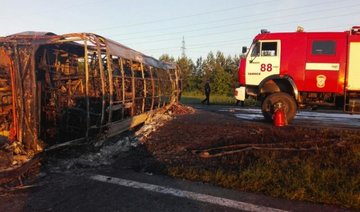
Fourteen other children were injured when the bus was torn in two and the train pulled off its rails, in the worst accident involving a school bus in France for three decades.
Investigators only finished identifying the dead teenagers overnight due to the severity of their injuries, with the mayor of the neighboring village describing the scene as “a vision of horror.”
The accident site was sealed off as police examined whether a technical or human error was to blame.
It has not been confirmed whether the automatic barriers were open at the time of the crash, though national rail operator SNCF said the crossing was “functioning normally,” citing witnesses.
“The families of those caught up in the accident are going through something absolutely terrible,” said Prime Minister Edouard Philippe, who visited Millas on Thursday.
Most of the students were from the local Christian Bourquin junior high school, where pupils were in shock as they headed in on Friday morning.
“I went to sleep at two or three in the morning. I was watching the news, I wasn’t able to sleep,” said teenager Lorena Garcies, dressed in black.
Her cousin and another friend were on the bus, but escaped with broken bones and trauma.
“I’m trying to be strong for them,” she said.
The female driver of the bus was among the injured and has not yet been questioned, but Perpignan prosecutor Jean-Jacques Fagni said investigators had spoken to the train driver.
“There was good visibility,” said regional chief Carole Delga.
“This level crossing wasn’t really dangerous and no technical problems had been raised,” she told Europe 1 radio.
She nonetheless pledged to modernize dangerous crossings, as a debate broke out about whether a technical error had caused the crash.
Samuel Conegero, the father of one of the children, said his son took a photo showing “the barriers were lifted” when the bus drove into the path of the incoming train.
“We will obviously consider malfunctions of all kinds,” senior police official Jean Valery Letterman said. “This will take time.”
At the school, Sabrina Mesas, hugging her stunned daughter Lilou whose best friend was lightly injured in the crash, was struggling to stop fight back tears.
“We’re in total shock this morning,” Mesas said. “It’s important that everyone is together, that they can talk, to put into words what has happened.”
A psychological support team was on site and students were encouraged to come into school — authorities do not want them to face the tragedy alone, said Abdelkader Taoui, one of the doctors sent to help.
Teachers have also been left stunned. “I don’t even know how to get on with things,” said Jordi Sales, who teaches Catalan and Spanish at the school near the Spanish border.
Robert Olive, mayor of neighboring Saint-Feliu-d’Amont, described the scene as a “vision of horror.”
The accident is the worst involving a school bus in France since 1987, when 53 people including 44 children were killed in a pile-up involving two coaches that were taking students to a summer camp.
France has also seen multiple deadly rail accidents in recent years, including the derailment of a high-speed TGV train that was being tested in 2015, killing 11 people onboard.
In 2013, seven people were killed when a commuter train slammed into a station south of Paris. A signaling defect was blamed for that crash.


![]()

France stunned by deadly school bus crash
France stunned by deadly school bus crash

Latest updates


Recommended


© 2026 SAUDI RESEARCH & PUBLISHING COMPANY, All Rights Reserved And subject to Terms of Use Agreement.