Ryanair to recognize unions in historic shift to stop strike

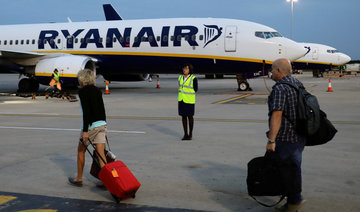
Ryanair on Friday said it would recognize pilot unions for the first time in its 32-year history in a bid to stop the first pilot strike in its history from taking place. (Reuters)
Updated 15 December 2017
Follow

Ryanair to recognize unions in historic shift to stop strike

DUBLIN: Ryanair on Friday announced that it would recognize pilot unions for the first time in its 32-year history in a bid to stop the first pilot strike in its history from taking place later in the day.
Chief Executive Michael O’Leary’s refusal to recognize unions was at the heart of the ultra low-cost model he developed to turn a small Irish regional airline into Europe’s largest carrier by passenger numbers.
“Recognizing unions will be a significant change for Ryanair, but we have delivered radical change before,” O’Leary said in a statement. “We hope and expect that these structures can and will be agreed with our pilots early in the New Year.”


Saudi non-oil trade surplus with GCC jumps 102% in November  

Updated 08 February 2026
Follow

Saudi non-oil trade surplus with GCC jumps 102% in November  

RIYADH: Saudi Arabia’s non-oil trade surplus with Gulf Cooperation Council countries more than doubled in November, driven by a surge in exports, preliminary government data showed. 

The surplus reached about SR6.6 billion ($1.76 billion), up 102 percent from SR3.3 billion a year earlier, according to the General Authority for Statistics. 

Total non-oil trade with GCC countries rose 30 percent to SR20.4 billion from SR15.7 billion, as exports outpaced import growth. Non-oil goods exports climbed to SR13.5 billion in November from SR9.5 billion a year earlier, while imports increased to SR6.9 billion from SR6.2 billion. 

Re-exports made up the bulk of outbound trade, rising to SR9.76 billion in November from SR6.56 billion a year earlier, while national exports increased to SR3.75 billion from SR2.92 billion. 

The UAE remained Saudi Arabia’s largest GCC trading partner on a non-oil basis. Exports to the Emirates totaled SR10.48 billion in November versus SR7.18 billion a year earlier, comprising SR8.38 billion in re-exports and SR2.10 billion in national exports.   

Imports from the UAE were SR4.79 billion, up from SR3.95 billion, lifting the non-oil trade surplus with the UAE to about SR5.69 billion from SR3.23 billion.  

Trade with Kuwait also expanded, with exports rising to SR769.9 million from SR610.6 million, including SR199.2 million in re-exports and SR570.7 million in national exports. Imports from Kuwait fell to SR176.4 million from SR333.3 million, pushing the trade surplus to SR593.5 million from SR277.3 million.  

With Bahrain, exports edged down to SR900.7 million from SR929.7 million, reflecting a decline in re-exports to SR380.3 million from SR572.7 million, while national exports increased to SR520.4 million from SR356.9 million. Imports rose to SR862.4 million from SR662.4 million, reducing the surplus to SR38.3 million from SR267.2 million.  

Saudi Arabia narrowed its non-oil trade deficit with Oman, as exports increased to SR666.7 million from SR356.5 million, supported by re-exports of SR259.6 million versus SR39.3 million and national exports of SR407.0 million versus SR317.3 million.   

Imports from Oman declined to SR873.2 million from SR1.11 billion, bringing the trade balance to a deficit of SR206.6 million compared with a deficit of SR749.1 million in November 2024.  

Trade with Qatar strengthened, with exports rising to SR691.1 million from SR395.8 million, including re-exports of SR536.2 million versus SR253.9 million and national exports of SR155.0 million versus SR141.9 million. Imports increased to SR199.3 million from SR148.9 million, resulting in a surplus of SR491.8 million, up from SR246.9 million.