Rapes, other new allegations in Kenya’s election unrest

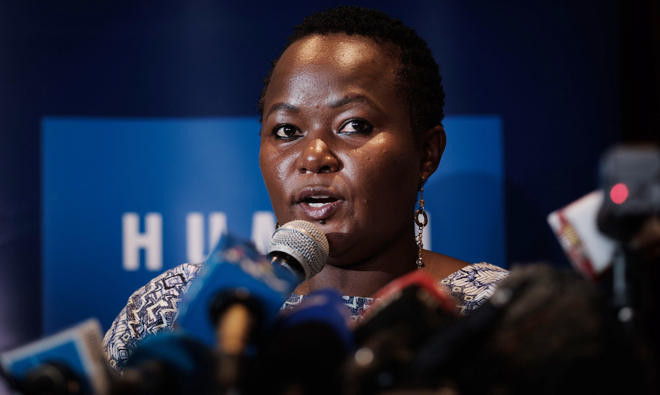
Agnes Odhiambo, Senior Women's Rights Researcher of NGO Human Rights Watch Kenya speaks during a press conference for their report "Kenya: Sexual violence in 2017 elections" in Nairobi, Kenya, on Dec. 14, 2017. Kenyan security forces raped, beat and assaulted civilians during violence in recent elections, Human Rights Watch said. (AFP)
Updated 15 December 2017
Follow

Rapes, other new allegations in Kenya’s election unrest

KAMPALA: Kenya’s opposition leader was targeted in a virulent online campaign created by a US-based company during the recent election turmoil, a privacy watchdog said Thursday, while another rights group reported multiple gang-rapes by men in uniform in opposition strongholds.
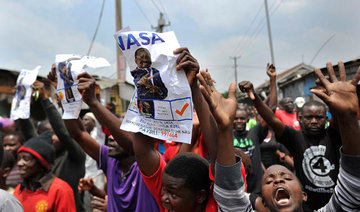
The reports highlight the volatility of the months during which the Supreme Court nullified the re-election of President Uhuru Kenyatta and ordered a new vote that opposition leader Raila Odinga boycotted and Kenyatta won. Anger remains high among Odinga supporters; scores were killed in clashes with security forces.
The data-driven social media campaigns allegedly created by Texas-based Harris Media contributed to one of the most divisive votes in the East African nation’s history, the London-based Privacy International said. One campaign attacked Odinga and the other praised Kenyatta, both on behalf of the president’s re-election campaign.
The campaign against Odinga included a claim that he would “remove whole tribes” if elected, the report said. Voting in Kenya is often along ethnic lines, and previous elections have led to deadly violence.
The social media campaigns “relied on ad words in Google search and apparently targeted advertising on a range of social media platforms,” the report said. “This raises serious concerns about the role and responsibility of companies working for political campaigns in Kenya’s volatile political climate ... It also highlights the risks inherent to voter profiling and micro-targeting in a country with no data protection laws.”
The report does not allege any crime was committed. Harris Media did not claim responsibility for the campaigns, the report said. The company did not immediately respond to a request for comment.
The separate report by Human Rights Watch described rapes of men and women and cited victims and witnesses in the slums of the capital, Nairobi, and the opposition strongholds of Kisumu and Bungoma.
“Some were raped in the presence of family members, including young children,” the report said. “Most women said they were raped by policemen or men in uniform, many of whom carried guns, batons, tear gas canisters, whips, and wore helmets and other anti-riot gear.”
In at least one case a girl died after being raped, said Human Rights Watch, which accused Kenya’s government of often ignoring election-related sexual violence.
Kenya’s police chief Joseph Boinnet rejected the allegations in the report as “utter falsehoods” and challenged Human Rights Watch to produce evidence.


Saudi ambassador becomes first foreign envoy to meet Bangladesh’s new PM

Updated 22 February 2026
Follow

Saudi ambassador becomes first foreign envoy to meet Bangladesh’s new PM

  • Tarique Rahman took oath as PM last week after landslide election win
  • Ambassador Abdullah bin Abiyah also meets Bangladesh’s new FM

Dhaka: Saudi Arabia’s ambassador to Dhaka became on Sunday the first foreign envoy to meet Bangladesh’s new Prime Minister Tarique Rahman since he assumed the country’s top office.

Rahman’s Bangladesh Nationalist Party made a landslide win in the Feb. 12 election, securing an absolute majority with 209 seats in the 300-seat parliament.

The son of former Prime Minister Khaleda Zia and former President and BNP founder Ziaur Rahman, he was sworn in as the prime minister last week.

The Saudi government congratulated Rahman on the day he took the oath of office, and the Kingdom’s Ambassador Abdullah bin Abiyah was received by the premier in the Bangladesh Secretariat, where he also met Bangladesh’s new foreign minister.

“Among the ambassadors stationed in Dhaka, this is the first ambassadorial visit with Prime Minister Tarique Rahman since he assumed office,” Saleh Shibli, the prime minister’s press secretary, told Arab News.

“The ambassador conveyed greetings and best wishes to Bangladesh’s prime minister from the king and crown prince of Saudi Arabia … They discussed bilateral matters and ways to strengthen the ties among Muslim countries.”

Rahman’s administration succeeded an interim government that oversaw preparations for the next election following the 2024 student-led uprising, which toppled former leader Sheikh Hasina and ended her Awami League party’s 15-year rule.

New Cabinet members were sworn in during the same ceremony as the prime minister last week.

Foreign Minister Khalilur Rahman is a former UN official who served as Bangladesh’s national security adviser during the interim government’s term.

He received Saudi Arabia’s ambassador after the envoy’s meeting with the prime minister.

“The foreign minister expressed appreciation for the Saudi leadership’s role in promoting peace and stability in the Middle East and across the Muslim Ummah. He also conveyed gratitude for hosting a large number of Bangladeshi workers in the Kingdom and underscored the significant potential for expanding cooperation across trade, investment, energy, and other priority sectors, leveraging the geostrategic positions of both countries,” the ministry said in a statement.

“The Saudi ambassador expressed his support to the present government and his intention to work with the government to enhance the current bilateral relationship to a comprehensive relationship.”

Around 3.5 million Bangladeshis live and work in Saudi Arabia. They have been joining the Saudi labor market since 1976, when work migration to the Kingdom was established during the rule of the new prime minister’s father.

Bangladeshis are the largest expat group in the Kingdom and the largest Bangladeshi community outside Bangladesh and send home more than $5 billion in remittances every year.