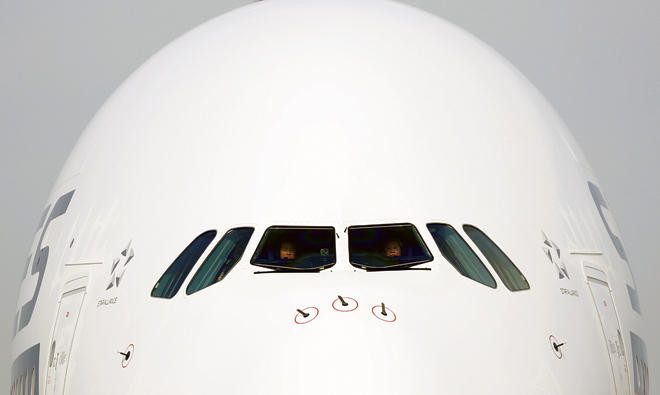
LONDON: The future of Airbus’ A380 depends to a large extent on Emirates, the Dubai carrier that is by far the aircraft maker’s largest customer, analysts told Arab News.
Airbus was upstaged at the recent Dubai Airshow when instead of an expected announcement that Emirates would order 36 of Airbus’ superjumbos, it disclosed an order with arch-rival Boeing for 40 787s at a list price of $15 billion. It is not clear when or if Emirates will order more A380s, the mainstay of its fleet.
The battle between the A380 and 787 has been going on for years with the former being bigger and able to carry more passengers, but the latter sleeker and more energy efficient. The two companies are also promoting two business models, with the A380 designed to fly to a hub such as Dubai for onward travel, while Boeing has bet on passengers preferring to fly “point-to-point.”
That said, the hub model could still be valid, but with smaller aircraft using it, Tim Coombs, managing director at Aviation Economics, told Arab News.
Reuters reported on Thursday that Airbus was considering cutting production to six or seven planes a year. But it had not made a final decision on the matter, a top executive told the news agency, amid growing question marks over the future of the double-decker jet.
The A380 has battled against sluggish sales for some time and has previously announced plans to lower output to 12 aircraft in 2018 and eight in 2019, compared with an annual peak of 30.
Coombs said: “Without the support of Emirates, the A380 program would be a bit of a disaster as Airbus has failed to sell the carrier, in any great number, to other airline networks.” He said Emirates and the A380 project were “inexorably linked.”
“It’s not healthy from Airbus’ point of view that they are so reliant on one carrier,” he added.
“But I think they have an order book for other aircraft to justify a cut in production of the A380.”
“Every other aircraft in their production line has probably got a seven-year backlog in orders from other carriers, but that’s not the case with the A380.”
Chris Tarry, an airlines analyst at CTAIRA said, “Airbus is clearly looking at what the future rate of delivery is going to be, and it would be logical and sensible to adjust your production to what you are going to sell.”
He added: “Clearly the A380 hasn’t sold as well as when the plan was put together all those years ago, the market has changed and the reality is that you can now move passengers on a new-generation, smaller aircraft as economically as on a larger one. The A380 was conceived maybe 30 years ago, but the markets move on.”
Airbus has faced pressure on other fronts this year, with engine delays on its popular A320neo single-aisle carrier, and having to cope with the impact of corruption investigations. Denis Ranque, chairman of Airbus, told the Financial Times on Thursday that senior management will have to change after a raft of investigations that have rocked Airbus to the core.
“There is no strict timeline,” Ranque said in an interview with the FT. “That enables us to make a staggered and reasonable approach to this. Some changes will be needed but it is far too early to say when, who and how.”
Airbus was said to be currently strengthening its compliance procedures in the wake of allegations about its use of middlemen to win aircraft deals. It is facing probes in the UK, France, Germany and Austria.


![]()
Future of A380 hangs on Emirates amid rumors of production cuts
Future of A380 hangs on Emirates amid rumors of production cuts


Latest updates



© 2026 SAUDI RESEARCH & PUBLISHING COMPANY, All Rights Reserved And subject to Terms of Use Agreement.