Turkish, US, Iraqi military officials discuss security challenges

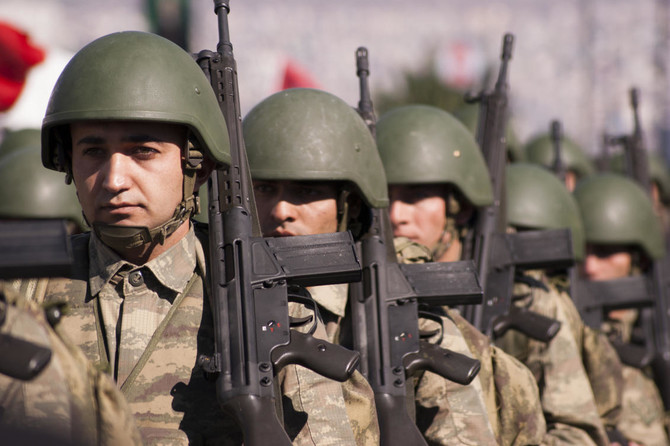
Turkey is part of EUCOM, and has long provided its southern Incirlik base for anti-Daesh airstrikes by the US-led coalition. (Shutterstock)
Updated 14 December 2017
Follow

Turkish, US, Iraqi military officials discuss security challenges

ANKARA: Senior Turkish, Iraqi and US military officials met in Ankara on Thursday to discuss regional developments and security challenges.
Turkish Chief of General Staff Gen. Hulusi Akar, his Iraqi counterpart Othman Al-Ghanimi, Commander of US European Command (EUCOM) Curtis Scaparrotti and Commander of US Central Command (CENTCOM) Joseph Votel attended the meeting.
The focus was on Iraq, Syria and counterterrorism efforts, said the Turkish General Staff. The meeting comes six days after Baghdad’s announcement of the total defeat of Daesh in Iraq.
The main items on the agenda were the need to prevent the emergence of any terror movements post-Daesh, and recent US promises to stop delivering weapons to the Syrian-Kurdish People’s Protection Units (YPG) and take back heavy weapons already delivered.
Turkey is part of EUCOM, and has long provided its southern Incirlik base for anti-Daesh airstrikes by the US-led coalition, thereby assisting CENTCOM. Both Turkey and the US have military bases in Iraq.
“The US wants to see Turkey and Iraq on its side against terrorism,” Nursin Atesoglu Guney, dean of the faculty of economics, administrative and social sciences at Bahcesehir Cyprus University, told Arab News.
“But Turkey’s priority is now the elimination of the YPG, seen by Ankara as an offshoot of the outlawed PKK (Kurdistan Workers’ Party) terror group.”
Washington does not want to push Ankara away, and intends to pull Baghdad away from Tehran, she said.
“For this, the US uses counterterrorism cooperation as a general framework for regional cooperation,” she added.
Defense Secretary Jim Mattis recently said the US would stop arming the YPG, its main local partner in Syria.
Ankara’s main concern is that weapons supplied to the YPG will end up in PKK hands in Turkey.
Erol Bural, a former military officer and a terrorism expert at the 21st Century Turkey Institute, said Ankara and Washington regularly hold security meetings.
“But the inclusion of Iraq in this framework shows that the meeting essentially focused on Iraq’s security post-Daesh,” Bural told Arab News.
“It’s clear that there’s an effort to continue the US-Turkish relationship through military channels, as the political channels are currently blocked.”
Bural said he does not expect a joint operation against PKK militants in Iraq in the short or medium term, as this requires further coordination and an improvement in relations between Ankara and Baghdad.
“But they can take steps to ease and accelerate airspace usage to conduct airstrikes against PKK hideouts in Iraq,” he said.
“Post-Daesh, the common security concern of the three countries may be the possibility of a Daesh comeback or the emergence of similar radical terror organizations.”
Accordingly, Bural said the three countries should boost border security and intelligence sharing against the PKK and other terror organizations.
“It’s also important to take proactive steps to counter violent extremism in the region,” he added.


Baghdad says it will prosecute Daesh militants being moved from Syria to Iraq

Updated 6 sec ago
Follow

Baghdad says it will prosecute Daesh militants being moved from Syria to Iraq

  • The US military started the transfer process on Friday with the first Daesh prisoners moved from Syria to Iraq

BAGHDAD: Baghdad will prosecute and try militants from the Daesh group who are being transferred from prisons and detention camps in neighboring Syria to Iraq under a US-brokered deal, Iraq said Sunday.
The announcement from Iraq’s highest judicial body came after a meeting of top security and political officials who discussed the ongoing transfer of some 9,000 IS detainees who have been held in Syria since the militant group’s collapse there in 2019.
The need to move them came after Syria’s nascent government forces last month routed Syrian Kurdish-led fighters — once top US allies in the fight against Daesh — from areas of northeastern Syria they had controlled for years and where they had been guarding camps holding Daesh prisoners.
Syrian troops seized the sprawling Al-Hol camp — housing thousands, mostly families of Daesh militants — from the Kurdish-led force, which withdrew as part of a ceasefire. Troops last Monday also took control of a prison in the northeastern town of Shaddadeh, from where some Daesh detainees had escaped during the fighting. Syrian state media later reported that many were recaptured.
Now, the clashes between the Syrian military and the Kurdish-led Syrian Democratic Forces, or SDF, sparked fears of Daesh activating its sleeper cells in those areas and of Daesh detainees escaping. The Syrian government under its initial agreement with the Kurds said it would take responsibility of the Daesh prisoners.
Baghdad has been particularly worried that escaped Daesh detainees would regroup and threaten Iraq’s security and its side of the vast Syria-Iraq border.
Once in Iraq, Daesh prisoners accused of terrorism will be investigated by security forces and tried in domestic courts, Iraq’s Supreme Judicial Council said.
The US military started the transfer process on Friday with the first Daesh prisoners moved from Syria to Iraq. On Sunday, another 125 Daesh prisoners were transferred, according to two Iraqi security officials who spoke to The Associated Press on condition of anonymity in line with regulations.
So far, 275 prisoners have made it to Iraq, a process that officials say has been slow as the US military has been transporting them by air.
Both Damascus and Washington have welcomed Baghdad’s offer to have the prisoners transferred to Iraq.
Iraq’s parliament will meet later on Sunday to discuss the ongoing developments in Syria, where its government forces are pushing to boost their presence along the border.
The fighting between the Syrian government and the SDF has mostly halted with a ceasefire that was recently extended. According to Syria’s Defense Ministry, the truce was extended to support the ongoing transfer operation by US forces.
The Daesh group was defeated in Iraq in 2017, and in Syria two years later, but Daesh sleeper cells still carry out deadly attacks in both countries. As a key US ally in the region, the SDF played a major role in defeating Daesh.
During the battles against Daesh, thousands of extremists and tens of thousands of women and children linked to them were taken and held in prisons and at the Al-Hol camp. The sprawling Al-Hol camp hosts thousands of women and children.
Last year, US troops and their partner SDF fighters detained more than 300 Daesh militants in Syria and killed over 20. An ambush in December by Daesh militants killed two US soldiers and one American civilian interpreter in Syria.