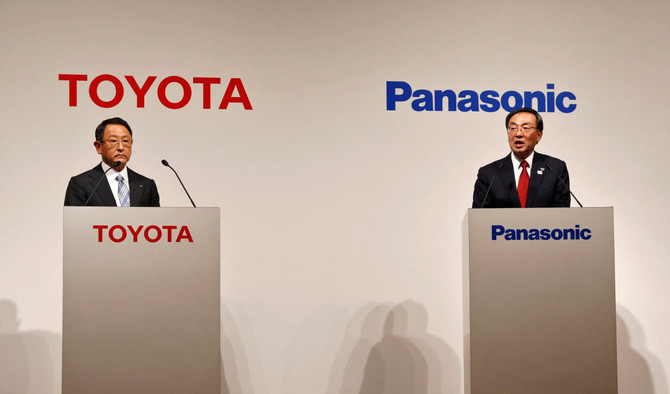
TOKYO: Toyota Motor and Panasonic said on Wednesday they are considering jointly developing batteries for electric vehicles (EVs), a partnership that could help Panasonic extend its market lead in automotive lithium-ion batteries.
The announcement builds on an existing agreement under which Panasonic manufactures batteries for Toyota’s gasoline-electric and plug-in hybrid vehicles.
Toyota said last year it was planning to add fully electric vehicles to its product line-up in a shift away from its previous green-car strategy of focusing on plug-in hybrid and fuel-cell vehicles. It has said it plans to start marketing pure EVs in the early 2020s.
Panasonic is the main EV battery supplier for luxury US car maker Tesla. The electronics firm commands 29 percent of the market for batteries used in plug-in hybrids and EVs, showed Nomura Research data for the first half of 2017.
Nearest rival LG Chem holds 13 percent of the market, followed by China’s BYD on 10 percent and Contemporary Amperex Technology (CATL) at 9 percent.
“Working with automakers from the initial stages could allow battery makers to win orders that unlock economies of scale further down the road,” Credit Suisse analyst Mika Nishimura said in a research note to clients ahead of the Toyota-Panasonic announcement. “Partnerships could also allow battery makers to share R&D and capex costs with automakers to some extent.”
Panasonic sees batteries as central to its plan to nearly double automotive business revenue to ¥2.5 trillion ($826.14 billion) by the year through March 2022. To that end, it has been expanding battery production capacity globally.
It started mass production of battery cells at Tesla’s “Gigafactory” in the US state of Nevada earlier this year and plans to follow suit at a new plant in Dalian, China. It is also adding new production lines in Japan.

Toyota, Panasonic consider joint development of EV batteries
Egypt–Saudi power link set to boost regional energy integration, minister says
RIYADH: Electricity interconnection projects between Egypt and Saudi Arabia will strengthen regional energy cooperation and economic integration, Egypt’s minister of electricity and renewable energy said during a visit to a key cross-border power facility.
Mahmoud Esmat made the remarks while inspecting the Egypt–Saudi electricity interconnection station linking the two countries’ power grids, where he reviewed construction progress and equipment testing ahead of trial operations expected in the coming weeks, according to a statement from the Egyptian State Information Service.
The project is described as the first of its kind in the Middle East in terms of scale, manufacturing technology, operation, and application in grid interconnection lines.
The initiative supports the state’s broader vision to implement sustainable solutions aimed at ensuring the stability of the national unified grid and enhancing the reliability and quality of electricity supply.
It also aligns with Egypt’s allocation of 136.3 billion Egyptian pounds ($2.8 billion) to the electricity and renewable energy sector in its 2025–26 development plan, nearly double the 72.6 billion pounds set aside the previous year.
The plan focuses on diversifying energy sources, expanding renewable capacity, and strengthening the national grid to meet rising demand.
The statement said: “The minister toured the station’s departments and control and operation center, following up on the completion of testing for all equipment and components in preparation for launching operations and synchronizing the project with the unified power grids of Egypt and Saudi Arabia in the coming weeks.”
It added: “Esmat reviewed the implementation rate of the project and testing works, as well as the project’s timeline. He highlighted finalization of operational tests at the Badr transformer station and the Sakakin Taba 2 station, as well as the 500 kilovolts overhead transmission line extending approximately 320 km.”
The minister said the project forms part of broader efforts to build an integrated power network connecting the two countries, facilitating efficient and flexible electricity exchange and laying the groundwork for a unified Arab electricity market.
He added that the initiative reflects a clear vision and comprehensive strategy to strengthen the efficiency of the energy system while delivering both immediate and long-term solutions to safeguard grid stability and enhance service quality.