UNITED NATIONS: The UN rights chief told the Security Council on Monday that tough sanctions imposed on North Korea are complicating the delivery of desperately needed humanitarian aid and called for an assessment.
An estimated 18 million North Koreans, or 70 percent of the population, suffer from acute food shortages and aid agencies provide “literally a lifeline” for 13 million of them, said UN Human Rights Commissioner Zeid Ra’ad Al Hussein.
“But sanctions may be adversely affecting this essential help,” he told a special Security Council meeting on human rights in North Korea.
Sanctions that have tightened controls over international bank transfers “have caused a slowdown in UN ground operations, affecting the delivery of food rations, health kits and other humanitarian aid,” he said.
The rights chief asked the council to conduct an assessment of the human rights impact of sanctions and urged them to take action to minimize consequences.
Over the past year, the council has adopted three rounds of sanctions aimed at choking off revenue to Pyongyang’s military programs after Kim Jong-Un’s regime carried out a sixth nuclear test and a series of advanced missile launches.
The council’s sanctions committee on North Korea will meet later Monday to hear a briefing from a UN humanitarian official on the impact of recent punitive measures.
Aid groups are facing hurdles to clear customs for goods destined for North Korea, to ensure procurement and transport of aid supplies, as well as rising food prices in the reclusive state that have shot up 160 percent since April, said UN Assistant Secretary-General Miroslav Jenca.
The Security Council discussed the human rights crisis in North Korea despite objections from China, Pyongyang’s ally.
China requested a procedural vote to block the meeting, but failed to garner enough support.
Ten countries voted to allow the meeting to go ahead, three were opposed — China, Russia and Bolivia — while Egypt and Ethiopia abstained.
At least nine countries must back a contested agenda item for it to be discussed at the council and the veto does not apply.
Chinese Deputy Ambassador Wu Haitao said the council’s discussion of rights abuses in North Korea was “counterproductive” at a time when tensions are running high on the Korean peninsula.
US Ambassador Nikki Haley said human rights should be discussed more often by the top UN body as a way to bolster conflict prevention.
“Any country that does not take care of its people ends up in conflict,” said Haley.
The US, Britain, France, Sweden, Italy, Japan, Senegal, Ukraine and Uruguay had requested the meeting, the fourth to be held since 2014.
China has sought every year to block the special meeting, arguing that the Human Rights Council in Geneva was the forum to address concerns about North Korea’s rights record, and not the Security Council.
Pyongyang is accused by a UN commission of inquiry of running a vast network of prison camps, resorting to torture, arbitrary detentions among other widespread abuses.
The rights chief told the council that “the context of military tensions seems to have deepened the extremely serious human rights violations” endured by the country’s 25 million citizens.
North Korea’s UN mission released a statement taking aim at the United States and its allies for raising “the non-existent ‘human rights issues’” at the council.
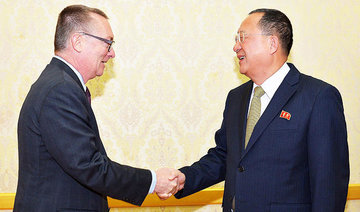
The UN’s political affairs chief, Jeffrey Feltman, will brief the council on Tuesday on his talks in Pyongyang ahead of a ministerial-level meeting on North Korea on Friday.


![]()

UN sanctions affecting aid in North Korea — rights chief
UN sanctions affecting aid in North Korea — rights chief


Latest updates


Recommended


© 2026 SAUDI RESEARCH & PUBLISHING COMPANY, All Rights Reserved And subject to Terms of Use Agreement.