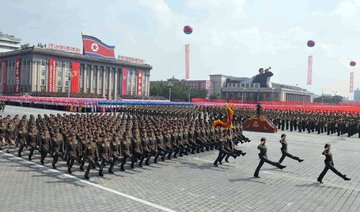
SEOUL: UN political affairs chief Jeffrey Feltman, who visited North Korea this week, expressed willingness to ease tension on the Korean peninsula, state media said on Saturday, amid a rising war of words over the North’s missile and nuclear programs.
North Korea also said in a statement carried by its official KCNA news agency that the UN envoy acknowledged the negative impact of sanctions on humanitarian aid to North Korea.
Feltman, the highest-level UN official to visit North Korea since 2012, was not immediately available for comment.
“The United Nations expressed concerns over the heightened situation on the Korean peninsula and expressed willingness to work on easing tensions on the Korean peninsula in accordance with the UN Charter which is based on international peace and security,” KCNA said.
North Korea is pursuing nuclear and missile weapons programs in defiance of UN sanctions and international condemnation.
On Nov. 29, it test-fired an intercontinental ballistic missile which it said was its most advanced yet, capable of reaching the mainland United States.
The United States and South Korea conducted large-scale military drills this week, which the North said have made the outbreak of war “an established fact.”
KCNA said North Korean officials and Feltman agreed that his visit helped deepen understanding and that they agreed to communicate regularly.
Feltman visited Pyongyang from Tuesday to Saturday, KCNA said.
Last month’s missile test prompted a US warning that North Korea’s leadership would be “utterly destroyed” if war were to break out. The Pentagon has mounted repeated shows of force after North Korean tests.
North Korea regularly threatens to destroy South Korea and the United States and says its weapons programs are necessary to counter US aggression. The United States stations 28,500 troops in the South, a legacy of the 1950-53 Korean War.

North Korea says UN envoy expressed willingness to ease tensions
Spain begins 3 days of mourning for deadly train wreck while searchers look for more bodies
ADAMUZ: Spain woke to flags at half staff on Tuesday as the nation began three days of mourning for the victims of the deadly train accident in the country’s south, while emergency crews continue searching for possible bodies.
The official death toll of Sunday’s accident rose to 40 by late Monday. But officials warned that that count may not be definitive, with emergency workers still probing for bodies among what Andalusian regional president Juanma Moreno called “a twisted mass of metal.”
Interior Minister Fernando Grande-Marlaska told Spanish national television RTVE late Monday that searchers believe they have found three more bodies still trapped in the wreckage. Those bodies are not included in the official count, the minister said.
The crash took place Sunday at 7:45 p.m. when the tail end of a train carrying 289 passengers on the route from Malaga to the capital, Madrid, went off the rails. It slammed into an incoming train traveling from Madrid to Huelva, another southern Spanish city, according to rail operator Adif.
The head of the second train, which was carrying nearly 200 passengers, took the brunt of the impact. That collision knocked its first two carriages off the track and sent them plummeting down a 4-meter (13-foot) slope. Some bodies were found hundreds of meters (feet) from the crash site, Moreno said.
Officials are continuing to investigate the causes of the incident that Spanish Transport Minister Óscar Puente has called “strange” since it occurred on a straight line and neither train was speeding.
But Puente said late Monday that officials had found a broken section of track.
“Now we have to determine if that is a cause or a consequence (of the derailment),” Puente told Spanish radio Cadena Ser.
Spanish Prime Minister Pedro Sánchez visited the accident site near the town of Adamuz on Monday, where he declared three days of mourning with flags lowered on all public buildings and navy vessels. Spain’s King Felipe and Queen Letizia are scheduled to visit on Tuesday.
Meanwhile, Spain’s Civil Guard is collecting DNA samples from family members who fear they have loved ones among the unidentified dead.
The official death toll of Sunday’s accident rose to 40 by late Monday. But officials warned that that count may not be definitive, with emergency workers still probing for bodies among what Andalusian regional president Juanma Moreno called “a twisted mass of metal.”
Interior Minister Fernando Grande-Marlaska told Spanish national television RTVE late Monday that searchers believe they have found three more bodies still trapped in the wreckage. Those bodies are not included in the official count, the minister said.
The crash took place Sunday at 7:45 p.m. when the tail end of a train carrying 289 passengers on the route from Malaga to the capital, Madrid, went off the rails. It slammed into an incoming train traveling from Madrid to Huelva, another southern Spanish city, according to rail operator Adif.
The head of the second train, which was carrying nearly 200 passengers, took the brunt of the impact. That collision knocked its first two carriages off the track and sent them plummeting down a 4-meter (13-foot) slope. Some bodies were found hundreds of meters (feet) from the crash site, Moreno said.
Officials are continuing to investigate the causes of the incident that Spanish Transport Minister Óscar Puente has called “strange” since it occurred on a straight line and neither train was speeding.
But Puente said late Monday that officials had found a broken section of track.
“Now we have to determine if that is a cause or a consequence (of the derailment),” Puente told Spanish radio Cadena Ser.
Spanish Prime Minister Pedro Sánchez visited the accident site near the town of Adamuz on Monday, where he declared three days of mourning with flags lowered on all public buildings and navy vessels. Spain’s King Felipe and Queen Letizia are scheduled to visit on Tuesday.
Meanwhile, Spain’s Civil Guard is collecting DNA samples from family members who fear they have loved ones among the unidentified dead.
© 2026 SAUDI RESEARCH & PUBLISHING COMPANY, All Rights Reserved And subject to Terms of Use Agreement.