Magnitude 6.2 quake hits southeastern Iran: seismological center

An Iranian man rests as he lies atop salvaged mattresses and items outside damaged buildings in the town of Sarpol-e Zahab in the western Kermanshah province near the border with Iraq, on Nov. 14, 2017, following a 7.3-magnitude earthquake that left hundreds killed and thousands homeless two days before. (AFP)
Updated 13 December 2017
Follow

Magnitude 6.2 quake hits southeastern Iran: seismological center

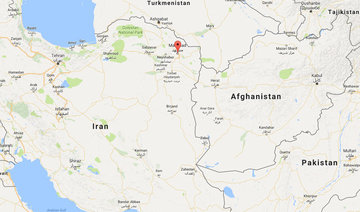
TEHRAN: A 6.2-magnitude earthquake struck Iran’s southeastern province of Kerman on Tuesday, the Iranian seismological center reported, though minimal damage was reported.
Eighteen people were wounded in the quake, which struck in the villages of Hejdak and Ravar in Kerman province, the national emergency service told state broadcaster IRIB.
Officials said old houses were damaged in six villages, and classes at schools and universities were canceled.
The quake struck at 12:13 p.m. (0843 GMT) with the epicenter around 50 kilometers (30 miles) north of the provincial capital of Kerman and about 800 kilometers from Tehran.
It was measured as magnitude 5.9 by the US Geological Survey and several smaller aftershocks were reported.
Later Tuesday, the USGS reported another quake in the region, a 6.0-magnitude temblor about 65 kilometers from Kernan.
“Overall, the population in this region resides in structures that are extremely vulnerable to earthquake shaking, though some resistant structures exist,” the service said.

Iran sits atop several fault lines, and Tuesday’s quake comes less than a day after a 6.0-magnitude tremor struck the western province of Kermanshah along the border with Iraq.
On November 12, Kermanshah was hit by a major 7.3-magnitude quake that killed 620 people according to the latest toll provided Monday by Tasnim news agency.
Iran’s worst quake in recent years was a 6.6-magnitude tremor that struck near Bam in 2003, decimating the ancient city and killing at least 31,000 people.
In 1990, a 7.4-magnitude quake in northern Iran killed 40,000 people, injured 300,000 and left half a million homeless, reducing dozens of towns and nearly 2,000 villages to rubble.
Iran has experienced at least two other major disasters in recent years — one in 2005 that killed more than 600 people and another in 2012 that left some 300 dead.


Death toll in Iran protests over 3,000, rights group says

Updated 17 January 2026
Follow

Death toll in Iran protests over 3,000, rights group says

  • The protests erupted on December 28 over economic hardship and swelled into widespread demonstrations calling for the end of clerical rule
  • President Donald Trump, who had threatened ‘very strong action’ if Iran executed protesters, said Tehran’s leaders had called off mass hangings

DUBAI: More than 3,000 people have died in Iran’s nationwide protests, rights activists said on Saturday, while a “very slight rise” in Internet activity was reported in the country after an eight-day blackout.

The US-based HRANA ​group said it had verified 3,090 deaths, including 2,885 protesters, after residents said the crackdown appeared to have broadly quelled protests for now and state media reported more arrests.

The capital Tehran has been comparatively quiet for four days, said several residents reached by Reuters. Drones were flying over the city, but there were no signs of major protests on Thursday or Friday, said the residents, who asked not to be identified ‌for their safety.

A ‌resident of a northern city on the ‌Caspian ⁠Sea ​said ‌the streets there also appeared calm.

The protests erupted on December 28 over economic hardship and swelled into widespread demonstrations calling for the end of clerical rule in the Islamic Republic, culminating in mass violence late last week. According to opposition groups and an Iranian official, more than 2,000 people were killed in the worst domestic unrest since Iran’s 1979 Islamic Revolution.

“Metrics show a very ⁠slight rise in Internet connectivity in #Iran this morning” after 200 hours of shutdown, the ‌Internet monitoring group NetBlocks posted on X. Connectivity ‍remained around 2 percent of ordinary levels, ‍it said.

A few Iranians overseas said on social media that ‍they had been able to message users living inside Iran early on Saturday.

US President Donald Trump, who had threatened “very strong action” if Iran executed protesters, said Tehran’s leaders had called off mass hangings.

“I greatly respect the fact that all scheduled ​hangings, which were to take place yesterday (Over 800 of them), have been canceled by the leadership of Iran. Thank you!” he ⁠posted on social media.

Iran had not announced plans for such executions or said it had canceled them.

Indian students and pilgrims returning from Iran said they were largely confined to their accommodations while in the country, unable to communicate with their families back home.

“We only heard stories of violent protests, and one man jumped in front of our car holding a burning baton, shouting something in the local language, with anger visible in his eyes,” said Z Syeda, a third-year medical student at a university in Tehran.

India’s External Affairs Ministry said on Friday that commercial flights were available and that ‌New Delhi would take steps to secure the safety and welfare of Indian nationals.