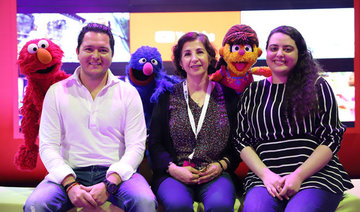
DUBAI: It has been a year of significant social change in Saudi Arabia and everyone is sitting up and paying attention.
“The changes we’ve experienced this year alone are equivalent to changes that take maybe 10 or 20 years in other societies. We’ve been waiting for these decisions for so long,” said Saudi YouTube star Hatoon Kadi, speaking on the sidelines of VIDXB — a gathering dedicated to online video content held in Dubai on Dec. 8 and 9.
While it might be a stretch to claim that Kadi and online content creators like her from the Kingdom are directly responsible for any of the monumental changes witnessed in Saudi Arabia this year — Kadi herself certainly would not make that claim — it is fair to say that the surge in popularity of Arabic-language content has given a public voice to those who, traditionally, have not had one. And in doing so, important social issues have been brought into the spotlight.
Take, for example, Kadi’s own 2013 video about women driving in the Kingdom. “I had a slogan in that video — ‘the most important man in a Saudi woman’s life is her driver,’” Kadi told Arab News. It was a lighthearted way of making a serious point, which is Kadi’s general approach on her wildly popular Noon Alniswa channel that has more than 350,000 subscribers.
“Usually, when you make people laugh about things, their sub-conscious mind will be analyzing this: ‘OK, I laughed about this, but there’s something to it, maybe something we need to change or look differently at.’ So sarcasm and comedy are accepted by people because usually they’re not judgmental, because people really hate it when other people preach at them,” Kadi explained. “So when you’re just talking about the issue and you make them laugh about it, they’ll accept it more.”
Importantly, Kadi pointed out, when she started making videos, she did so “by laughing at the things I do.”
It was a point she made onstage at VIDXB too, she was not creating content to make herself seem more important, or smarter, than the average person. She was highlighting issues that affected her and — by extension — the society in which she lives. “I always thought to myself, ‘what is society?’ And it’s us. It’s people,” she said.
She admitted that seeing a clearly conservative (by her own admission) Saudi woman poking fun at herself was seen as “strange” when she started out. But, she added, “people accepted it in the end.
“We’re always afraid of introducing new concepts,” she said. “And a lot of people say that GCC society will not accept this. But I know my limits — they’ve been shaped by my religion and my conservative upbringing — so why not set our own rules? And why not laugh about ourselves?”
Kadi was quick to stress that she is not suggesting everybody embrace anarchy or ignore traditions. She is simply saying that it is OK to question things and not blindly follow the norm.
“Our society is very conservative. We feel we’re obliged to be like each other. That’s just how we were brought up. So if a woman is very conservative and she cares about what other people think, I will not tell her, ‘you are wrong.’ You just belong to a society where it takes a lot of courage to be different,” she explained. “So, I really respect if someone just wants to stick (to what they know).”
Kadi has firsthand experience of the courage needed to speak up in a conservative society: “I had lots of comments saying things like, ‘you are very ugly. You are very fat. How dare you? You don’t have a mirror? Why do we have to look at you?’ When you hear such comments that really criticize the core of your femininity, you want to believe that you don’t care, but that’s wishful thinking. It really hurts.”
Kadi admits there were times when she nearly quit making videos. But advice and support from friends convinced her to keep going. “And you know, after all these years, I look back at my show and I see it was worth fighting for,” she said. “I have created my own way. I’m happy. I’m comfortable with myself. I’ve tried to focus on what I’m really good at. These days I care what other people say about my content, but not about the way I look.”
And recently, of course, “I had the pleasure of making another video after the decision that allowed us to drive that said ‘real Saudi men can now acquire the long-awaited position as the most important man in your wife’s, or your sister’s, or your mother’s life. It’s not the driver anymore.’”
Triumphs like that make it all worthwhile for Kadi.
“I’ll never be able to know if I had any real impact. But I know that I did what I had to do. And I have other episodes for other women’s issues, or social issues, and I’ll be waiting for those decisions too. And I’ll be happy that I did my bit,” she said. “At least I know that when I had the voice, I used it for the good of my society.”